Showing posts with label Books. Show all posts

Ancient world history in Indian scriptures - Historical events

This is the third (last) part of an essay on depiction of world and Indian histories in the famous Hindi writer Acharya Chatur Sen’s book Vayam Rakshamah. The first part of this essay introduced the figure of Chatur Sen and his works. The second part of the essay explained the broad context of Chatur Sen’s writings.

All the descriptions given here are from Acharya Sen's work, based upon decades of studies of ancient Hindu sacred books.

Knowledge of the world in ancient India

Ancient people living in different parts of the world had knowledge of different groups of persons living in different parts of the world, and had visits and communications among them, according to Sen. Some of the geographical areas mentioned in the book and their old Indian names in ancient Hindu sacred books are as follows:

Jambu dweep: Mainland Asia
Ang dweep: Sumatra
Java: Yav dweep
Malay dweep: Malaysia
Shankh dweep: Borneo
Kush dweep: Africa mainland
Varaha dweep: Madagascar
Swarn dweep: Sri Lanka
Andhralay: Australia
Kolavarah or Ketumaal dweep: Norway
Aryaviryan: Azerbaijan

Names of different locations according to Hindu scriptures

Origin of Clans that peopled India

According to Sen, the stories of different clans that later peopled India cover the geographical areas that start from northern India in the east and goes up to Gulf of Persia and the coast of Caspian sea in the west. In fact all the important clans that peopled India and many other countries started somewhere near Caspian sea around 4 to 5 thousand BC. This same area, that is today constituted by Armenia, Azerbaijan, Iraq and Persia, called Elam or Elavrat in ancient Hindu texts, continued to be important for the forefathers of the future Indians for about 1500-2000 years, that means till about 3000 BC. Even after this period, till today, the memories of those initial millenniums in Elam continue to be central in Hindu mythologies.

Many different clans of people who later grew as very different people, originated from the same groups of persons near the Caspian coast. Thus the three most important bloodlines that peopled India – Dev, Danav and Daitya, originated from the same family. Dev clans contributed to the Suryavanshi line of Aryans and Daitya clans contributed to the Chandravanshi line of Aryans. For the initial thousand or more years, there was constant inter-mixing between these three bloodlines, but later wars separated Dev group of people from the other two, who were jointly called “Asur” group of people.

There were other groups of people such as Garud and Naag near the Caspian coast and Pichash, Gandharav and Kinnar, in the northern part of mountainous India.

Original families near the Caspian coast and the first waves of emigration towards India

The story starts some where around 4 to 5 thousand years BC, at the beginning of Satyug, on the south coast of Caspian sea, the family of Swayambhu Manu. Manu had two sons, Priyavrata and Utanpaad. That land was divided into four areas – Sugd, Maru, Varvadhi and Nisha. Later on Harayu (Heart) and Vakrit (Kabul) also joined the western areas.

About 4000 years BC, Nabhi, grandson of Priyavrata moved east towards the area of Sapt Sandhu. Bharat, grandson of Nabhi, gave the name Bharat Varsh to that land. Descendents of Utanpaad also moved east towards Saptsandhu and later on, became the kings of this area, taking over from the descendents of Priyavrata.

Reverse emigration, back from Sapta Sindhu towards the Caspian sea

In a few generations, the families that had moved east lost contact with the families in the west. In any case, even in the west, families from the same forefathers, were fighting with each other for power and domination. Thus, children of Chakshuk Manu, a descendent of Uttanpaad line of family, with a kingdom in Sapt Sandhu, decided to go to the west and attack the kingdoms there. Five sons of Chakshak Manu - Atyarati, Jananpati, Manyu (Abhimanyu), Ur, Pur and Taporat, took part in the battle expedition to the west. One of the sons of Ur, called Angira, accompanied his father in the war. This expedition had success and they established kingdoms in different parts of the western lands.

Thus elder sons, Atyarati and Janapati settled in the central part. Ancient Persian history speaks of Manu as Manyu, while Greeks called him Maimnen. He built the city of Manyupuri or Susha. Ur dominated parts of Africa, Syria and Babylonia. Pur settled south of Caspian sea and gave his name to Persia. Taporat settled in Taporia region (Manjadiran). Angira went off in Africa.

Alborz mountain in Taporia region was considered as paradise. On the mountain lived Tapsi Vikuntha and his son Vaikuntha, and thus the area was known as Vaikunthadham in ancient Indian texts. The attack of the five brothers wreaked wide-spread destruction and the event is recorded in ancient Persian history as “destruction of paradise” and the five brothers were called Aahirman or Shaitan.

The big floods in the paradise

A few centuries later, about 3,200 BC, the big rivers in ancient Persia had huge floods, probably after the eruption of a volcano in the western coast of Caspian sea, near the city of Baku.

All the western part of Persia, and parts of Babylonia were submerged in water. Palestine, that is 6000 feet above sea level was also submerged. Only the high mountains reaching up to 18,000 feet were not submerged. These floods have been recorded in almost all the different ancient texts.

Accounts of Manu being saved by a Matasya (fish) in the ancient Hindu text Matasya-Puran, probably refer to saving of Dev clan persons by fishermen from the Caspian sea coast area.

Daughters of Daksha and their children

Shortly after the floods, important new clans were born that will have important impact on the whole region, from Africa in the west to India in the east. These clans came from the daughters of Daksha, from the clan of Swayambhu Manu.

Aditi, one the daughters of Daksha gave birth to 12 sons. Varun, the eldest son, established the Sumerian clan in Susha. In the lands laid dead by the floods, he built canals for draining the water and flattened the earth, making it fit for agriculture. All these works gave Varun the name of life giver or Brahma, as well as the lord of water. Varun's children took the name of Dev clan. They gave the name Ksheersagar to the bay to the south of their land (Bay of Persia).

Children of Vivaswan Surya, the youngest son of Aditi, established the Suryavanshi clan of Aryans, who occupied north India. Vivaswan Surya married Renu from the family of Bhrigu, son of his eldest brother Varun. Surya and Renu had five children - Vaivasvat manu, twins Yam and Yami, then, another pair of twins, Nasatya and Dasr (also known as Ashwini Kumars).

Growing up, Yam went to his uncle Varun, who made him king of land called Aavivard or Dozakh or Nark, a land that had been completely destroyed by the floods and thus, known as the "land of dead".

Other children of Aditi, such as Vasu, Maru, Bhanu. Ghosh, Sandhya, etc. gave rise to other clans. Rudra, an important figure in Hindu mythology in this line was born in the family of Vasu.

Another daughter of Daksha, Diti, gave birth to Daitya clan. A third daughter, Danu, gave rise to Danav clan. The society was matrilineal, that means only mothers name was important.

Initially all the clans were inter-marrying. But as time passed, the fights among different clans started, called Devasur wars.

Indra, born at the Caspian coast, slowly became friends with Varun and Dev clan. It was the time when writing of first Ved (Rigved) was starting. Varun's son Vashisht made some of the Richa (poems) for it. Indra asked his friend Narad, step brother of Vashista to make some richa about him. Later on other persons in the clans, when they heard the richa about Indra, asked for some richa in their names.

Chandra from the family of Bhrigu, fell in love with Tara, wife of Brihaspati, a priest of Dev clan and ran away with her. Brihaspati with help of other clans declared war on Dev clan, and Devs lost the war. Tara was sent back to Brihaspati, but she was pregnant with Chandra's son. When the child, Budh was born, Brihaspati refused to keep him and he was sent back to Chandra.

Migration of Aryas to India and attack on Sat Sindhu

Vaisvat Manu (eldest son of Vivaswan Surya) and Chandra, both decided to emigrate to the east, and together constituted the two main Arya clans in north India. Vaisvat Manu settled near Saryu river and started the suryavanshi clan of Aryans, while Chandra settled near the meeting place of the two rivers, Ganga and Yamuna and started the Chandravanshi clan of Aryans.

Some time later, Indra attacked Vritra, the king of Saptsandhu area from the Daitya clan. Though Vritra had good relationships with Dev clan, Dev clans chose not to interfere in Indra's attack. Vritra was killed by Indra, that led to the destruction of the major cities of Sapt Sindhu (the ruins of Harappa and Mohan Jo'daro).

A few centuries later, the main clans ruling in the western part in Elavrat, gradually became less important and were mixed up with other population groups.

Conclusions

This is just a simplified summary of Acharya Chatur Sen's theory of early settlements in ancient world and in ancient India, where waves of people came in from the west, spreading not just in India, but also inhabiting Indonesia, Malaysia, Australia on the east and Africa on the west. According to him, the different population groups such as Daitya, Danav, Naag, Kinoor, etc. all came from the same original families and separated after an initial period of inter-mixing lasting some millenniums.

Book cover Vayam Rakshamah

Sen's history has three key events linked to India's inhabitation.

(1) The first settling of Sapt Sindhu, around 4,000 years BC and then, after some generations, return of some of these people back to west to the Caspian sea.
(2) The second is settling of Aryavrata in north India by Surya and Chandra clans around another 1000 years later.
(3) Some time later, there was the attack of people from the west on the kingdoms of Sapt Sindhu.

In Vayam Rakshamah, Sen also looks at the development of different clans of kings living in India, in Aryavrat and in the south in Dandkaranya and Dakshinaranya, that I have ignored in this article. For people interested in understanding more of Chatur Sen's theory of early settlements of people in what we know as India and middle east, read Vayam Rakshamah. It may not be a very interesting work of fiction, as far as the story of Polsatya Ravaan, but it does make for an interesting, if a little confused study on early Indian history according to the ancient Hindu books.

Ancient world history in Indian scriptures - Introduction

This is first part of an article in 3 parts on ancient World History and Indian history. It looks at the ancient history of world and India, given in Hindu sacred books including Veda, Puran and Brahman stories, based upon the works of an eminent Hindi writer, Acharya Chatur Sen (1891-1960). Part 2 explains the context of writings by Sen, while part 3 presents the main ideas of world history in Sen's work.

Introduction to some works of Acharya Chatur Sen

Acharya Chatur Sen, a trained Ayurvedic doctor, was a prolific Hindi writer and published 186 books including 32 novels, more than 450 short stories, and many non-fiction books on themes as diverse as politics, history and Ayurveda. Apart from a strong interest in ancient Hindu sacred books, he also wrote about hisotry of Islam in India.

Acharya Chatur Sen, eminent Hindi writer

I have read two of his works related to ancient India -

(a) Vaishali ki Nagarvadhu (वैशाली की नगरवधु, The courtesan of Vaishali, first published in 1949 by J. S. Sant Singh and Sons Delhi for Hindi Vishwabharati) about a courtesan called Ambapali during the time of Gautama Buddha, a few centuries before Jesus.

(b) Vayam Rakshamah (वयं रक्षामः, We are Raksha, first published in 1955; from the edition published by Rajpal and Sons, Delhi 2009) about Raavan, the mythological king from Ramayana.

Each of these books carries a long list of ancient texts that were consulted by Chatur Sen for writing that book. Vaishali ki Nagarvadhu, the first book in this series, was dedicated to Jawaharlal Nehru and in preface of this book Chatur Sen had explained that though a work of fiction, the book was attempt to remove the "black curtian that has hidden the defeat of religion, literature, royal governance and culture of Aryas, and the win of progressive cultures of mixed races, during thousands of years, that have not been tackled by historians." He had also explained that writing that book had taken "ten years of research in the cultures of Aryas, Boddh, Jain and Hindus".
dedication to Nehru, Vaishali ki Nagarvadhu, Chatur Sen
By the time, "Vayam Rakshamah" came out in 1955, Chatur Sen was 63 years old and not keeping very well. In the dramatic preface of this book, Sen declared that "he had put in all the learnings and knowledge, both emotional from his heart and logical, from his brain, into writing this book and he had no more left to contribute." About his own mental condition he had written, that like horses, bulls and donkeys, who can die while pulling heavuy burdens, he might also die because of burden of writing this book."

At that time, he was also worried that his depiction of ancient history of Aryas and other races may not be accepted easily as it touched on areas that can be seen as obscene. At the same time, he felt that he had to speak the truth as he had understood it from the studies of the ancient Hindu books:
In this book, I have presented the forgotten word-pictures of different human clans such as Nar, Naag, Dev, Daitya, Danav, Arya, Anarya, etc. from pre-vedic times, who had been seen through the coloured lenses of religion and mythologised into gods of the heavens. I have the courage to present them as human beings. "Vayam Rakshamah" is certainly a work of fiction, but at the same time it is the result of deep study of Ved, Puran, philosophy and foreign texts ... it the summary of my life's work.

Cover, Vayam Rakshamah, Chatur Sen
This book was accompanied by an accompanying explanatary book, to justify and reference whatever he had written in the book, with notes from different sources that Sen had studied.

Upinder Singh in "A history of ancient and early medieval India" (Dorling Kindersley India, 2008) had written, "History is not one but many stories, only a few of which have yet been written. ... there are two parallel images of ancient South Asia - one based on literary sources, the other on archeology." About the ancient texts, Singh wrote, "Ancient texts are much older than their surviving scripts, and have alife of their own. They have grown and changed over time, and this process of growth and change - the period of composition - could in some cases have lasted for hundred of years before they were compiled or given a more or less final shape."

The descriptions of ancient Indian and world histories, from analysis of ancient Indian texts, have been attempted many times, by scholars from different disciplines, from India and many other countries. Continuing archeological excavations as well as new technologies such as satellite mapping imaging, have provided new corroborative evidences to the the different theories.

Still I think that it could be interesting to look at the conclusions about the ancient world events during prehistorical times, at which Acharya Chatur Sen had arrived through his decades long studies. I don't think that people have seriously taken a systematic look at the literary works of Indian authors writing in Hindi or other Indian languages, in terms of analysing their ideas and their implications.

This article is mainly based on the descriptions in Sen's book, "Vayam Rakshamah".

(End of part one of a three parts article)

Note: Special thanks to Sanjay Bengani and Sameer Lal for the image of Acharya Chatur Sen!

Children of mixed gods

Yesterday, I was at the presentation of Fatima Ahmad's new book "Aukui". Fatima's mother was half Indian and half Vietnamese, her father was Somali. Fatima was born in Cambodia, where she lived for the first 21 years of her life, till the war broke out and they were forced to migrate to Somalia.

In Somalia, Fatima faced the more orthodox side of her religion. She was not supposed to go out, not to talk to men. It was different to grow up as a Msulim in Cambodia, a predominently Buddhist country than in Somalia. After three years in Somalia, Fatima moved to Italy. (In the picture below, during a reading from her book - Fatima is in the middle)

Fatima Ahmad, Roberta Sangiorgi from Eks&Tra & Stefano at Casa Khoula library Bologna

"Aukui" means "black devil" in Cambodian and refers to the difficulties she faced in Cambodia because of her skin colour. She also had to overcome barriers created around her disability. She said that she has written this book to tell her story to her younger brothers and sisters, who were born later and do not know about their roots. About her religious beliefs, Fatima said that she takes what she likes from Islam, Buddhism and Catholicism.

Discussions about mixing of faiths and religions immediately resonate in me. In my family, we have three religions - Hinduism, Catholicism and Sikhism.

I think that with globalisation, with people moving from one country to another, there will be even more opportunities for people of different religions to meet, fall in love and make families. I also think that today, with greater awareness about ideas of human rights and religious liberalism, there are greater opportunities for people in mixed families like ours to maintain our distinct religious identities and yet be all together in harmony.

A couple of months ago, I was in Vietnam and one evening, I had a discussion with a friend, who is Buddhist and has married to a Catholic. They are planning to shift to Italy in a couple of years. "I continue to be Buddhist", she had said. I had thought that in her words, there was an unexpressed anxiety about shifting to a predominently Catholic country and yet, continuing to be a Buddhist.

"And the children of such mixed families, what about their religion?", sometimes people ask me. I don't know how did others deal with this, I can only share how we dealt with it. For us, all children have a right to their family traditions from both the sides, mothers' and fathers' sides. This means that children should be able to feel at home in all their family religions, should participate in all their religious traditions and rites. We had had a church wedding and a hindu wedding, our son had his baptism and his mundan.

It is true that sometimes religions have prayers that talk about supremacy of their god and being the only true religion, but I think that if children can understand that their parents are in peace with each other, they grow up with their own understanding of their religions.

I feel that these children growing with shared understanding and beliefs of different religions, will be the new citizens of the world. I also feel this understanding is precious and should be valued and nurtured.

In India, because we grow up with different religions around us, over the centuries we have developed so many examples of mixing up of religions and traditions. Between Islam, Hinduism, Sikhism, Jainism, Christianity, etc.

Once I had read about one of the first Indian censuses done during British times and how people had difficulty in telling their religions, they were not sure if they should call themselves sikhs or hindus, and were forced to decide. Over the past decades, growing ideas of religious orthodoxy and fundamentalism among all the different relgions, seem to strengthen the differences, the divisions and the boundaries between religions and beliefs.

We, the children of mixed gods need to counter this and ask for respect of our religions, our mixed religions.

I have been reading debates about Indian census and if we it should ask questions about the castes or not. I wish that Indian census would also ask about religions of persons and give them the possibility of giving multiple answers - we can also be Hindus and Muslims at the same time, Sikhs and Jains at the same time, Hindus and Sikhs and Parsi at the same time. I wish there is a question that asks, how many believe that there is just one god for all human beings not withstanding their different religions? and how many of us also pray in religious places of other religions?

Alternate world histories

Tamim Ansary has written an alternate world history. Born in Afghanistan and settled in America, Ansary was asked to edit a school book on history and his job was to identify the significant world events, divided into ten units, each unit with three chapters. Thus, the world history had to be broken down into thirty chapters.

In the introduction to his new book, Ansary explains his experience of dealing with members of his school editorial committee, negotiating with them about what events can be significant enough to go into those chapters, and how those persons didn't see Islam as important enough to have a chapter.

Ansary says, from the view point of the academics in the West, the world history can be sub-divided more or less into the following significant areas - birth of civilization (Egypt and Mesopotamia); the classical age (Greece and Rome); upper rennaisance (spread of Christianity); Rennaisance and riforms; Illuminism (sicence and exploration); the revolutions (democratic, industrial and technological); the coming up of nation states and the fight for the empires; first and the second world wars; the cold war; and the triumph of democratic capitalism.

However, Ansary proposes to look at the world from the point of view of Islam and to identify their significant events for the world history, and he comes up with the following list - The antiquity (Mesopotamia and Persia); birth of Islam; the Caliphate and the search for universal unity; the fragmentation - the era of Sultanates; the catastrophe - the crusades and the mongols; the rennaisance and the era of three empires; the permeation of the Orient by the West; the reform movements; the triumph of modernist lays; and the Islamic reaction.

Thus, Ansary has written a book called, "Destiny disrupted. A history of world through Islamic eyes".

I like the idea of the book and I think that it will be interesting to read about the world and the events through an alternate point of view. The Western worldview is so dominating that we end up thinking that this is the only way there is to look at the world.

I think that it will be equally interesting to read about the world histories as seen by other points of views. For example, from India, what events we see as significant, that shaped the world? Probably it will start around Mohanjodaro and Harappa, go on to spread of agricutlure in the Ganges valley? What role will play Ashoka and Buddha in shaping the history of the whole Asian continent?

And the Chinese world history, how it will it differ from others? And the worldview of an African or a south Amerindian?

Perhaps, some book publisher will bring together persons from all over the world to write an alternate world history, that brings together the significant events from all our pasts! I would like to read that.

Women changing rural India: Sarpanch Sahib

Common perception is that in spite of poverty and under-development, women in South Asia have played a much more active role in leadership and politics of their countries and their communities than in the western “developed” world. Persons like Sirimavo Bhandaranayike, Indira Gandhi, Sheikh Hasina, Benazir Bhutto, Mayawati and Aung San Kyi are responsible for this common perception. Yet, those who know the reality of our world, know that for most women, especially in rural areas, their lives are often closed in the boundaries of traditions, hidden behind veils, bound by rules of caste and class.

India started an experiment in 1993 to change this apparently immutable world of rural women by reserving certain election seats at village council level (Gram Panchayats) for them. At that time, many persons had thought that this would not change anything, men will continue to decide and rule as usual, using their wives or mothers or daughter-in-laws as a cover.

Initially almost all the women who entered the poltical arena because of this policy, were in some way forced by their families. Most of them did not receive any training for the roles they were asked to take on. Almost fifteen years later, it is perhaps time to take stock and understand how this change has worked out in practice and if indeed there has been a change?

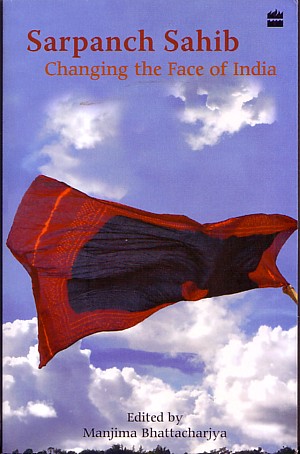
Yes, in spite of all the cynicism and active obstruction by old political power-brokers, the experiment has started to bring about a change. “Sarpanch Sahib – Changing the face of India”, edited by Manjima Bhattacharjya (Harper Collins India with India Today and The Hunger Project, 2009), tells the stories of some such women who became presidents of their Gram Panchayats (village councils).


The stories of the book are told by women like Manju Kapur, Indira Maya Ganesh, etc. and are immensely readable. They talk of villages from different parts of India. To understand what these women went through and continue to pass through, what it means for them to live lives of poverty and yet strive for better governance against all odds, makes for a humbling experience.

I liked all the stories. They are succcess stories, even if they show that nothing is easy and at times, the idea of “success” does not quite express what they have achieved. They show that change in the unchanging world of rural poverty, could be almost imperceptible. Like the story of a person like Kenchamma, a dalit woman, who continues to shell betel nuts for a living, even while she is into her second term in the Gram Panchayat. Like this passage from her story:
Quite far removed from the Kenchamma of 1993, who cried in humiliation as she returned from her first meetings, bewildered and frustated at not being able to say anything. We were walking through the village and my eyes fall on her callused hands. She points to the skin of betel nut strewn in piles every where. She did four sacks yesterday. At 50 rupees a box she makes 200 rupees for the day. ...An uneducated Dalit woman has done for her village what seasoned political aspirants have not. But what has she got in return? What does one make of this strange sort of limbo? Thins have changed so much over one generation – from Cariappa’s to his daughter-in-law’s, yet they remain disturbingly unchanged.
Kenchamma has been president of the panchayat twice and is now a grudgingly respected member of the village community – respected by Dailts and Lingayats. But she is still a poor Dalit woman. As if being any other way would be improper. Improper not to live in a thatched, leaking mud hut, or to plaster her house, to not struggle for daily wages, improper to imagine other livelihoods, work not just for the village but make a career out of governance and use the 10 years of hands-on learning she has had. The boundaries have been pushed, but still only from the limits of the home to the village. Isn’t it enough that you have been allowed to reach this far, the voices seem to suggest?
I think that Kenchammas of this world are wise, they know that entrenched social hierarchies can react back with terrible fury if they feel that the status quo is being challenged. They know that they can not count on any one else to protect them. So they bide their time, they accept to continue to living lives of poverty and marginalisation, even while achieving small changes, providing education for their children. They are not aiming for revolutions, they are aiming for a change. Most of us from worlds far away from theirs, including many development experts, are frustrated with this path of slow change.

Perhaps we, or some of us, would have preferred revolutions?

I would recommend this book to everyone, especially those who think that they know India, that they are building the modern new India, that they are bringing in the progress. It would bring a sense of balance in what they think about themselves and gain some respect for those Kanchammas, working in far away places to bring small changes in rural India, taking personal risks that most of us wouldn't have the courage to take.

Migrating souls: Leaving India by Minal Hajratwala

Books and stories that talk about immigrant experience fascinate me. Stories about Indian immigrant experience, their second generations in their new homelands, fascinate me even more. I have realised that when I read them, I talk to myself all the time.


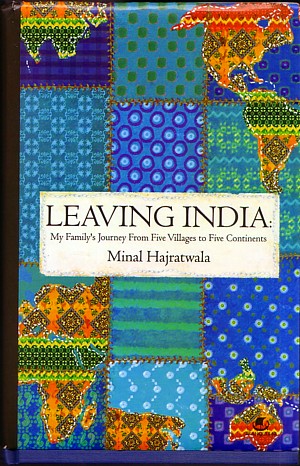
At one place in the book, Minal says, “Deep in the marrow of every story is a silence”. Perhaps, it is there, in that silence, that the reader and the author can meet and talk, about what was left unsaid and what can not be expressed in words. In that sense, it was particularly hard to read “Leaving India – my family’s journey from five villages to five continents”, because our parallel dialogue in that silence was at times so intense.

When I start realising that I am liking a book and that I would like to write about that it, I start bending the corners of those pages that have particular passages that touch me in a special way, so that when I write I go back and refer to those particular passages.

In “Leaving India”, I have marked so many pages, that if I try to write all the feeling they evoke in me, probably I will end up writing a bigger book. So I will not even attempt to write all those things.

I read it almost in one go, over a period of three days. And, I had to stop myself at times, to put aside the book and go for a small walk, just to think, and also to prolong the joy of reading it.

Minal’s family’s journey starts from five villages in south Gujarat, at a time when there was no state called “Gujarat”, in late nineteenth century. Poverty and dreams of making a mark in far away parts of the British empire, take away the men, leaving their wives with their children in Gujarat. Slowly, the wives also follow their husbands and then as fortunes of the empire change, and new opportunties arise, the emigrants change homes, searching for more hospitable lands where they can grow their families in peace and dignity.

Among all the stories, the one which touched me most was the story of Bhupendra and Bhanu, Minal’s parents, probably because I could empathise and understand more the kind of problems they went through. Among all the pages that I had marked, I have decided to take one passage from this part of the book that touches on the challenges and opportunities that emigration experience can give us:
In New Zealand, Bhanu might have become small and huddled; our lives there were always slightly shabby, as if the gray of the skies had settled over our skins, clothes, hopes. In Fiji, she would have been one of the several daughter-in-law, bickering for position in a chaotic and quarrelsome extended family. In India she could have lived a life of middle– or upper-class privilege, with ahousehold of maids to supervise.
In America my mother bloomed like a tropical flower, colourful, with a thick, strong stem, petals as sturdy as bark....
Slowly we became – all four of us – American. For Bhupendra and Bhanu this would become clearer with each visit to India or Fiji. Although they tried to blend in, to do as the locals did, the mask was less and less perfect. The changes were physiological: they oculd not drink the water, had to be careful about what they ate ... The changes were also psychological. They found they simply could not understand why certain things were as they were, how people could stand to live that way.
You don’t need to move to USA to realise that you have changed. Shifting from Patna to Delhi or Mumbai can change you equally. Going to university, living on your own, every change marks your difference. In that sense, you don’t need to be an emigrant to understand what Minal is writing about.

Minal’s own journey as a second generation emigrant growing up in USA, was also interesting since through it I could imagine a dialogue with my son and see his growing up experinece. He himself would never talk of such things with me, and unless he decides to write a book about himself one day, I have no way to enter that world.

Minal’s own journey is much tougher, I think, compared to my son’s journey, since it is linked to her struggle to live her sexuality that doesn’t fit in with the heterosexual “normality” of the traditional family.

As the world globalises, I think that Minal Hazratwala’s book tells a story that is more universal, that can be understood and felt by all those who move away from the places where they grew up, from villages to the cities, from one country to another.

LEAVING INDIA, My Family’s Journey From Five Villages to Five Continents, by Minal Hajratwala, 2008, published by Houghton Mifftin Harcourt company USA e Tranquebar press India.

Writing in the time of conflict

Recently I had the opportunity to listen to three writers talk about the conflicts in their countries and how it affects and influences their writing. This seminar was part of a wider event organised by Italian weekly Internazionale. The three writers were Suad Amiry from Palestine, Romesh Gunesekera from Sri Lanka and Abdourahman Waberi from Djibuti and talking to them was Italian journalist Maria Nadotti.

It was a fascinating discussion and for a long time I kept on thinking about it. Here are a few excerpts from this seminar.


Maria: Suad Amiry’s family was originally from Palestine, but they had to leave their countries before her birth and she was born in Damascus. However, she went back to live in Ramallah in Gaza some years ago. Palestine is composed of Gaza and Cis-Jordan, not connected to each other.

Gaza is a narrow strip of land along the coast, 6-14 km wide and about 40 km long. In this area live 1.537.000 persons, that means 472 persons per square km.

Cis Jordan is about 6000 square km area, its borders are not defined exactly, with a population of about 2.5 million Palestinians and about half a million Isrealis.

Suad: Talking about Palestine, it is a country that is shrinking all the time. At the beginning of century (Note: I think that she means the beginning of previous century - nineteen hundred), Palestine was four times as it is today.

In Palestine, space and time do not have significance. What I mean by that is that if I go out of the house to go to Jerusalem, which is only 15 km away from Ramallah. In a place like Ferrara, you can say “15 km means 15 minutes”. But in Palestine, those 15 km between Ramallah and Jersualem can take you 15 minutes, can take you 2 hours, could take you a whole day, may be you never reach Jerusalem, may be you never come back.


Thus the notion of the state of Palestine, in a situation of occupation, is different. Palestine is more or less the size of the island of Alba in Italy, but it has 500 check-points. These check points don’t separate Palestine from Isreal, they really separate Palestine from Palestine.

So if you talk of geography and if you look at the map of Palestine, it looks like a swiss cheese. Maria has asked me to talk about geography of Palestine so you see, it is an Arab country and has Arab culture, but we can never get to any Arab country because of the occupation.

The world media is only interested in bombardments and the suicide bombings, Abu Mazen and Yassef Arafat. No one really cares about three and half million persons under occupation. For me occupation means that space around me keeps on changing. I am an architect and I see that change. I became a writer purely by accident. Because of building of settlements, because of occupation, because of building of wall, we live in a changijng place all the time.

May be you have seen “Cinema Paradiso”, where the whole village goes into estrangement because one cinema, one building is gone. In Palestine, we live thousands of “Cinema Paradiso” because when I go out I am not sure what I am going to find.

Maria: Here we are talking of small countries, that are becoming even smaller. For political erosion, as in Palestine. For geographical erosion and migrations as in Sri Lanka and Djibuti.

My question is that migrations make a country smaller and at the same time, in another way, enlarge it. They multiply it. What would I know about those other countries without the voices of the emigrants? Writing about your countries from outside or from inside? What happens when you write about your countries from far away? Not just far away physically but also far away in memories? What do we know about our countries after thirty years of not living there? How does that differ from writing about it, living there in the middle of daily routines?

Suad who lives there, writes her daily happenings, an on going dialogue. While Romesh and Waberi write much more through evocation.

Romesh: This is complicated. People feel that you have to write about what you know or where you come from. There is a kind of pressure on you to write about certain things. Like some American writers feel that they can write only about the good things in America and not about the trash, even if trash is from where great literature comes.


There is an assumption that where you come from, that might affect your writing. One of my Indian writer friends, when he saw my first book, a very slim book, he said that it is because I come from a small island. He doesn’t write very big books but he believes that being from a large country, he has so much to cover and his canvas is going to be very large. May be there is an element of truth here.

How you write about a country when you are far away from it, is not an issue, because I am a writer of fiction. Unlike the writers of happenings, when you write fiction, in your imagination you are actually there. I am interested in the connection between the real world and the fictional world, but anyone who reads fiction and is excited by it, knows that there is an area of frisson between the real and the imaginary world. You are writing about a place and about people, which is true and also not true. That is why people love to go to the places where fiction is placed. Like, if you like James Joyce, people go to Dublin and they walk on the street where Leopold Bloom walked, they stop where he stopped and they know that he never existed and he never walked on that street. It is all in imagination. I think that connection is what is interesting.

Suad: As Maria said, I became a writer thanks to Sharon and my mother in law. I lived my life as an architect and being an architect is a state of mind. As writers also we are in a state of mind. “Murad Murad” is my fourth book, but I really can’t say that I am a writer. I can tell you what I do, how I live in my writing.

My first book “Sharon and my mother in law” came as a result of curfew for 42 days. My mother in law was ninety one year old and she came to live with me during those days. I tell Isrealis that one day I may forgive you for putting us under a curfew for 42 days but I will not forgive you for making my mother in law live with me. With her, those 42 days seemed like 42 years.

There were Isreali soldiers outside our house and I had my mother in law inside the house. So I had double occupation. Those of you who follow the news, you know that Isreali occupation is enough to drive you crazy but having my mother in law made me a writer. So what happened was that every day I would sit at home and write what ever was happening in our home, between my mother in law and I.

I wrote about going shopping when they lift the curfew for two hours and you can go out and buy everything you need, imagine eighty thousand people trying to shop all together. It was a mad house. I wasn’t thinking of writing. I was writing emails to friends, telling them that please do not share these with anybody, because they were so nasty about my mother in law. Little did I realize that people like nastiness, they liked them because of their frankness. It was reporting that was not intended to become a book.

Actually it could be fictional because living in Palestine is so unreal. Sometimes, I ask when is reality? I don’t say what is reality, I say, when is reality? It is true that I am reporitng from everyday experience. People keep on asking me, is that real, is that true? I write for real, what people think may be fiction.

My second book, “No sex in the city” (Note: I am just translating from the Italian title that she quoted, actual original title may be different) was about Ramallah. That book was instigated and triggered by Hamas winning the elction in Palestine. That was so drammatic in my life, being a woman who was active, like I was active in PLO (Palestine Liberation Organisation). I have been involved in it all my life, it is a secular movement. We always felt that we worked for women’s issues and secularism. To be one of the first countries of the world that would elect a religious party was drammatic, it made me loose reality. It made me think about who am I, what country am I living in, what future do I have? I felt that I have spent so many years of life to convey to the world that Palestinians are normal human beings, and then with election of Hamas!

I wanted to say that Palestinians are normal human beings, that Moslems are normal persons and those elections pushed me to write about the life of my women friends. I wanted to call that book “Palestinian Menopause” but the editor was afraid of the “menopause” in the title, and then the title was “No sex in the city” and that was fine because no one is afraid of the word “sex” in Italy.

It is about the life of women friends and about very real stories about how people became Palestinian. It is not about Palestinians. Only when I wrote that book, I realized that my women friends, the menopausal group with whom we go out every day, one is Egyptian, one is Moroccan, one is Armenian, one is American, hardly there is a Palestinian except for me, and I am half Palestinian and half Syrian. What brought us together was because of Palestine, as a cause rather than as a geography.

My last book is again from a harsh reality. The reality of building that wall, that is a concrete wall. But for me that wall is not a physical thing. It is a monster. If you ask Palestinians to tell about three events that marked the history of Palestine, they will say 1948 when 800,000 people were thrown out of historical Palestine that became Isreal and my family happened to be one of them from Jaffa; then they would say the setting up of those 500 check-points inside a small area, that prevents us from moving; and the third would be the wall.

Let me explain how this book “Murad Murad” came about. The wall is such a reality that I always ask – what would have happened if we Palestinians or Arabs around all the Jewish state of Isreal, how would the world treat us? It is beyond me, I don’t know whether it is a reality or fiction, that Isrealis, who everyday talk about need for peace, want to be part of the middle east, built that wall that separates them from their future neighbours.

Murad was like my mother in law in my other book, “Sharon and my mother in law”. My mother in law, who was ninety one year old, for me was a symbol of resistance. For her the curfew didn’t matter, she wanted her milk in the morning at seven o’clock. No matter what happened, she wanted to have lunch at one o’clock. So to me she was a symbol of resitence, of wanting to live a normal life in spite of the curfew imposed by Isrealis. Murad was symbolised same resistance to me.

I contemplated, how would I write about the wall? Then I thought that I want to write about the wall from an animal’s point of view. We human beings are so egocentric. The first things that hurt me about the wall was the one million five hundred thousand olive trees that were uprooted for this wall to be constructed. I was thinking what would a deer or a hare would think of this wall. Then Murad appeared one day in my life. He is a twenty one year old boy, who has been working in Isreal for the last seven years of his life. He woke up one day like the other 200,000 Palestinian workers, who had spent all their lives there and were told by Sharon that “No more illegal Palestinian workers coming to work in Isreal.”

We are all aware of issues of migrations and workers, but it is very difficult for me to think of Palestinian workers being illegal in their homes.

Abdourahman: Coming to the question of reality and fiction, it is very complicated. I often have this discussion with my students and ask them what is reality? If you go to the Piazza Trento and you shoot a video there near a lively place outside a café and then you go ten minutes later and the place is empty, so what is reality? I think that reality is something untrackable, something fluid.


Having written eight-nine books on my small country, I realize that I am not writing just from reality’s point of view or from geopolitical point of view, but I am also writing about something that is depper than reality, something that is country of my imagination that is mixed and overlapping with the country of reality. You have history, geography, mythology, etc. so this geological overlapping is something that you try to pierce or break into pieces by the use of the language or the use of imagination.

My writing has to do with both, with reality and also with mythology and history. That is why I use fables like in this book “In the United States of Africa”. That “In” in the title signals that everything has happened, and the purpose of the book is to say that United States of Africa is a reality. It has been created by imagination. I start by taking it forward from there, that so what would happen? From this point of view, you can create distance and you can also produce criticism, what I call social criticism. You start with imagination and from that imagination, you can create a political action.

You can write like that about Palestine, how it was in 1844 and how it could be in 1984 and thus it can exist in the heads of the readers without polemics or whatever. Why I wrote this book, because I was an African in Europe or an European African, I have been for so long in France that I have been Francised, so what I am asking is who am I and who are we in this world?

I am asking if all Europe wants to emigrate to Africa, what would happen? Then you would see the issue of emigration and work, one of the key issues of today, from a different point of view. That is what I have tried.

Actually I am ready with a new book that is called “Passage of tears” that is looking at Djibuti in recent times. That is looking at two important areas – the Islamic discourse in the public and social space that is often linked to Al Qaeda and Bin Laden, and a new interpretation of Islam for a new political agenda. The country is changing also because of interest of the Persian gulf in Africa. Djibuti had strong exclusive links with France, but it is no longer the case. In Djibuti you have French, because France is an important partner within the global agenda, but you also have the US because it has the biggest military base in Africa in Djibuti. Then you have influence from Afghanistan, Iraq, Yemen and all those places. And in the book it is framing the situation from social and economic point of view. Having said that I am also trying to build some kind of historical connection between Djibuti of today and the France of the fascist Arab days, that situation of nineteen thirties and fourties in France, at that time Djibuti was a colony. This is a way of making the landscape and making new perspectives. It has to do with geropolitical situation and with history.

Romesh: I can add to that because it struck me that even with fiction, the reader is getting news from some where. It tell you about real things even if it is not reality. My last book, The Match, part of it is set in the Philippines in the nineteen seventies when I grew up there. I was a little worried when I did that, wondering if I new enough about it or if I could do it well. When the book was published, I was very interested in reactions from the people in Philippines.

Philippines is a country of young people and so most people and most people who read the book were not there in the nineteen seventies, so it is a new country in a sense. To read about that for them was to read about a different place. The other feed back that I got was that newspapers etc. you don’t have to be Philippino to understand the country, you just have to be there or you just have to imagine it to redefine the way you think about the place.

That made me think of something that Russian writer Nobokov said about fiction, when you read something and you sense the excitement or a sense of fear of the character, what you sense is actually quite often the real sense of writer behind that who has a sense of excitement or fear about the sentences that he or she is dealing it, it comes out of the words themselves.

Comment: It was a fascinating morning listening to the three writers. I felt the three of them also symblised three different ways of bring a writer. For me Abdourahman's way of talking about his work seemed more intellectual, Romesh's way of articulating seemed more emotional, while Suad seemed more rooted in irony.

I liked all three of them, and I also liked the way Maria probed them, but I was struck very much by Suad's way of narrating her daily dilemmas. There is so much rhetoric all around about human rights, democracy and other such ideals and yet listening to her and what happens in Palestine is a cruel reminder of the distance between reality and rhetoric.

After the meeting I talked some more with Romesh. I asked him if the main protagonist in his new book "The Match" is more autobiographical in the sense that it is about a person who has forgotten his roots and then in the middle age, rediscovers them, and that emigrant writers often touch on this theme of rediscovering their roots, sooner or later in their writings. Romesh said that almost all important writers are emigrants, from Shakespear to Dante, which I found very intriguing.

Altaf Tyrewala

It was January 2008. We were in the north Italian city of Turin for an event organised by an Italian literary foundation, Grinzane. I had asked Altaf Tyrewala for an interview and finally we got around doing it during a bus journey as we were going out for some lunch. Lavanya Shankaran, who was sitting behind us didn’t realise that it was an interview and I was recording it and she also joined in the conversation. I was so happy since the discussion was very stimulating and I was imagining that my recorder is recording her voice as well. Unfortunately that was not the case I can only hear some of her words. I vaguely remember what she said but that is not enough to re-construct her part of dialogue and I regret that immensely.

Here are some excerpts from the transcript of that discussion. The symbols are AT for Altaf Tyrewala, LS for Lavanya Shankaran and SD for me, Sunil Deepak.

AT: I like reading something that has been stripped to the bare essentials. I am almost incapable of enduring descriptions, etc. Anything that assumes that I don’t know ... I read the internet, I try to remain clued in to the world. What I like to read is something that I can not access as an information.

SD: Have you read anything by Agota Kristof like her trilogy of city of K? When I read your book (No God in Sight), after the first chapter I had thought of Agota Kristof. She is Hungerian and lives in Switzerland. She is old now. She writes short books and her chapters are like your’s. Few lines, just bare essential. And yet, she can evoke strong feelings with her few words.

AT: Considering that we are living in a wired world, half of my readings happen on internet so brevity is of extreme importance. Even in my day to day life, when I read books and magazines, I like things to be as concise and as essential as possible. Of course I understand that there is certain advantage in longivity as well, when some thing is dealt with in great depth, I am open to that also.
SD: When we were getting in the bus, you said something about your wife. Did she know you as a writer or as a person before you became ...?

AT: I was a poor graduate student in America when we met. We were studying together. She thinks that I completely misrepresented myself (laughs) because I turned out to be a writer. But because she has seen me before I was a writer, she is an immensely grounding presence in my life. It would have been so easy to float up in this writerly universe ..but she keeps on reminding me that don’t forget ...

LS: That is very wise thing you are saying... sensible, to keep your feet on the ground ..it is important that the spouse is not a writer otherwise ... writers are whackoos (laughs)... very difficult to have another writer in the house...
You can read the full interview on Kalpana by clicking on this link.


From left Shashi Tharoor, Altaf Tyrewala, Prof. San Pietro, Lavanya Shankaran & Nirpal Singh Dhauliwal in Turin, January 2008
(More pictures from Turin event are available on Kalpana)

Amira Hass, Arundhati Roy & M. J. Akbar

Yesterday M. J. Akbar was in Rome for the release of his new book in Italian "Fratelli di Sangue", or the Blood Brothers. This is how he started his speech:

India is the world’s latest quotation mark. Nepal has become a question mark, Sri Lanka an oversized exclamation mark; and Bangladesh is imprisoned between brackets, the space for leeway decreasing by the day. Pakistan is teetering towards a full stop. China has turned into yesterday’s paragraph: still impressive, but with the contradictions becoming evident through cracks separating sentences.

What a wonderful feeling to be an Indian at that moment in history when the world begins to applaud as India comes within reach of that long-promised tryst with destiny, and shifts imperceptibly towards the centre of the stage.

And last night, I was reading the article by Amira Hass on Arundhati Roy in the Italian magazine, Internazionale. And, I was thinking about the differences in their view points, between the India described by M. J. Akbar and that described by Arundhati Roy. They do not seem to be same countries.

Amira is an Isreali journalist, one who lives in Palestine and talks about the Palestinian human rights. I can imagine that she must be seeing and reporting on things and situations that can't be described as happy and optimistic. Yet, even she seems a little afraid of the sense of darkness and doom in Arundhati Roy's words. Or, may be, it is me, reading between the lines and imagining things that are not there. But it is true, reading Ms. Roy is not easy, especially when we are used to the shining and glowing descriptions of India as exemplified by the words of M. J. Akbar above. Reading Arundhati or listening to her speak, I often feel that she is a very negative person, looking only on negative side of things yet, I also understand that the unpleasant things she says do have grains of truth in them that we often refuse to acknowledge because they are so unpleasant.

Both Arundhati and Amira were in Ferrara (Italy) for a conference in early October. I had already written about Arundhati's speech in that occasion. She had mentioned about the evening spent with Amira and how much she had enjoyed it. Amira's article is about the discussions from that evening. Here are a few examples from Amira's speech (my translation from Italian):

"The cruelty, in some way, is hidden by discourses on Gandhi, about the country where everyone medidates and does yoga. Oh yes, everything is going well, we play cricket, we elect Miss world and Miss Booker prize, we even have dissent, what a beautiful happy family. Instead no. The country is passing through dark and cruel times and you know what I tell you? That if we close our eyes, they will become darker and even more cruel. India does not have scruples of killings." she comments. And makes her list, even if partial: "A million persons, the dalits, the untouchables, still work in direct contact with excretions and what is tragic is that they are willing to fight for their right to work with human excretions, because they don't know what other work they can do. Everyday dalits are lynched but no accusess the persons responsible for this. In all of India killings of Muslims continue. In the last years 137 thousand farmers have committed suicide. Only in Kashmir, 60 to 80 thousand persons ahve been killed ... In the middle of the country, Arundhati Roy continued, there is a proper civil war going on: "Now they have discovered those damned mines of Bauxite in the states of Orissa and Chhattisgarh, that is used
for making Aluminium and the multinationals are doing everything to exploit it. You have to see what they are doing, bringing down whole forests, removing hills, deviating rivers, devastating the earth and forcibly evicting the inhabitants..."
Is Arundhati exagerating or is Akbar talking about illusions? Probably the truth lies some where in between or a little on both sides. While we have many Akbars, persons who see India as progressing and developing, there are not many Arundhatis talking about what is happening to those who can't be heard. Even when there are persons like Arundhati, I guess that it is not so pleasant to listen to them. Like for me. I would rather listen to Akbar any day.

Even Arundhati does not have any illusions about the persons for whom she raises her voice. "If at the end of so many battles, we shall win, the persons whom we are defending, you will see, those same persons will the ones to hang us first on a tree. I am talking about Maoists and islamists of Kashmir: at times we take sides of persons, who do not have place for us in their imaginations."

Overdose of writers

It was wonderful to meet all the writers from India, to interact with them, to learn about them as persons and a little bit about their creative way of working, the differences among them, their individuality and their conflicts, their fears, their pet phrases. Yet, in the end, the feeling was like after a too big lunch with too many dishes.

Now I need to be quiet and calm for some time to digest all that I heard and saw. I spoke to almost all of them individually (except for Shashi Tharoor and Vikas Swarup). I had long chat with Bhagwan Dass Morwal right on the first day. With Uday Prakash, there was lot of interaction and somehow, I found myself contradicting him often, perhaps to provoke him! Gayathri Murthy was familiar right from the first moment, while Nirpal Singh Dhaliwal, initially thought that I won't like him but later, I changed my mind. Some morning conversations with Tarun Tejpal, Lavanya Shankaran, Anita Nair and Altaf Tyrewalla. I specially liked Altaf. It was also nice to sit with Sudhir Kakkar during a lunch.

One of the most interesting discussions we had was during a lunch break with an Iraqi journalist living in Italy, a Singaporean journalist of Indian origin married in Italy (a coincidence that she knew my sister in Delhi), Nirpal Singh, writer of Indian origin living in UK. The discussion about our mixed identities, our roots, our families, our feelings and the absurdities of our worlds, was both moving and challenging.

Apart from Indian writers, it was a wonderful opportunity to meet some of the well known writers from all over the world. I have loved reading books of Luis Sepulveda and Tahar Ben Jaloun and meeting them, listening to them was wonderful. Some others like Rosetta Loy, Peter Schneider, Bjorn Larsson, Alain Elkann, Gianni Riotta, Lorenzo Mondo, Francesca Sanvitale, I knew less well but after knowing them, I am going to read them too.

Only Federico Rampini, I missed. I was looking forward to listen to him and to get him sign a copy of his book for me but when he spoke, I was busy giving an interview. Afterwards, when I went out to look for him, he was busy in an interview.

Listening to Prof. Sanpietro and his wonderful wife, Myra as well as Prof. Alessandro Monti was equally rewarding. Interviews, speeches, long lunches, longer dinners, an evening at Rigoletto and meeting so many persons, you can understand my sense of indigestion.

I have recorded many of my discussions with the Indian writers, so perhjaps one day I will be finish transcribing all of them for you and also put them up for podcasting. In the mean time, you can take a look at some of the pictures I took during these days.

Meeting Indian Writers

About a month ago I was contacted by Grinzane Cavour foundation, an organisation based in northern Italian city of Turin that is also involved in promoting translation of literature from other languages into Italian and literary awards. They told me that for their next award ceremony they are planning a two day seminar on Indian literature and writers, and asked for my advice.

My suggestion was that keep a space for persons writing in Indian languages as well, whose works are almost unknown in Europe. Finally this suggestion was accepted and they have kept a small space on writings in Indian languages in which they have invited Uday Prakash, Bahgwan Dass Morwal and Gayathri Murthy. I am also invited to speak in this session.

The remaining authors from India or of Indian origin, are all those who write in English and these include Shashi Tharoor, M.J. Akbar, Tarun Tejpal, Sudhir Kakkar, Anita Nair, Lavanya Shanker, Altaf Tyrewala, Vikas Swarup & Nirpal Singh Dhaliwal.

Some of these authors, I have not read yet. Some others, I tried but did not like their way of writing. However, among the two new writers, I really liked Lavanya Shanker and Altaf Tyrewala.

This meeting is starting tomorrow. I am very curious to know these well known writers and listen to them. I also hope that I can get some interviews, record their speeches, etc. and then report on this blog.

Inspiration for John Grisham's new book

John Grisham, it seems, loves Bologna. His driver in Bologna, Luca Patuelli says that perhaps he (Luca) has inspired the new book being written by Grisham. This is according to our local newspaper called "Bologna".

Actually He had already based his last book, The Broker, in Bologna. To recognise this service to the tourism of the city, University of Bologna had invited him for a high profile thanks-giving in September 2005. To write The Broker, Grisham had come to stay in Bologna for some time, going around and checking all the details for his book.

Luca says, "He is a real nice person, does not give himself any airs."

About the insipration for Grisham's new book "Playing for Pizza" that should come out in November, Luca says, "I don't know if I can say that I inspired it. However, Grisham did ask me how did I speak English so well and I told him that I was a player at the American football centre." Infact, Luca had played with Bologna Warriors first and then with Phoenix San Lazzaro. Grisham was amazed, American Football in Italy?

So they say that Luca took him to Scandiano to watch the Italian Superbowl 2007 between Lions Bergamo and Panthers Parma. "No, that is not true. I couldn't take him to any match because at that time the season was already over."

The hero of "Playing for Pizza" is a player for national league, who is forced to leave USA and accepts to play for Parma Panthers.

In the pictures below, John Grisham in Bologna University in 2005.


Word worlds

I had planned this weekend three months ago, when I had first heard about programme of "Internazionale" conference in Ferrara. Internazionale is a strange magazine from Italian standards. Most Italian newspapers and magazines are very introverted, in the sense, their main focus is on gazing at their own belly buttons. At the most they look towards USA and to a lesser degree towards, some of the European neighbours. Rest of the world does not exist except as a stereotype or in times of disasters. Internazionale publishes only translated articles from around the world, and not just from English language magazines and it is the only magazine that I now try to read regularly, except for Hans (in Hindi).

They had announced this weekend of roundtables, meetings and debates with many of the well known journalists and writers that appear regularly in the pages of the magazine. I had made elaborate plans that started with daily train journeys to Ferrara and listening to the worlds of some of the authors that I like to read, from morning till late evenings.

Let me start by the last discussion of yesterday evening that is still relatively fresh in mind.

The theme of the discussion was the space between narrative and reporting of what is happening around the writers when they write. The question posed was, is your fiction all immagination even if you are surrounded by bombs, injustice, poverty and all those other things that ask for denouncement? The participants were Arundhati Roy from India, Efraim Medina Reys from Colombia, Elif Shafak from Turkey and Laila Lalami from Morocco. It was moderated by a too verbose Goffredo Fofi (picture below).


After reading many of her writings, I had imagined Arundhati Roy speaking but the real Arundhati was very different from that imagination. I am sure that if I transcribe her speech (which I can, since I recorded her speech on my Ipod, but right now I can't as I have too many other things to do) it would sound like all other speeches, full of anguish and poetry and yet listening to her was different because it also had rawness of emotions and occasional groping for the words, that is missing from written speeches. Among other things she spoke about the meaning of writing in English for her. She also spoke briefly about Kashmir and maoists and Narmada. Some bits of her speech, like talking of Indian military in Kashmir as an occupation force, made me a little uncomfortable, even if I agree that stories of what is happening in Kashmir have not been told in India. Her contention that knowledge, too much of it, may be stopping us from facing the issues, was intriguing, but then many of the issues that she touched upon require a lot more depth and understanding.


Elif spoke about her moving from a country to another, about her roots up in the air and about the need to write to escape from the boring reality of every day life. Laila told about the straightjacket of "Muslim women writer" and stereotypes about what non-western writers can write (Arundhati called it cooperated moderate Muslim).

Yesterday I also watched a documentary "Lest we forget" of Jason da Silva, about stories of asians and arabs in the aftermath of 9/11 in USA. Plain clothes men banging at the door, taking away the "suspicious looking Muslim who has been reported by a neighbour", wives and children in anxiety not knowing what is happening to their husbands and fathers, persons being deported after months of prisons without any news to their families, the film was like hammer blows about all those lives that are seen just as numbers or news-stories as long as they happen to others and that we justify so easily in terms of terrorism, law and order, security and nationhood. The story of Berny from India, with Canadian passport held in Chicago airport because they felt that her passport was false and sending her back to India after cutting & cancelling her passport was scary since it touched on the very roots of our security - right now, we can feel "oh, it is something for those muslims, I am a Hindu so this does not affect me..". Once the prejudice and racial things starts, it touches everyone and every thing.

Day before yesterday there were interesting discussions about Chavez and Lula, the two faces of the left in Latin America, discussing them were Mino Carta/Brazil, Cristina Marcano/Venezuela and Ugo Pipitone/Mexico. I also liked the discussions about blogs, internet and censorship in China by Pierre Haski and the Chinese dissident student leader, Cai Chongguo (in the picture below). And the discussions by the European correspondents of newspapers living in Rome about Italy and italians.


Today is the third and the last day of this initiative and there are some nice speakers planned for the day, but I am too tired to go. I guess that I am too old to stand for hours in queues, get pushed around with huge crowds and then listen to long debates, standing up... I will like to, but my body aches. So I will wait for the next issue of Internazionale to read it all. It will be less fun but much more comfortable!

Home: Manju Kapur

During the last trip to India, I had bought Manju Kapur's new book, "Home". I had earlier read her "Difficult daughters" and liked it.

Kapur's book is set in Karol Bagh area of Delhi in nineteen sixties and seventies. That was one reason, why I wanted to read this book as I had grown up in the same area and I could identify with some of the characters of the book very easily. In that sense the book does not disappoint. Once I started reading it, I could only stop when I had finished it. Reading words like "Ajmal Khan Road" or the descriptions of sari shops in Karol Bagh, evoked quick images of real places and persons that I had known.


The book is about the Banwari Lal family. The shop owner Banwari Lal, his sons Yashpal and Pyarelal and their wives and children and it explores the world of joint families. This world of joint families is not the large happy make-believe families of Suraj Barjatya films. It is a world trying to grapple with complexities of adjusting your aspirations and individualities with those of the others inside closed walls of the house, facing challenges of generational changes, trying to accomodate growing children in narrow personal spaces and even narrower working spaces.

This world of joint families does have altruistic elders, a mutual support system and intimacy that makes joint family living such a pleasure and a pain, but the book does not dwell much on these aspects, it rather focuses on tensions and rivalaries, almost a darwinian struggle of finding your own space for catching the sunlight and growing up, escaping the shadows of the others, who came before you or who have more rights than you.

The book has a large set of characters, the patriarch, his wife, two sons, their wives and children, a dead daughter and her family etc. The first part of the book focuses on a few of these characters, esepcially on Sona, married to the elder son Yashpal and her sister, Rupa, married to a teacher, Prem Nath. Sona, beautiful, insecure and anxious can't have children while younger brother Pyarelal's ordinary looking wife Sushila quickly has the required sons, Ajay and Vijay. Ten years after the marriage finally Sona has a daughter, Nisha and then a son, Raju.

Death of Banwari Lal's daughter and their decision to take the daughter's son, Vicky in the house with them and Vicky's relationship with Sona, is the subject of the first part of the book. Sona, childless at that time, is expected to take care of Vicky. Vicky's adolescence and his first sexual experiments with his young cousin, Nisha make the family send Nisha to live with her childless aunt, Rupa. Nisha grows up and falls in love with a boy of another caste, and when the family finds out about it, this relationship is quickly snubbed out. Manglik Nisha can't find a husband and remains a spinster in the house, till she decides to set up her own business of making readymade clothes. Success of this business coincides with her marriage to a childless widower and the book ends with her pregnancy and the decision to leave the readymade clothes business.

In terms of characterisations, Kapur paints with a large brush with expressionist brush-strokes, giving a few details here and there and leaving you to fill in the rest from your own imagination. Except for Sona and Rupa, and to a lesser extent, Vicky, Yashpal and Banwari Lal, all other characters in the first part of the book remain shadowy figures. For example, Pyarelal and his wife Sushila, are cardboard characters, there is nothing distinctive about them that you can remember after finishing reading the book. In the same way, the second half of the book concentrates on Nisha, excluding almost everyone else. This helps you to focus on the main story of the book, even as it creates some dis-satisfaction. So compared to another large family story like "A Suitable Boy" by Vikran Seth, here family is just a setting and the story still remains limited to a few main characters and is not a proper joint family saga.

Kapur uses fairly simple language. There is hardly a phrase in the book that you stop to re-read to savour the words construction or profound ideas. Her language is just a tool to tell the story.

There are a few episodes of sex scattered throughout the book. Though it is still does not reach the level of explicit sex in the Harold Robbbins or Sidney Sheldon books written more than thirty years ago, but compared to the staid world of women writers of Indian literature (I confess that I still haven't read anything by Shobha De!), it does seem daring. Vicky's violence on young Nisha or Nisha's own experience with her fumbling boyfriend, both are explicit enough to make us understand why her character feels and behaves the way she does. Another sex scene between Rupa and Premnath, does not serve the story in any way but it makes the two characters more real. The book throws in an occasional "chutiya" in colloquial way probably for authenticity.

Overall, the book is a good read, even if I had liked "Difficult daughters" much more. Once you finish it, it does not leave any strong characters in your mind, rather it is all about persons who were shaped by their destinies and they could do little to fight it or to shape it in their own ways. So, after a few days of reading the book you will just remember that it was a good read, but may forget the characters and the story.

One up for the talibans

The headlines, "De Vinci code banned" depresed me. Even though there were some protests when "Sins" was released, in the end, the film was released without people burning down theatres or cars. Reading the news was slightly better. It does not say that the film is banned, it only says that a group of persons will watch the film and decide. I hope that they decide to show it.

We need sane persons in India. Very badly. It seems we are running out of them.

Every group of religious louts is just waiting to pounce on the slightest provocation.

Now Amir Khan is warned, how dare he speak about Narmada Bachao or against Modi? They will not let his Fanaa to be released in Gujarat, they say. Show him the Hindu might?

The Sikhs have done it too. Jo Bole so Nihaal is a caricature. The child in Kuch Kuch Hota Hai is a caricature. How dare they?

The Muslims, Sikhs, Hindus, everyone is ready with petrol cans. They define themselves as saviours of their religions. Dissent is equal to blasphemy they feel. Armed with hockey sticks or worse, they come out with their torches. And the soveriegn Government representing the people bows its head and presents its butt so that it can be kicked by any thug, ready for banning any thing so that "it does not disturb public order".

So we are going for a taliban rule in India. Only insecure louts will decide what we can read, see or think? I am not saying that we have to be agree with everyone but you can disagree on something and still be civil? Amartaya Sen talks about the ancient traditions of dissent and criticism inherent in Hinduism and in Indian culture in his book "The Argumentative Indian". Yet, those traditions are being corrupted everyday and we are prisoners of fire-wielding hardliners, who have decided that we Indians are not mature enough, we need censorship, they will decide for us.

If a country (Italy) that hosts the Vatican itself, can show De Vinci code, it seems strange that India has to worry about the feelings of Catholics.

Pinter breathes fire

When I first heard that Pinter has won the 2005 nobel prize for litterature, I thought they were talking about Luigi Pintor, an Italian writer who had died earlier this year. Pintor, a rebel, was ousted from the Italian communist party and established his own newspaper and magazine, il Manifesto. He wrote simple, small books, that are a real delight to read with their profound insight into human psyche.

I vaguely knew about Harold Pinter, the British playright. I had not seen or read any of his plays, but I had seen him on the "HardTalk" on the BBC in December 2004, when he had said that both Bush and Blair should be tried for their war crimes. This interview and the episode of HardTalk can still be seen through internet.

His acceptance speech for the Nobel prize is equally hard hitting. He feels that while there has been lot of debate and discussions on effects of Soviet empire and communist rule, similar debate has not touched on american activities of "eliminating people-friendly democracies" by declaring them communists and killing innocents till such countries have despots friendly towards multinationals and american products and at that point, they are called democracies. He gives some examples of Latin America, before talking about Iraq. This speech can be read on internet.

*****

I am sure that Pinter is a wonderful writer and does deserve his nobel prize. Yet, I also feel that Nobel prize committee is biased towards writings in European languages. Otherwise, I can't imagine, how writers of stature of Mahashweti devi can be ignored?

Yet the painful truth is that writers in "local" languages spoken by millions of persons are ignored, till someone can translate them in more "mainstream" languages and then they can be "discovered".