Showing posts with label Italy. Show all posts

Reliving teenage dreams in Florence

Even after decades, can we ever forget those first giddy confused times, when our bodies changed, hormones were raging and suddenly we thought that we were in love with some one, and the world seemed stronger, sharper, more colourful?

And then, how does it feel when many years later, suddenly you find yourself sitting in front of one of your old dreams? It happened to me yesterday and I felt confused, stuttering and giddy, as if I had gone back to being sixteen once again.

But let me start from the other things, before telling you about my meeting with my teenage crush.

Yesterday, 8 December was the day of Rahul Bose and Onir's new film, "I am" in River to River film festival in Florence, Italy. River to River is the most important festival of Indian films in Italy since 2001 and is directed by Ms Selvaggia Velo. This year it has an important retrospective of Satyajit Ray's films.

Rahul Bose has five of his films in the festival this time - Split wide open, Every body says I'm fine, Mr. and Mrs. Iyer, I am and The Japanese Wife. I had already seen Every body says I'm fine and Mr. and Mrs. Iyer but still it was good to see them again.

I had not seen Dev Benegal's "Split wide open" and I loved it. It has plenty of scenes that usually create great scandals in Indian media including, plenty of Hindi cuss words, two integral nude scenes of Bose, a steamy sex scene and even a scene where the mumbai mafia don takes out his dick hanging it in Bose's face. So they must have talked a lot about this film when it had come out in 1999. However, I hardly knew anything about it and so had started watching it without too many expectations. If you have not seen it, get hold of a DVD and watch it.

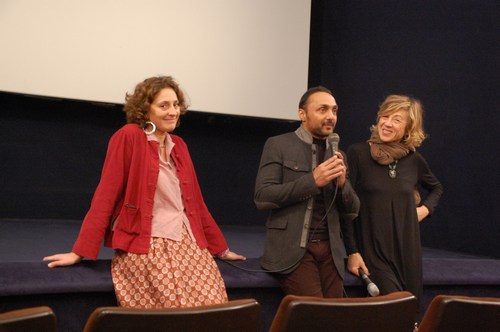
River to River festival 2010, Rahul Bose, Selvaggia Velo

In the picture above, Bose is answering questions by the audience after the film. Next to him are Selvaggia Velo, festival's director and the English/Italian translator (sorry for not asking her name).

I had a conversation with Bose, that focused mainly on his involvement in the NGO called The Foundation, and touched superficially about his films.

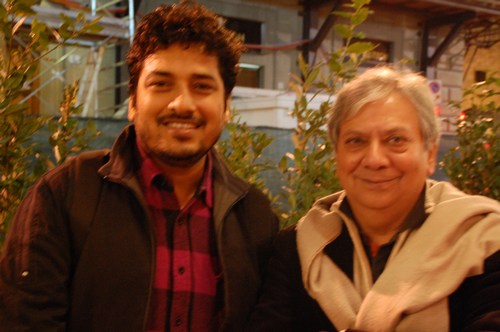
Coming out of hall, I ran into Rizwan Siddiqui and Vijay Singh. I had seen Rizwan's short film "Kharboozey" on 7th. Vijay introduced himself and told about his works including a film called Jai Ganga. I need to look for his works and see them. Rizwan lives in Lucknow and Vijay is based in Paris.

River to River festival 2010, Rizwan Siddiqui and Vijay Singh

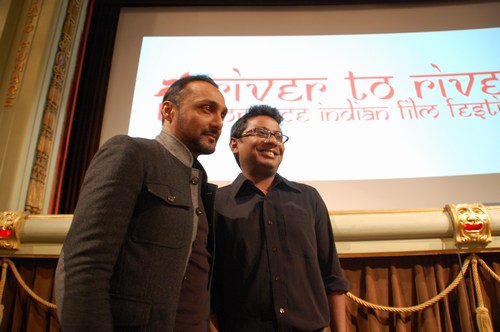
Then it was the time for the Italian premier of Onir's film, "I am". Here are film's director Onir and one of the actors, Rahul Bose.

River to River festival 2010, Rahul Bose, Onir

The film is beautiful and as usual for Onir's films, has beautiful music. Made of four inter-related stories, characters from each story spill off into others, the film touches on some of the sensitive issues including child abuse, homosexuality, artificial insemination and conflict-religion issues. The stories are based on real life incidents. Onir was telling that it will probably release in India in February 2011. Don't miss it.

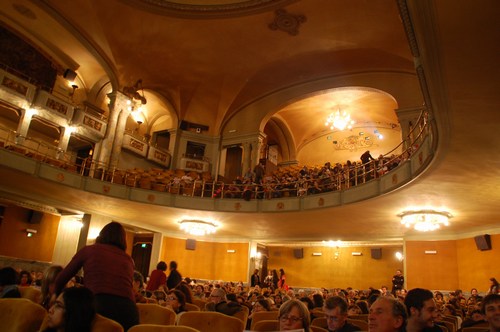
The cinema hall where they are holding the main festival, Odeon, is one of the historical old-style theater of Florence. Yesterday, for "I am" it was full.

River to River festival 2010, cinema Odeon Florence

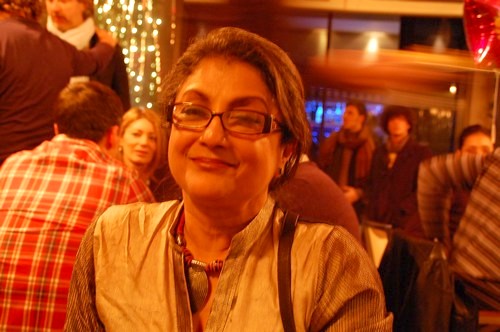
Now about my coming accross one of my teenage dreams, Ms. Aparna Sen. Her "Iti Mrinalini" opened the festival and her "The Japanese wife" is going to close the festival today evening (9 Dec.).

I had read lot of her interviews and had thought of asking her a lot of questions. But in front of her, I felt confused and forgot half of my prepared questions. I don't remember what she answered and probably I was a very distracted interviewer, asking something, then interrupting her, and all the time sneaking looks at her! Hopefully she is used to men like me and didn't take me for being exceptionally stupid or clumsy.

The evening after talking to her, passed in a daze. Couldn't have asked for more! Thanks Ms. Sen.

River to River festival 2010, Aparna Sen

If you wish, you can see Aparna Sen's Question-answer sessions after Mr. and Mrs Iyer at the festival on Youtube. On the same page, you can also find links to videos of Rahul Bose answering questions.

***

Must see places in Bologna

Are you planning a visit to Bologna and would like to know what places you should visit? Or, you have looked at the tourist guides, but you would like some thing more? Often people coming to Bologna ask my advice. Naturally my advice depends upon my interests. When I visit a place, I like understanding about local history, and arts. I also like visiting any sites of archeological interest. This list reflects these interests.

Places to see near Bologna:

Let me start with two places that are not in Bologna but are very close and can be a great for a half day trip: Marzabotto and Dozza.

(1) Marzabotto is a small town, to the south of Bologna, at the foothills of Apennine mountains. Marzabotto is a stop on the Bologna-Porretta train line and there are frequent trains from the Bologna railway station.

On one of the hills called Monte Sole, not very far from Marzabotto, during the last phase of second world war, there was a massacre of civilians by German troops. Between 29 September to 5 October 1944, 770 civilians were killed including 216 children, 316 women and 142 elderly persons. You can still hear echoes of that massacre in the ruins of houses and churches on Monte Sole.

However, the place I would like to suggest you to visit is the Etruscan necropolis, close to the city. Here was one of the largest Etruscan settlement in this part of Italy and its pre-roman ruins are breath-taking including the strange tombs with round stones. Close to the necropolis, there is an Etruscan museum.

Etruscan necropolis, Marzabotto

(2) The second place, outside Bologna but not very far, that I would like to suggest for a half day trip is medieval town of Dozza. It is to the east of Bologna, on the road going towards the seaside towns of Rimini, Riccione and the small mountain country of San Marino. Located on a small hill with a medieval castle, surrounded by gentle hills known for their San Giovese vineyards, Dozza is like a small jewel. Some decades ago, the old city decided to reinvent itself by inviting artists from different countries to come to the city to paint or to draw murals on the houses. Over the years, a large number of houses in the old city present those artwork in a permanent open-air art exhibition.

Walking on the cobbled streets, surrounded by colourful paintings and artwork is a wonderful experience. The basement of the medieval castle of Dozza holds the regional Enoteca, vine tasting and selling centre with the possibility of trying some of the best vines from Emilia Romagna region.

Cobbled streets of Dozza

To go to Dozza, you can take a bus going towards Imola from the regional bus station of Bologna, not very far from the central railway station.

Places to see in Bologna:

Now we come to my favourite places in the city. These places may be mentioned in some tourist guidebooks but usually these are not considered important. Some of them may not be there in the tourist guidebook, or at least not in the way I want you to look at them. I am going to start from the southern edge of the city and work up my way towards the north and east. Thus the order of the places I am suggesting is geographical and not because of their importance or beauty. Most of these places do not require a ticket, they are free.

(3) Third place on my list is a hiking trip near Parco della Chiusa (Parco Talon), a huge park and protected forest around a small dam on the river Reno located in Casalecchio di Reno, a suburb on the southern edge of Bologna.

Take the road next to the church, without entering the Park and walk up. This place has bomb shelters from the second world war, when many persons from Bologna had taken refuge there. In two minutes you will find yourself in a protected forest and the first of the “cross-stations”, the small altars along the mountain track to commemorate the 12 places where Jesus had stopped before his crusifixtion.

Hiking near Parco Talon

The hiking trip is for following the trail of the cross-station altars to reach the San Luca church at the top of the hill. Views from the top are beautiful and hike itself, in the middle of protected forest area is wonderful. At places the climb is a little steep, but for most parts it is fairly easy. Remember to wear sturdy shoes, take a wind-cheater or a jacket with you and do it in company, don’t do it alone.

For coming down from San Luca try the stairs and the covered archway that starts from the city centre and goes up all the way to the church.

To reach Parco della Chiusa, take a bus like 20 going towards Casalecchio and get down at the bus stop just after the park.

(4) Fourth place on my list is the Certosa cemetery near the city stadium. The 2000 years old cemetery is built on an old Etruscan archeological site and requires at least half a day for a proper visit. It is divided into sections and is full of “monumental graves”, graves built like monuments with beautiful sculptures representing ideas and fashions of different historical periods.

Certosa cemetery

It is like a huge open air museum. I have been there many times, but still there are parts of the cemetery that I have not yet explored.

To go to the cemetery, take any bus going towards the stadium (14, 20, 21, 89, 94) and get down at Certosa.

(5) Fifth place on my list is the old port of Bologna, that goes back to the time when the city was criss-crossed with canals. After the second world war, unfortunately most of these canals have been covered for making parking places and roads.

Inside the old city, there are a number of places where you can go down for an underground visit to the old canals including some Roman ruins. Usually you need to book these tours in advance and pay for them. However, the place I am suggesting is just outside the old city and here the canal comes out in open.

You can start your visit from the corner between Via Minzoni and Viale Pietramellara, the circular ring road surrounding the old city. Here you can see the Salara, the salt house of the old port. It now hosts the Bologna Gay, Lesbian, Bisexual and Transgender (GLBT) centre with a wonderful library on GLBT themes and a very lively restaurant in the basement, inside the moat, venue of many cultural events in the evening.

After the visit to Salara, we need to go to the old port. The ruins of the main port are close to via Gagarin. You can take bus 11A or 11B going towards Via Agucchi and get down in Via Gagarin and look for the canal. On one side of the road, next to the canal is Villa Angeletti, a beautiful park. On the other side, there are apartment buildings and an unimportant looking small track that goes along the canal. Take this unassuming track and a 5 minutes walk will bring you to a wonderful place hidden from the main road – the ruins of the old port.

Old port

Behind the port, the canal is divided into two parts with a long and narrow island between the two sides. Stairs go down to the island and is a wonderful place for a walk and for bird watching. If you feel like it, you can even walk along the canal to the “chiusa”, the place where boats were lifted up for moving in the canal. You can also visit the industrial museum close by.

(6) Now we start moving towards the centre of the old town and I suggest a stop at St Francis church at Piazza Malpighi. One of the earliest buildings of French gothic architecture style in Italy, it was damaged during the second world war and you can make out the repair on its façade. It was used as a customs house during Napoleon’s occupation of Bologna in eighteenth century. Used as a meeting place for the arts students in medieval Bologna, it is worth visiting for the graves of law teachers. There is a wide variety of statues, lying down, busts, reading a book and many more, above the graves. There is the grave of a heretic Pope, Pope Alexander V, also known as Anti-pope. The slender bell tower is very beautiful.

St Francis church

The cloister of St Francis church has one of my favourite engravings of a classroom scene from medieval Bologna. It shows that bored teachers and playful students haven’t changed after so many centuries.

(7) From St Francis church let us now move towards the central city square, Piazza Maggiore. Just let me mention the wonderful Sala Borsa, as you enter the square near the Neptune statue. Sala Borsa’s last incarnation was as the Bourse or the share market, but before that it was a general market, a park with a water reservoir and fountains, a botanical herbal garden of monks and even before that an old inhabited site with two thousand years old Roman ruins.

Sala Borsa now holds the central library of Bologna. Its wedding cake like balconies with a beautifully painted roof is worth a look. But even more important is to look down through its transparent floor, where you can see the old ruins from different archeological periods.

Sala Borsa

(8) After Sala Borsa, enter the Palazzo d’Accursio next door and walk to the wonderful stairs at the back, that were made for horsemen to gallop up the two floors without slipping. Go the second floor for the Municiple art collection of Bologna. The second floor main hall is wonderful with its frescoes in different shades of browns. Take a look at medieval frescoes in the Sala Farnese and you will feel like standing there and gazing at them endlessly. (If you have problems in climbing the two floors, you can look for the elevator).

However, don’t get lost with Sala Farnese, remember to go to the Municiple art collection (you will have to collect a free ticket). If you don’t have the time to go through all the collection, ask one of the volunteers there to guide you to the Pelagio Pelagi collection. This rich nobleman of Bologna has left his art and sculpture collections to the city and a key part of his collection are his own works. I love his paintings and I think that he merited more appreciation. Probably he was dismissed for being a “rich art lover” and never got his due as an artist.

Pelagio Pelagi art collection

(9) After you are done with admiring the square and the cathedral, I suggest that you move to Santa Maria della Vita church on Via Clavature, 5 minutes walk away from the square. This church was part of the oldest hospital in Bologna and you have time, you can take a look at the old hospital museum next door. But don’t miss the “ugly Marias” of Bologna inside the church, in a side room, that can be reached by small stairs next to the altar. These are a set of terracotta figures made by Niccolò dell’Arca showing the dead Christ and the grieving Marias (Mary, Christ’s mother and Mary Magdalena), their mouths open in a silent scream.

Ugly Marias of Bologna

They are incredibly moving, though Bologna men are known for calling any ugly looking women as “like the ugly Marias of Bologna”.

(10) The next on my list is the small St. Cecilia chapel on Via Zamboni, 10 minutes walk from Via Clavature. You will see the faded frescoes on the outside wall of St. Cecilia church and underneath the archway, desperate looking signboards asking you to visit the chapel. For once, it is not a ploy to lure unsuspecting tourists to some mediocre sightseeing visit. The chapel is worth a visit and it is a pity that it is so little known.

Via Zamboni and St Cecilia church

If you follow the signs and go through the side entrance, you will find yourself in a passageway with a small door pointing towards the chapel. The shock when you enter the chapel after such unassuming entrance is worth the visit. The bright coloured frescoes covering all the walls are like a hallucination. It is a small chapel and yet the quantity of images and colours it contains is very impressive.

(11) Now we move to my last stop for this Bologna trip. This is another climbing trip. Walk back to the twin towers in the centre of Bologna and enter the tower of Assinelli. There is a three Euro ticket and the climb up the narrow winding stairs is tiring. Every now and then, depending upon the state of your lungs and body weight, you will need to stop, catch your breath and look out of narrow windows at the panorama of Bologna.

But the view from the top is really great, it is literally breath-taking, and it makes you understand why Bologna was called the city of towers. Most of the towers are gone now, but still hidden among the buildings, there are enough of them to justify this name.

If you are in Bologna on a snowy winter day, the view from the top becomes even better with snow covering the roof gardens of old city.

Snow and christmas lights from top of the tower

Conclusions:

There are many more places that I love in Bologna. When I had started to write this post, I was thinking of mentioning seven best places, but I just couldn’t decide which ones to leave out. However, I can easily add another 11 places, and I am sure that there are many more things to do in Bologna, that I still need to discover.

If you do come to Bologna and this post is useful in some way, please do remember to tell me about it.

You can also download a PDF version (without images) of this post for printing and carrying with you to Bologna.

Children of mixed gods

Yesterday, I was at the presentation of Fatima Ahmad's new book "Aukui". Fatima's mother was half Indian and half Vietnamese, her father was Somali. Fatima was born in Cambodia, where she lived for the first 21 years of her life, till the war broke out and they were forced to migrate to Somalia.

In Somalia, Fatima faced the more orthodox side of her religion. She was not supposed to go out, not to talk to men. It was different to grow up as a Msulim in Cambodia, a predominently Buddhist country than in Somalia. After three years in Somalia, Fatima moved to Italy. (In the picture below, during a reading from her book - Fatima is in the middle)

Fatima Ahmad, Roberta Sangiorgi from Eks&Tra & Stefano at Casa Khoula library Bologna

"Aukui" means "black devil" in Cambodian and refers to the difficulties she faced in Cambodia because of her skin colour. She also had to overcome barriers created around her disability. She said that she has written this book to tell her story to her younger brothers and sisters, who were born later and do not know about their roots. About her religious beliefs, Fatima said that she takes what she likes from Islam, Buddhism and Catholicism.

Discussions about mixing of faiths and religions immediately resonate in me. In my family, we have three religions - Hinduism, Catholicism and Sikhism.

I think that with globalisation, with people moving from one country to another, there will be even more opportunities for people of different religions to meet, fall in love and make families. I also think that today, with greater awareness about ideas of human rights and religious liberalism, there are greater opportunities for people in mixed families like ours to maintain our distinct religious identities and yet be all together in harmony.

A couple of months ago, I was in Vietnam and one evening, I had a discussion with a friend, who is Buddhist and has married to a Catholic. They are planning to shift to Italy in a couple of years. "I continue to be Buddhist", she had said. I had thought that in her words, there was an unexpressed anxiety about shifting to a predominently Catholic country and yet, continuing to be a Buddhist.

"And the children of such mixed families, what about their religion?", sometimes people ask me. I don't know how did others deal with this, I can only share how we dealt with it. For us, all children have a right to their family traditions from both the sides, mothers' and fathers' sides. This means that children should be able to feel at home in all their family religions, should participate in all their religious traditions and rites. We had had a church wedding and a hindu wedding, our son had his baptism and his mundan.

It is true that sometimes religions have prayers that talk about supremacy of their god and being the only true religion, but I think that if children can understand that their parents are in peace with each other, they grow up with their own understanding of their religions.

I feel that these children growing with shared understanding and beliefs of different religions, will be the new citizens of the world. I also feel this understanding is precious and should be valued and nurtured.

In India, because we grow up with different religions around us, over the centuries we have developed so many examples of mixing up of religions and traditions. Between Islam, Hinduism, Sikhism, Jainism, Christianity, etc.

Once I had read about one of the first Indian censuses done during British times and how people had difficulty in telling their religions, they were not sure if they should call themselves sikhs or hindus, and were forced to decide. Over the past decades, growing ideas of religious orthodoxy and fundamentalism among all the different relgions, seem to strengthen the differences, the divisions and the boundaries between religions and beliefs.

We, the children of mixed gods need to counter this and ask for respect of our religions, our mixed religions.

I have been reading debates about Indian census and if we it should ask questions about the castes or not. I wish that Indian census would also ask about religions of persons and give them the possibility of giving multiple answers - we can also be Hindus and Muslims at the same time, Sikhs and Jains at the same time, Hindus and Sikhs and Parsi at the same time. I wish there is a question that asks, how many believe that there is just one god for all human beings not withstanding their different religions? and how many of us also pray in religious places of other religions?

Favourite Italian models 2010

One of my friends likes nude female forms on his desktop, and oscillates between paintings of famous patiners like Rubens and the models in flesh and blood. I noticed that he had placed the icon of the trashbox right between the legs of his current wallpaper-heart throb and I was wondering, what it could mean in psychological terms? Any guesses from the psychiatrists or psychologists among you?

Anyway, I was talking to him about his favourite Italian top-models and this is the list he gave:

No. 5 Barbara Montereale - she is the young single mom, who had come to news for having gone to some parties of Italian prime-minister, and has since done some calendars, etc.

Italian top models and sex symbols, 2010

No. 4 is Chiara Salvadé - she is a newspaper and radio journalist, as well as a model.

Italian top models and sex symbols, 2010

No. 3 is Emanuela Fulgori, who is a model.

Italian top models and sex symbols, 2010

No. 2 is Bianca Balti, the Italian top-model and actress, who came to limelight after she was chosen for a Dolce & Gabbana campaign.

Italian top models and sex symbols, 2010

No. 1 is Lucia Galbava, a new and upcoming model. Actually she is from Bratislava, but my friend insisted that since she is working for Italian fashion, so she can be considered Italian top model.

Italian top models and sex symbols, 2010

Personally I like the idea of Chiara Salvadé, since I like the idea of beauty with brains, but I don't like her pictures. However, if I have to chose my favouirtes from the Italian covergirls, I would choose Margherita Buy. She is no girl, but is a wonderful actress and I like her very much.

Italian top models and sex symbols, 2010

Actually I prefer, Indian women dressed in traditional Indian dresses as wallpapers for my desktop, but if I have to choose an Italian face, I would prefer it to be Margherita Buy.

Meaning of dance

This post is on reflections about different meanings and ways of interpreting dances, and presents some images from World Dance Day celebrations in Bologna (Italy).

Giornata mondiale della danza, Bologna, 29 aprile 2010

If someone asks you, "what is the meaning of dance for you?", what would you say? Perhaps my question is not so clear, and another way of putting that question could be, "How would you define dance?" or even, "what kind of feelings does dance give you?"

Giornata mondiale della danza, Bologna, 29 aprile 2010

I think that if someone asks me this question, I would think about the drum beats, the rhythm, the desire to move my feet with the beats. As a child, I used to go the school, where my sister was learning kathak and I was supposed to study arts. Kathak has a basic step, "Ta thai thai tat, aa thai thai tat", just watching my sister do it for hours every day, I must have picked it up from there. Now, when I watch a dance that I enjoy, I often find that my feet still follow that old rhythm of Kathak.

If I think of classical dances like Bharatnatyam or Odissi, the same question would make me think of grace, harmony, beauty and years of practice.

Giornata mondiale della danza, Bologna, 29 aprile 2010

Yesterday was the "Giornata Mondiale della Danza" (World Dance Day) and our city, Bologna celebrated it in grand style. Culturally, Bologna is one of the most exciting cities in the world. If you love archeology, arts, dance, music, films, literature, or even history and philosophy, Bologna gives you ample opportunities through out the year to choose events, where you can interact with artists, thinkers and writers and participate in wide variety of events, often free of cost. Still, yesterday's dance event was really special, even for the Bologna standards.

The organisers had asked different dancing schools and groups of Bologna to present their works in the different city squares. Most of these are open spaces, but there are also a few covered squares in the city. Such wide open spaces with fountains, statues and old historical buildings, can be seen in many countries of Europe, but are distinctive character of Italy.
Giornata mondiale della danza, Bologna, 29 aprile 2010
In India such spaces, without people trying to sell things or motorbikes and cars passing through, are unimaginable. But then, India with its burning hot sun for most parts of the year, is probably not suitable for open "Piazzas" (squares), though till 20-30 years ago, certain parts of New Delhi, around Birla Mandir and Parliament house had many open spaces. However, I am digressing here, let me go back to my theme of dances.

While I walked from one square to another, feeling like a guest at a wedding buffet, tasting one dance here, moving to another dance there, I was thinking about the meaning of dance, especially the modern interpretations of dances.
Giornata mondiale della danza, Bologna, 29 aprile 2010
For example, what do you think when you see a group of children with disabilities dancing? Do you feel a little goody-goody, thinking that everyone has right to be happy and to participate in dancing and thus even disabled children have a right to dance? I suspect, that such feelings are sometimes accompanied by certain other thoughts, that we may not say to ourselves, because they are not "politically correct". This is because we attach certain expectations to how we expect people to dance and to be good looking, to be graceful and to be perfect? Perhaps if we can accept that dance is about being happy and expressing that happiness, we can appreciate that dance better?

Yesterday one of the dances that I saw was very strange. In Galleria Galvani, next to the archeological museum, a girl was wrapped around an old pillar, with its paint peeling off. She was staring at some detail of the pillar and moving in extreme slow motion. Another girl with sad face, hid behind another pillar. A third girl with a basket on her head, her dress torn, a shoe on one foot and the other foot shoeless, her face lost in her own thoughts, moved slowly down the stairs. A boy with a old cord tied to his t-shirt like a tail, pulled an old broken table. There was no music.
Giornata mondiale della danza, Bologna, 29 aprile 2010
My first thought was that this is some kind of new-age dance and it will be better to go and look for something better. Fortunately I statyed there, looking at them and letting my mind run free. Perhaps they are representing life in stones and "inanimate" objects, I thought, since I feel that everything in this universe has life, including mountains and houses, may be in different forms. Then I thought of mental illness, the pain of depression, the bottomless grey pit from which, it is difficult to come out.

Suddenly watching those dancers, moving in slow motion was a strong emotional experience. Feeling their pain, I felt like crying. So I think that meaning of dance is to transmit emotions, and if it can then it is a good dance, even if it is not about rhythm or beats.

In an old gallery, that widens into a covered square, there was a group of "oriental" dancers. They were wearing little clothes, with open hair and middle-eastern or arabic music, doing sensual belly dances. Most the persons watching these dances were women and they were very loud in expressing their appreciation by blowing whistles and clapping. I think that dancing is also about expression of sexuality, a liberation from all those taboos that chain us.

Giornata mondiale della danza, Bologna, 29 aprile 2010

Wild movements of hips and powerful drum beats from Africa that pulsed in the whole body, making me sway and move, were also about sexuality, about being free from all shackles, about expressing ourselves without shame or inhibitions. This dance was in the wonderful setting of Piazza Nettuno.

Giornata mondiale della danza, Bologna, 29 aprile 2010

Close by in Piazza Maggiore, in front of the municipal pharmacy, there was Kairos, a group of young people doing strange contortions accompanied by songs that used everyday words in new ways. Can contortions, arms and legs intertwined, mean dance?

Giornata mondiale della danza, Bologna, 29 aprile 2010

One of the most emotional moment yesterday was during the Bharatnatyam recital, when the CD player had some problems and got stuck. The Narthaki group under the guidance of Alessandra Pizza was embarrassed for a moment, till Alessandra decided to sit down and sing the song herself. The Sanskrit words, her voice full of passion and emotions, her hands drawing the gestures in the air, she seemed like an ancient Indian guru, graceful and wise.
Giornata mondiale della danza, Bologna, 29 aprile 2010
Just watching her made me feel goosebumps all over. She was not dancing herself, only guiding her students to dance, but looking at her was as electrifying as any dance could be. So perhaps for dancing, people do not really need to dance, they can just make our imaginations dance? What do you say?

Giornata mondiale della danza, Bologna, 29 aprile 2010

Writing in the time of conflict

Recently I had the opportunity to listen to three writers talk about the conflicts in their countries and how it affects and influences their writing. This seminar was part of a wider event organised by Italian weekly Internazionale. The three writers were Suad Amiry from Palestine, Romesh Gunesekera from Sri Lanka and Abdourahman Waberi from Djibuti and talking to them was Italian journalist Maria Nadotti.

It was a fascinating discussion and for a long time I kept on thinking about it. Here are a few excerpts from this seminar.


Maria: Suad Amiry’s family was originally from Palestine, but they had to leave their countries before her birth and she was born in Damascus. However, she went back to live in Ramallah in Gaza some years ago. Palestine is composed of Gaza and Cis-Jordan, not connected to each other.

Gaza is a narrow strip of land along the coast, 6-14 km wide and about 40 km long. In this area live 1.537.000 persons, that means 472 persons per square km.

Cis Jordan is about 6000 square km area, its borders are not defined exactly, with a population of about 2.5 million Palestinians and about half a million Isrealis.

Suad: Talking about Palestine, it is a country that is shrinking all the time. At the beginning of century (Note: I think that she means the beginning of previous century - nineteen hundred), Palestine was four times as it is today.

In Palestine, space and time do not have significance. What I mean by that is that if I go out of the house to go to Jerusalem, which is only 15 km away from Ramallah. In a place like Ferrara, you can say “15 km means 15 minutes”. But in Palestine, those 15 km between Ramallah and Jersualem can take you 15 minutes, can take you 2 hours, could take you a whole day, may be you never reach Jerusalem, may be you never come back.


Thus the notion of the state of Palestine, in a situation of occupation, is different. Palestine is more or less the size of the island of Alba in Italy, but it has 500 check-points. These check points don’t separate Palestine from Isreal, they really separate Palestine from Palestine.

So if you talk of geography and if you look at the map of Palestine, it looks like a swiss cheese. Maria has asked me to talk about geography of Palestine so you see, it is an Arab country and has Arab culture, but we can never get to any Arab country because of the occupation.

The world media is only interested in bombardments and the suicide bombings, Abu Mazen and Yassef Arafat. No one really cares about three and half million persons under occupation. For me occupation means that space around me keeps on changing. I am an architect and I see that change. I became a writer purely by accident. Because of building of settlements, because of occupation, because of building of wall, we live in a changijng place all the time.

May be you have seen “Cinema Paradiso”, where the whole village goes into estrangement because one cinema, one building is gone. In Palestine, we live thousands of “Cinema Paradiso” because when I go out I am not sure what I am going to find.

Maria: Here we are talking of small countries, that are becoming even smaller. For political erosion, as in Palestine. For geographical erosion and migrations as in Sri Lanka and Djibuti.

My question is that migrations make a country smaller and at the same time, in another way, enlarge it. They multiply it. What would I know about those other countries without the voices of the emigrants? Writing about your countries from outside or from inside? What happens when you write about your countries from far away? Not just far away physically but also far away in memories? What do we know about our countries after thirty years of not living there? How does that differ from writing about it, living there in the middle of daily routines?

Suad who lives there, writes her daily happenings, an on going dialogue. While Romesh and Waberi write much more through evocation.

Romesh: This is complicated. People feel that you have to write about what you know or where you come from. There is a kind of pressure on you to write about certain things. Like some American writers feel that they can write only about the good things in America and not about the trash, even if trash is from where great literature comes.


There is an assumption that where you come from, that might affect your writing. One of my Indian writer friends, when he saw my first book, a very slim book, he said that it is because I come from a small island. He doesn’t write very big books but he believes that being from a large country, he has so much to cover and his canvas is going to be very large. May be there is an element of truth here.

How you write about a country when you are far away from it, is not an issue, because I am a writer of fiction. Unlike the writers of happenings, when you write fiction, in your imagination you are actually there. I am interested in the connection between the real world and the fictional world, but anyone who reads fiction and is excited by it, knows that there is an area of frisson between the real and the imaginary world. You are writing about a place and about people, which is true and also not true. That is why people love to go to the places where fiction is placed. Like, if you like James Joyce, people go to Dublin and they walk on the street where Leopold Bloom walked, they stop where he stopped and they know that he never existed and he never walked on that street. It is all in imagination. I think that connection is what is interesting.

Suad: As Maria said, I became a writer thanks to Sharon and my mother in law. I lived my life as an architect and being an architect is a state of mind. As writers also we are in a state of mind. “Murad Murad” is my fourth book, but I really can’t say that I am a writer. I can tell you what I do, how I live in my writing.

My first book “Sharon and my mother in law” came as a result of curfew for 42 days. My mother in law was ninety one year old and she came to live with me during those days. I tell Isrealis that one day I may forgive you for putting us under a curfew for 42 days but I will not forgive you for making my mother in law live with me. With her, those 42 days seemed like 42 years.

There were Isreali soldiers outside our house and I had my mother in law inside the house. So I had double occupation. Those of you who follow the news, you know that Isreali occupation is enough to drive you crazy but having my mother in law made me a writer. So what happened was that every day I would sit at home and write what ever was happening in our home, between my mother in law and I.

I wrote about going shopping when they lift the curfew for two hours and you can go out and buy everything you need, imagine eighty thousand people trying to shop all together. It was a mad house. I wasn’t thinking of writing. I was writing emails to friends, telling them that please do not share these with anybody, because they were so nasty about my mother in law. Little did I realize that people like nastiness, they liked them because of their frankness. It was reporting that was not intended to become a book.

Actually it could be fictional because living in Palestine is so unreal. Sometimes, I ask when is reality? I don’t say what is reality, I say, when is reality? It is true that I am reporitng from everyday experience. People keep on asking me, is that real, is that true? I write for real, what people think may be fiction.

My second book, “No sex in the city” (Note: I am just translating from the Italian title that she quoted, actual original title may be different) was about Ramallah. That book was instigated and triggered by Hamas winning the elction in Palestine. That was so drammatic in my life, being a woman who was active, like I was active in PLO (Palestine Liberation Organisation). I have been involved in it all my life, it is a secular movement. We always felt that we worked for women’s issues and secularism. To be one of the first countries of the world that would elect a religious party was drammatic, it made me loose reality. It made me think about who am I, what country am I living in, what future do I have? I felt that I have spent so many years of life to convey to the world that Palestinians are normal human beings, and then with election of Hamas!

I wanted to say that Palestinians are normal human beings, that Moslems are normal persons and those elections pushed me to write about the life of my women friends. I wanted to call that book “Palestinian Menopause” but the editor was afraid of the “menopause” in the title, and then the title was “No sex in the city” and that was fine because no one is afraid of the word “sex” in Italy.

It is about the life of women friends and about very real stories about how people became Palestinian. It is not about Palestinians. Only when I wrote that book, I realized that my women friends, the menopausal group with whom we go out every day, one is Egyptian, one is Moroccan, one is Armenian, one is American, hardly there is a Palestinian except for me, and I am half Palestinian and half Syrian. What brought us together was because of Palestine, as a cause rather than as a geography.

My last book is again from a harsh reality. The reality of building that wall, that is a concrete wall. But for me that wall is not a physical thing. It is a monster. If you ask Palestinians to tell about three events that marked the history of Palestine, they will say 1948 when 800,000 people were thrown out of historical Palestine that became Isreal and my family happened to be one of them from Jaffa; then they would say the setting up of those 500 check-points inside a small area, that prevents us from moving; and the third would be the wall.

Let me explain how this book “Murad Murad” came about. The wall is such a reality that I always ask – what would have happened if we Palestinians or Arabs around all the Jewish state of Isreal, how would the world treat us? It is beyond me, I don’t know whether it is a reality or fiction, that Isrealis, who everyday talk about need for peace, want to be part of the middle east, built that wall that separates them from their future neighbours.

Murad was like my mother in law in my other book, “Sharon and my mother in law”. My mother in law, who was ninety one year old, for me was a symbol of resistance. For her the curfew didn’t matter, she wanted her milk in the morning at seven o’clock. No matter what happened, she wanted to have lunch at one o’clock. So to me she was a symbol of resitence, of wanting to live a normal life in spite of the curfew imposed by Isrealis. Murad was symbolised same resistance to me.

I contemplated, how would I write about the wall? Then I thought that I want to write about the wall from an animal’s point of view. We human beings are so egocentric. The first things that hurt me about the wall was the one million five hundred thousand olive trees that were uprooted for this wall to be constructed. I was thinking what would a deer or a hare would think of this wall. Then Murad appeared one day in my life. He is a twenty one year old boy, who has been working in Isreal for the last seven years of his life. He woke up one day like the other 200,000 Palestinian workers, who had spent all their lives there and were told by Sharon that “No more illegal Palestinian workers coming to work in Isreal.”

We are all aware of issues of migrations and workers, but it is very difficult for me to think of Palestinian workers being illegal in their homes.

Abdourahman: Coming to the question of reality and fiction, it is very complicated. I often have this discussion with my students and ask them what is reality? If you go to the Piazza Trento and you shoot a video there near a lively place outside a café and then you go ten minutes later and the place is empty, so what is reality? I think that reality is something untrackable, something fluid.


Having written eight-nine books on my small country, I realize that I am not writing just from reality’s point of view or from geopolitical point of view, but I am also writing about something that is depper than reality, something that is country of my imagination that is mixed and overlapping with the country of reality. You have history, geography, mythology, etc. so this geological overlapping is something that you try to pierce or break into pieces by the use of the language or the use of imagination.

My writing has to do with both, with reality and also with mythology and history. That is why I use fables like in this book “In the United States of Africa”. That “In” in the title signals that everything has happened, and the purpose of the book is to say that United States of Africa is a reality. It has been created by imagination. I start by taking it forward from there, that so what would happen? From this point of view, you can create distance and you can also produce criticism, what I call social criticism. You start with imagination and from that imagination, you can create a political action.

You can write like that about Palestine, how it was in 1844 and how it could be in 1984 and thus it can exist in the heads of the readers without polemics or whatever. Why I wrote this book, because I was an African in Europe or an European African, I have been for so long in France that I have been Francised, so what I am asking is who am I and who are we in this world?

I am asking if all Europe wants to emigrate to Africa, what would happen? Then you would see the issue of emigration and work, one of the key issues of today, from a different point of view. That is what I have tried.

Actually I am ready with a new book that is called “Passage of tears” that is looking at Djibuti in recent times. That is looking at two important areas – the Islamic discourse in the public and social space that is often linked to Al Qaeda and Bin Laden, and a new interpretation of Islam for a new political agenda. The country is changing also because of interest of the Persian gulf in Africa. Djibuti had strong exclusive links with France, but it is no longer the case. In Djibuti you have French, because France is an important partner within the global agenda, but you also have the US because it has the biggest military base in Africa in Djibuti. Then you have influence from Afghanistan, Iraq, Yemen and all those places. And in the book it is framing the situation from social and economic point of view. Having said that I am also trying to build some kind of historical connection between Djibuti of today and the France of the fascist Arab days, that situation of nineteen thirties and fourties in France, at that time Djibuti was a colony. This is a way of making the landscape and making new perspectives. It has to do with geropolitical situation and with history.

Romesh: I can add to that because it struck me that even with fiction, the reader is getting news from some where. It tell you about real things even if it is not reality. My last book, The Match, part of it is set in the Philippines in the nineteen seventies when I grew up there. I was a little worried when I did that, wondering if I new enough about it or if I could do it well. When the book was published, I was very interested in reactions from the people in Philippines.

Philippines is a country of young people and so most people and most people who read the book were not there in the nineteen seventies, so it is a new country in a sense. To read about that for them was to read about a different place. The other feed back that I got was that newspapers etc. you don’t have to be Philippino to understand the country, you just have to be there or you just have to imagine it to redefine the way you think about the place.

That made me think of something that Russian writer Nobokov said about fiction, when you read something and you sense the excitement or a sense of fear of the character, what you sense is actually quite often the real sense of writer behind that who has a sense of excitement or fear about the sentences that he or she is dealing it, it comes out of the words themselves.

Comment: It was a fascinating morning listening to the three writers. I felt the three of them also symblised three different ways of bring a writer. For me Abdourahman's way of talking about his work seemed more intellectual, Romesh's way of articulating seemed more emotional, while Suad seemed more rooted in irony.

I liked all three of them, and I also liked the way Maria probed them, but I was struck very much by Suad's way of narrating her daily dilemmas. There is so much rhetoric all around about human rights, democracy and other such ideals and yet listening to her and what happens in Palestine is a cruel reminder of the distance between reality and rhetoric.

After the meeting I talked some more with Romesh. I asked him if the main protagonist in his new book "The Match" is more autobiographical in the sense that it is about a person who has forgotten his roots and then in the middle age, rediscovers them, and that emigrant writers often touch on this theme of rediscovering their roots, sooner or later in their writings. Romesh said that almost all important writers are emigrants, from Shakespear to Dante, which I found very intriguing.
Reclaiming my faith

It was January and sister Leela, an old friend and a nun from India, was with us that evening. Marco and Atam, my son and daughter in law, had come for dinner. Leela recited her prayers asking God to bless all the persons sitting around that table and made a sign of cross. All others murmured "Amen" and made signs of cross, including my Sikh daughter in law. I didn't.

A few days later, we were having dinner in the evening, when I told my wife what was troubling me. I had grown up in India, where I had learned that we respect all religions. As a child and a growing up man, in India, if I visited a Gurudwara of Sikhs, I would cover my head and kneel before Guru Granth Saheb, if I visited a church, I made a sign of cross, if I visited a temple I would fold my hands and accept the vermillion mark on my forehead.

We were not a religious family. Rather, I would say that I heard much more criticisms about Hinduism. My mother often complained about "hypocrisy in the temples and wasting precious milk and ghee on stupid rituals that can feed so many poor". My paternal grandmother, wrote "Ram, Ram" countless times on sheets of paper to espiate her sin of being a widow and read religious books. We would go to all Ramleelas and Durga Pujas with very non religious excitement of "having a good time" and hoping to get some tasty prasad to eat.

In Rajendra Nagar, where we lived, on one side we had Sajid bhai and his wife Ireen with their two children, and above them the very religious Sharma family. There were many Sikh families in our street. But my closest friend was Sam, who had come from Hyderabad to stay with his aunt, Mrs. Rock. With him, I had gone to a few mid-night Christmas masses.

Yet, religions of the persons were not something so clear in my mind. Like Akhtar bhai, who must have been just 5-6 years older to me and who used to come to our home to meet my father, I had never thought of him as "Muslim". When I had to go to Udaipur for an interview, I stayed with Haseena ji's family, a friend of my father, without really thinking that I was going to a "Muslim" house.

Perhaps those times were different and today religious identities and differences have become much more marked, but I often find myself thinking of the past and classifying persons by their religions, like I did above for Sajid bhai, Akhtar bhai and Sam. It feels wrong to me yet I can't stop myself from doing it. And it all started about two decades ago, when I decided that I will not make the sign of a cross.

Coming to Italy was what started this change. People here are more used to sharp religious boundaries and perhaps most of them expect persons to follow those boundaries clearly. "If you are not Catholic and you are not even a Christian, why do you make the sign of cross?" an Italian priest once asked me. I tried to explain that it was normal in India, that going to a church or making the sign of cross did not make me less Hindu, but it showed that I respected the others, but he was clearly not convinced.

That priest was not the only one. It happened a few more times. They said that it was "hypocrisy" or "ambiguous" or "dishonest" or "an attempt to conform and to ingratiate". I was angry and hurt and I stopped making the sign of cross in a church. Thus, whenever I accompanied my wife to a mass, I would stand stiffly, showing clearly that I was not Catholic.

It hurt me inside and every time I entered a church as a tourist, I felt that I was disrespecting God by not stopping to pray for a few moments. I knew that it was not rational. How does it matter to God if I pray inside me or I show it with folded hands or with a sign of cross? A temple or a mosque or a church is just a building and God is no more or no less there than in any other building? I tried to explain it to myself, to justify it, but I felt as I had violated something at deeper level inside me.

It was the first time, I was actually talking about it. I told my wife all this. She felt that I should not let myself be influenced by what others say or think about my religious ideas, but I should behave in the way I wish.

In April, when I visited India, I talked about it with Daisy and like my wife, she had the same advice for me, to behave in the way I felt inside me and not let myself be influenced by others.

Understanding something rationally is perhaps different from the emotional understanding, when something comes from deep inside you? I had the rational understanding but I was waiting for my inner self to understand it.

Finally it came on last Sunday. I was in Rome, visiting an old church. There was just an old woman sitting and praying. I made my peace with myself as my hands made the gesture of cross.

Actually I have not changed my way of thinking. The statues or the temple or the church or the mosque, do not make any difference to me, since I feel God is there in everything, in all beings live or inanimate. But I feel happier, I have reclaimed my right to respect the religions in way I feel right. If others feel that I am being a hypocrite or ambiguous, they are welcome to think what ever they wish.

Bollywood has arrived in Italy

These days there is a Bollywood wave in Italy after a series of Hindi films were shown on Italian national TV channel on prime time.

Compared to some of other western European countries like UK, France, Germany or Netherlands, Italy has a limited population of Indians and perhaps for this reason, Bollywood films were almost unknown in Italy till recently. There were persons who liked Bollywood and who watched Hindi films with English sub-titles but their numbers were extremely limited. On the other hand, there have always been some persons interested in world cinema, the kind of persons who go to film festivals and many of these persons were aware of the realistic films that usually make it to film festivals but they were not into the usual masala films of Bollywood.

During the past twenty years, I am only aware of two occasions when Indian films made it to the Italian TV and in both instances these films were broadcasted late in the night – one was Kagaaz ke phool by Gurudutt and the second was Lagaan by Ashutosh Gowarikar.

Italy doesn’t have a culture of subtitled films and all films must be dubbed into Italian. Many years ago a dubbed version of Deewar was released in Italy but it didn’t find any audience. More recently Lagaan, Mission Kashmir and Sawaariya were released in dubbed versions but none of them made it to any cinema halls and were only released on DVDs.

Perhaps the change came with the films made by expatriate Indian film directors like Mira Nayar, Deepa Mehta and Gurvinder Chadha. Mira nayar’s Salaam Bombay and more recently, Monsoon Wedding & The Namesake, Deepa Mehta’s Water and Gurvinder Chadha’s East is East and Bend it like Backham, all had theater releases, DVDs and TV broadcasts.

Then in the TV “dead-season” in summer 2008 the national channel RAI had shown 3 Hindi films (“Cheeni Kum”, “Hum Tum” and “Aur ho gaya na”). In summer, Italians go on holidays and TV viewership goes down and that is the time when usually old reruns of TV serials and films are shown. In 2008, there was some awareness of Bollywood first created. Then in 2009, this experiment was repeated and it started in July with “Namastey London”. The waves this year have been much bigger since the film topped the viewership ratings of the Saturday primetime.

Since then, on successive Saturdays, it has been Bollywood time on RAI and each time it tops the viewership ratings. Thus the series that was supposed to stop at end of July was extended to mid-August and now it seems it will go on till end of August. The other films shown so far in this season include – Fanaa, Salaam Namastey, Jab We Met, Laaga Chunri Mein Daag and Mujhse Dosti Karoge. Next saturday will be the turn of Dil Ka Rishta.

Suddenly people want to know about Hrithik Roshan, Saif Ali Khan, Rani Mukherjee, Preity Zinta and Kajol. My Italian blog Awaragi, where occasionally I wrote about Bollywood films, used to get about 10-15 hits a day and now on Sundays after the the Bollywood nights, the number of hits reach upto 700-800. Suddenly as an "expert" on Bollywood I am in demand with people writing in to ask about meanings of the words of the songs or other things related to Bollywood.

The Hindi films shown on RAI are reduced versions from which most of the songs and some scenes are removed. They last around 1 hour and 40 minutes so that with the ad-breaks they finish in 2 hours. For example in Salaam Namastey, the whole Javed Jaffery track and parts of the final hospital scene were removed, along with the songs. Unfortunately, even those background songs that are left in the film, are without subtitles so people write to ask for meanings. Initially, especially in 2008, the dubbing was strange with persons using sing-song voices, sounding caricatures of Indians like Peter Sellers in The Party, but that has improved considerably. All these films are mainly romantic films and perhaps for that reason, majority of feedback I have received is from women.

I think that this opens up a new market for Hindi films in Italy, especially in terms of DVDs. Right now, no Hindi film has proper Italian subtitles – most Italian subtitles in Hindi DVDs seem to be done with automatic translation software that often butchers the meanings. Italy is flooded with low quality pirated Hindi DVDs aimed at Indian, Bangladeshi and Pakistani emigrants. People write to me asking for Bollywood films dubbed into Italian or with proper Italian subtitles, but I don’t have any clue about what to advice to give to them.

I hope that Indian film-makers and international distributors can read it and take necessary steps to safeguard the interests of the Indian film industry.

New Italian Sex Symbol Is A Cow?


Yesterday’s news papers had a picture of the new Italian sex symbol – Cristina del Basso. Miss del Basso became known to the Italian public as one of the participants of the last season of Italian reality show Grande Fratello 9 (Big brother 9) and was immediately noticed for her very generous attributes.

It seems that ever since, Miss del Basso’s fame has been growing and her pictures with these huge tits hanging out were splashed all over newspapers yesterday because she is the new calender girl for the Panorama magazine 2009-2010 calender that came out yesterday.


These huge mammeries are not how the nature had made them, they have been surgically enhanced, but then in todays Facebook-Twitter era, the competition to get noticed is so high, that all help is welcome. I don’t think saliva-dripping hormone strung guys are complaining. I am just a little bit worried about her gravity-related problems, but probably I need not worry as she must be using some strong back-support to compensate for the forward-downwards pull.

Watching Miss del Basso’s pictures, I was reminded of a programme about cows with massive tits and fast-growing huge chickens that I had seen on Italian channel Rai 3 sometime ago. “Report”, this programme goes behind the scenes to dig deeper and understand the issues. They explained that in the Agro-food industry, to earn profits by supplying to big supermarket chains, one must increase production to very high levels.

So they have these Dutch Frisona cows, that stand in rows whole day, blocked above troughs carrying their food, munching antibiotics and hormone enriched cereals mixed with some other things (cow bone powder is no longer given to them after the mad-cow disease scare, they assure), and automated milking machines are attached to their tits so that each cow gives up to 60 to 90 liters of milk every day.


These cows never see those green grassy hills, where they shoot the lovely milk advertisements for enticing public to drink more milk. Within one or two years, these cows are literally pumped out completely, they can’t have any more calfs and their milk production goes down, so they end up in steak houses. It is a factory line production, where new cows come and old ones go to the butcher.

There are chickens as well. Thousands of chickens closed inside enclosures, packed tightly so that they look a beautiful furry carpet and like the cows, they spend all their days eating the feed fortified with antibiotics and hormones. In just 3 weeks they weigh 3.5 to 3.8 kg, ready to be packed and put on the supermarket shelves.

It is not very clear what those antibiotics do to the human beings who eat this meat but they are probably not very harmful as there is no ban on using antibiotics in animal & bird feeds.

If the idea of fucked up cows and chickens excites you, you can watch that episode of “Report” on their website. In the mean time, you can search for more pictures of Cristina del Basso or become her fan on Facebook.

After all it is just a question of markets. While Cristina del Basso may have decided to get screwed out of choice to enhance her attributes, while the dutch frisona cows have no choice but to be part of assembly production line, in the end both, the sex symbol and the cows, are praying to the same market god.

What is Barack Obama Looking At?


U.S. President Barack Obama (C) and France's President Nicolas Sarkozy (R) take their places with junior G8 delegates for a family photo at the G8 summit in L'Aquila, Italy, July 9, 2009. Leaders of the Group of Eight major industrial nations and the main developing economies are meeting in the central Italian city of L'Aquila until Friday to discuss issues ranging from global economic stimulus to climate change and oil prices.
REUTERS/Jason Reed (ITALY POLITICS IMAGES OF THE DAY)

Barack, Barack! What are you looking at?
You are ogling at the buttocks of a sexy white woman?
Is the booty of your Black beauty wifey Michelle Obama not enough for you?