Showing posts with label Films. Show all posts

Film director Onir - Florence Interviews (3)

Note: In December 2010, during the River to River film festival in Florence (Italy) I did brief interviews with Aparna Sen, Rahul Bose and Onir. All the three interviews were very satisfying because each of them gave me an opportunity to meet and get to know some lesser known aspects of people I have liked and admired. However, I am really pleased with this Onir interview because it talks of some issues that resonate emotionally with me. I have also contributed to his new film "I am" by helping with the Italian subtitles.

Interview
Sunil: Let us start with your new film "I am". The film was supposed to have five stories but in the end it has only four stories, what happened?

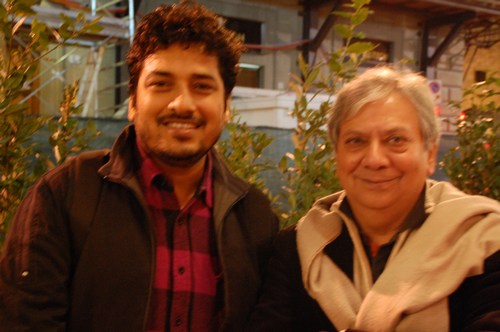
Film director from India, Onir
Onir: Initially I was thinking of five stories. However, when I made the second film, I realized that it was going to be difficult because I wanted the entire film to be less than two hours. For the five stories, the time needed would have much more so I decided to limit it to four stories.

Sunil: How did you decide which story to not to use in the film?

Onir: The story I discarded, I was not too happy with the way it was shaping up. I felt that that story needed more space, it needed a full length film just for itself, to do justice to it.

Sunil: Among the four stories of "I am" - Afia, Megha, Abhimanyu and Omar, do you have a favourite?

Onir: I can't say! All the four are stories that I wanted to make into films. When it was difficult to get separate finance for each of them, I decided to make them together. Each part of the film has its own distinct character, mood and style, so each of them is special to me for a different reason.

Sunil: You were born in Bhutan, so that means you are a world citizen. From a family that is originally from Bangladesh, then born in Bhutan and now settled in India. Increasingly, we all have mixed roots and identities.

I have been to some Nepali refugee camps where they had persons who were thrown out of Bhutan, so I am aware of some of the issues involved in this. You have been a migrant. What does that mean to you?

Onir: My leaving Bhutan was linked to the Nepali exodus. My father was principle of a school where they had Nepali children. There ten Nepali students were arrested and next day they were found hanging. So my father resigned and moved to Kolkatta.

Though I was born and brought up in Bhutan, they decided that people who are not of Bhutanese origin, will be second class citizens in that country, so we had to decide what to do. I didn't want to be a second class Bhutanese citizen, I preferred to be Indian citizen. However, when I talk of home, in my mind, my home is the place in Bhutan where I was born and where I grew up.

Due to this reason the story of Megha in "I am" is very special to me, because it is about homelessness. When I came to Kolkatta, though I was a Bengali, I was an outsider. Then I went to Berlin, and there of course, I was even more of an outsider. Then I came and settled in Maharashtra, where language and other things make me a little outsider.

I agree with you that where ever you live becomes a home, and at the same time, you are always an outsider.

I have some very very good friends in Berlin from the days when I was a student there. So there I feel absolutely at home with them, and with them I don't feel that I am an outsider. But at the same time there are things - like the time when there was this bomb blast in London. I was travelling in Berlin in the S-Bahn and suddenly I realized that I was the only brown person on the train and everyone was looking at me. So it was a kind of strange feeling that I had.

But I also have such feelings in Bombay when ever there were those Maharasthrian things .. I travel a lot by local trains and I feel that if you don't know the local language, then the place is not as friendly. Where ever we are, at the time of conflicts you realize that you are an outsider.

Sunil: Did you ever go back to Bhutan?

Onir: That experience is what has influenced Megha's story in "I am". In the story she is back home after twenty years. I had gone back to Bhutan after about thirteen years. Emotionally it was a very exhausting period, to go to the same old house and find other persons staying there. At the same time, there are so many things from your memories that are still the same there. But after that one experience, I didn't want to go back there, because emotionally it was very painful.

Sunil: Salman Rushdie in one of his books had written about "imaginary homelands" that we emigrants carry in our hearts, but these homelands are only spaces in fantasies, because when you do go back, you realize that it is not the same place anymore.

When I go back to places of my childhood, the differences between the reality and my memories always strikes me. Like to go back and find that the "big square" of my memories is actually a narrow little space. Did that happen when you went back to Bhutan?

Onir: I realized that all my friends were gone and the few there were .. in Bhutan, people get married very early, so there were these old friends with three kids and I realized that our worlds had grown apart a lot.

When I went to our old house, I immediately spotted this tree, I loved gardening and I had planed that tree, to see it was very emotional, though it was a small thing. Then inside the house, where we had our fireplace, the hole above it for the smoke was still there, though they had shifted the fire place .. so there were so many small things that brought back old memories.

Film director from India - Onir

Sunil: Your decision to get in to films came at a time when the TV and media revolution had not yet taken place. So how did your family react to it?

Onir: My parents were keen that I become a doctor. They wanted one son to become a doctor and the other son to become an engineer. After school, I came to study in Kolkatta and my father got me admission in the science college. He was thinking that after the science college I will try to go to the medical college. After he went back, after one week I applied for a literature course in another college. I shifted there and only after my name was cut off from the science college, I told my father.

So first there was shock in the family that I was doing literature and arts. Then I started doing very well in literature so my father was happy, he started saying that I will become a professor. Then one week before the finals of my post-graduate course, I quit and came to Berlin to study cinema and that was another shock to them. They were worried that we had no connection in Bombay or in the film fraternity, and Bombay is a very family driven industry, so were worried.

When I managed to my first film, it took me ten years to do it in Bombay .. I knew that this was my goal. I also knew that it will take time, and I was patient. I never thought, oh my god, it is taking me so long, etc. I knew that I was going to do it. When they finally saw my film ... and even now, they know that I have zero savings, I don't have a house, I don't have a car, what ever I earn goes back into film making because that is what makes me happy .. but now I find that they are happy about my work and they share my happiness when my films get made. I know that they are worried, but they are also proud of me.

Sunil: Did their other son become an engineer?

Onir: Actually he went into research. He did do computer engineering, but he liked physics. He went to do physics at Presidency college and I know that my parents are very proud of him. He has recently won the highest award that a scientist can get in India. I don't remember the name of the award, but it was given by the Prime Minister of India, about one month ago. He is very well known in his field of work.

My parents never really pushed us .. and now they are happy about both of us.

Sunil: You said that they were happy when they saw your first film, but that film (My Brother Nikhil - MBN) had a theme that may not have been very easy for your parents?

Onir: I was also worried about their reaction .. regarding the sexuality issue. My mother called me from Kolkatta. I was in Bombay and she had just seen the movie and was in tears. And she said, "..but couldn't you get a better looking man opposite Sanjay?" (laughs) And my father said, "I was never so nasty as a father" (laughs) and I had to explain that film's father was not you. Their reaction was very interesting.

About my dad, I was very moved because I had gone to New York for a screening of MBN and at the same time there was the first GLBT film festival in Kolkatta and my father went there. He went up on the stage and said, "I am very happy that you are giving him an award but I would rather you all paid a ticket and went to see the film in cinema theatre and not to see it free here."

Sunil: Actually when I had seen MBN, though it was a daring theme in Indian cinema, I had also thought that to show he is gay with a very strict authoritarian father was a kind of stereotyping. Another thing that had struck me was in terms of film's structure, I had thought that it very similar to an American film called "Jia" with Angelina Jolie.

Onir: It is interesting that you are pointing this out because people have compared MBN with Philadelphia. They were on the similar theme, but in terms of films structure, MBN was inspired from "Jia". I had been thinking, how do I make this film when I don't have much budget, how to tell this story. From "Jia", I got the idea of docu-fiction, though the idea that people are talking about a person, whom they had loved and who is dead ...

Sunil: I had felt that "Jia", though similar in structure, differed from MBN in an important aspect. In the sense that in "Jia", each person talking about the character played by Angelina Jolie presents a very different person, it was as if she showed a different aspect of her personality to different people, while in MBN, the vision of Nikhil by the different people was really similar...

Onir: Yes, we didn't take any story idea from other films, we just took the idea of docu-fiction and other persons talking about Nikhil, mainly his sister talking about him ...

Sunil: You have also been a song-designer for "Daman". What does that mean, to be a song-designer?

Onir: I had first done some song editing for Kalpana (Lajmi) and it was my first film work. When she started "Daman", she asked me to be the editor and it was my first film as an editor. For me it was an important step to get into films. I had liked her "Rudaali" and "Ek pal". As an editor I wanted to be on the sets and see what was happening, even if most editors don't do that. I knew that I wanted to be a director, so I wanted to see and learn as much as possible. So when she asked me, "Do you want to come" I said, "Of course and I will give whatever help I can give".

She knew that I had a sense of the music, so she asked me, "Do you want to direct the songs" as she didn't have money for a choreographer. I immediately said yes.

Before that I had already produced two music albums with Pritam. I had brought Pritam in film industry. Even there, he was composing the songs while I was a kind of song designer. There are different elements in the songs, and a song designer influences how those elements shape up, there were a lot of discussions and I was also involved in those. Decisions like what kind of singers, how many singers, what kind of instrumentation, what kind of song, etc. So I was part of the song design.

In "Daman" I was involved not only in the process of music recording, I also went on the sets and started shooting the songs. This experience with Kalpana was great because she had a small unit. Most of the assistants there were working on the film as a job, but they didn't have the passion. I was waking up early, I used to go to the sets take care of the art, check the costumes, etc. I didn't want more money but I wanted to learn as much as possible from all the different departments. So that when the time came for me to my film, I will be less dependent upon others.

Film director from India - Onir

Sunil: There was an interview of another person from south, who has worked with you on "I am" ..

Onir: Sandip

Sunil: In this interview, he had said that you are very well organized and you plan every thing in advance. Do you think that you are a "perfectionist" kind of person who wants to control every thing?

Onir: It is more about planning .. I have always been the producer of my films. And I have always made my films with extremely tight budgets. "I am" was shot in 24 days and MBN was shot in 28 days. For me planning and preparation means that I am not sitting on the sets wondering what to do next, what shot to take, etc. All that has already been planned and on the sets, I do a lot of home work. On the sets, I spend more time with my actors to prepare them for the scene.

Money and time are important resources, it is extremely important to respect what you have and to get the best out of it. For this self-discipline, I thank my Berlin days. Discipline is something I learned there.

Sunil: You also did some work for Ram Gopal Varma?

Onir: I did editing of some promos for his film "Bhoot". It was a nightmare working for him but any way ..

Sunil: I think that it is appropriate that working on a theme like Bhoot (ghosts), you have nightmares .. but my question is about other film makers and how they have influenced you?

Onir: I don't have an icon or an idol. I love the works of lot of different people who are good film makers, ... but the person who really inspired me to get into films was an experience when I was very young. It was because of the images from that film that stayed with me, very strong imagery that made me dream and want to become a part of films. That was Shyam Benegal and the film was Junoon. I was really young at that time and I didn't understand so much, but the visual impact was so strong that it made me desire to become part of the films ..

Sunil: Junoon was good .. I remember its premier at Chanakya in Delhi, where Shyam Benegal had come with Shabana Azmi and Deepti Naval... I read some where that you have some three old scripts and you are working on one of them with NFDC?

Onir: It was my first script and now I am reviewing it .. NFDC has been a partner in developing that script and I am planning to make it after "I am".

Sunil: Are there other old film scripts that are waiting to be made into films or are they part of a development process?

Onir: They are not ready for developed into films .. they keep on getting modified. I always keep on writing. I can't sit idle. When I am waiting for something, I will start writing. I write new scripts, I develop ideas, may be some of them will some day become films, may be not ..

Sunil: I wish you would make a musical. I like the music of your films. I loved the music in MBN.

Onir: MBN was at Milan GLBT film festival and it won the audience choice award. I remember the next day, a group of Italian men came to me and started singing "Le chalo ..", it really touched me.

Sunil: OK Onir, thanks for this interview. I really enjoyed talking to you.

Rahul Bose - Florence Interviews (2)

Rahul Bose, 43 years old, is known for his subtle and understated roles in many films such as Mr. and Mrs. Iyer, The Japanese Wife, Shourya, etc. He had directed "Everybody says I am fine" and is supposed to direct, "Moth smoke" (based on a book by Mohsin Ahmed). He has also played in the Indian national Rugby team for many years.

Rahul Bose, actor and director from India
I had the opportunity to meet and interview Bose during the River to River film festival in Florence (Italy) in December 2010. In the festival there was four of his films - Split wide open, Every body says I'm fine, The Japanese wife and I am. I had spoken to him before "I am" was shown in the festival.

Here is a transcript of my talk with him, that focused mainly on his work with voluntary organisations and only briefly touched some issues related to his films.
***

Sunil: I am curious about your role in Onir's "I Am". I know the screen play of "I am" because I did the Italian subtitles of of that film. It has four stories - Afie, Megha, Abhimanyu and Omar. In which of these four stories you play a role?

Rahul: I am in "Omar" but I am not Omar, I have the other guy's role.

Sunil: Can you say something about this role?

Rahul: This part deals with homosexuality, related to the judgement on the abolition of section 377, which decriminalized homosexuality in India. My part of the film looks at that. It looks at life before the judgement and after the judgement. It is about the discrimination and terror inflicted on homosexuals.

Sunil: This is not your first time with Onir, you were also there in "Bas ek pal"?

Rahul: No, this is my first time with Onir.

Sunil: I read your article in Tehalka magazine a few months ago, about raising funds through an auction. Then I also read about some work that you did in leading a group of non-governmental organisations (NGOs) in Bombay.

Rahul: That was the "group of groups". We had formed it after the tragedy of 26/11 so that we could get together and speak with one voice to the Government. There were a lot of groups that were speaking at that time, but we were all speaking with different voices. So our attempt was to get everyone together. We had worked very hard and in the end we had 52 groups under one umbrella. But like all things, the work needed to keep something like this going on, is so tremendous that after about 6 months, it fell apart.

Sunil: What kind of things this group was trying to achieve?

Rahul: So many issues linked to 26/11, like asking for police reforms ..

Sunil: In the sense of the outcry that happened after 26/11?

Rahul: Yes, but we wanted to give it a more secular and tempered response, by looking ahead and not reacting in a knee-jerk manner by blaming people and other nations unnecessarily. So it's aim was to try to speak in one voice and to speak in a temperate reasonable voice as citizens of a city that wants to say things to the Government ..

Sunil: But the kind of things that are allowed to happen in Bombay, they are so negative, and where Government does not step in, it does not do anything to stop those groups .. so what can you expect from that kind of Government?

Rahul: Whatever the Governments do or don't do in Maharashtra, it is important that they are made aware that there is an active citizenry that is watching, controlling and is going to speak about it. Just doing that is important. I am not saying that it made a big difference, but our idea was to tell them that we are here, we are listening and watching, and that we are angry. We want good governance.

We don't need 26/11 to ask for better governance. The city has had a very patchy record of good governance. Politically it is a hot bed.

Sunil: Tell me about your foundation.

Rahul: My foundation is called "The Foundation". I was raising money for this foundation through India's first sports' auction. We had 25 pieces from 25 Indian world champions, and we raised money for the foundation.

Sunil: What does the Foundation do?

Rahul: It has two initiatives - REACH and HEAL.

REACH is about restoring equality though education for advancement of children. We have given scholarships to 6 children in Andaman and Nicobar islands, to study at the Rishi Valley school outside Bangalore. The idea is to empower children, who otherwise would never leave their communities. They are getting education at a world class institution, so that they can one day get into mainstream of India's economic life and hopefully they will also take their learnings to their communities, or they can go anywhere in the world. But we never see anyone from Andaman Nicobar in any jobs in mainland India. So it is my wish that these children will become a bridge between people.

But there are different ways to do it and there are different questions. One way could be to build world class schools in Andaman and Nicobar, but then that won't really bring those children out of Andaman to go to the rest of India and become part of mainstream economic life.

Now we are looking at supporting children from another part of the country that is also disfranchised, we want to send children from there to world class schools. The schools have to be chosen carefully and the entire thing takes almost a year to be organised.

The other initiative is HEAL - help eradicate abuse through learning. It is about sexual abuse of children. 53% of all Indian children have some kind of sexual abuse.

Sunil: What kind of data you looked up on this issue? It sounds huge, like almost every second person in India is sexually abused?

Rahul: It is a police data, and it is absolutely shocking. Like most other countries, these are hidden statistics.

Sunil: How long you have been involved in the NGO work? How did it start?

Rahul: I have been involved in it since 2002, after the Gujarat riots. At that time, I began to work with a gender based NGO in Mumbai called Aksharma that worked together with Muslim girls and some Hindu girls, mainly dalits. The idea was to educate them with values of secularism and to empower them slowly, slowly expand their social orthodoxies so that they could attain some kind of status in their communities.

Sunil: This kind of involvement in different issues, has it changed the way you look at those issues, between 8 years ago when you started and today?

Rahul Bose - actor from India
Rahul: Yes, completely. I went into it with good intentions but with little knowledge. As you start to understand how social orthodoxies work, you start to respect the need to change things very slowly without antagonising the other side. For example, you don't want to antagonise the men in a girl's family. She has to go back and live with them, so it has to be done in a way that creates consensus, slowly. There can't be gender equality without men.

One learns, especially in India, that there are complex problems within the problems. It could be income, it can be health. You suddenly realize that the woman can't go out of the house because she is not well, she does not get right kind of food. India is a deeply humbling place, you think that you know things, but you don't. You start appreciating that to bring about any change, you need a long long time and it is never permanent, you always have to go back and look.

Sunil: The children you are supporting in Andman and Nicobar, they come from indigenous families?

Rahul: No, only one of them is half tribal. Out of 550,000 persons in Andmans and Nicobar, only about 35,000 are tribal and so there are about 8,000 tribal children. Rest of the persons came there in different waves of migration. All the children that we support come from modest socio-economic backgrounds.

Sunil: I am asking so many questions about your NGO work, because I work in a NGO too, an organisation that deals with persons affected with leprosy and disabled persons. I just came back from Guwahati, two days ago.

Rahul: I became familiar with Andamans after the tsunami. I made 23 trips there over a period of two and a half years, to organise relief and rehabilitation. I was representing a network of organisations called the Solidarity Initiative. We managed to do a few concrete things on the ground and it was satisfying.

Sunil: So many issues you are talking about and specifically in terms of secularism, how did you get there? What made you think about these issues in these terms?

Rahul: I think that part of it is do with the way I grew up. My family, the city, the milieu .. Bombay, where I grew up .. my friends - like I never asked why Nasir was Muslim, Vinay was a U.P. Brahmin, Cyrus was a Parsi. They were and remain my childhood friends. At that time, in our upscale economic circle, religion didn't play an important role. But it changed in 1992, when there was popular religious resurgence from all sides ..

Sunil: After the Babri Masjid thing?

Rahul: Not just that, it happened on all sides. Today we also have Christian fundamentalism, we have Hindu terror. You can see that today terror is polarised along religious lines.

Sunil: Let us leave this line of discussion, and to conclude, let me go back to the films. Your image has been that of an understated kind of actor, so I was a little surprised when I had seen "Split wide open", it was pleasant kind of surprise that you can play loud characters also.

Rahul: Thanks.

Sunil: Among all the roles that you have played, have there been characters that you didn't like becoming? Characters that made you feel uneasy?

Rahul: It was my role in Thakshak.

Sunil: The villain's role?

Rahul: It took me to some ugly places in my heart and I was afraid to be that ruthless psychopath, a complex person. It was very different, mentally very different from me as a person. Even the character in "Everybody says I'm fine" was very challenging.

Sunil: What was your role in "Everybody says I'm fine", I had seen it long time ago and I don't remember it.

Rahul Bose, actor and director from India
Rahul: I was the actor who has no work, a flamboyant character who wears all kinds of weird clothes. And, all his lies about how successful he is. (Smiling) In real life, I am not very successful, but I don't lie about it.

Sunil: But you are successful, especially in your own particular kind of cinema.

Rahul: Yes, I am happy.

Sunil: You also had some mainstream films. But were they not commercially successful?

Rahul: Hardly any of my films have been commercially successful! Perhaps Shourya, Chameli, Pyar ke side effects and Jhankar Beats had some commercial success. Two of my Bengali films, Antaheen and Anuranan had success in Calcutta, they ran for 100 days.

Sunil: And you are recognised as a good actor ..

Rahul: So I am happy ..

Sunil: OK, thanks Rahul for this chat. I greatly enjoyed it.

Note
I think that I was too much taken up by his work with NGOs that I forgot to ask all other things. Yet, I am happy that I spoke to him about NGO work and other social issues. He came across as a sensible and articulate person.

If I had more time, I would liked to talk more about their scholarship for poor children from marginalised groups such as from Andaman and Nicobar islands. I would liked to share ideas and experiences of organisations that I have visited in many countries that are concerned about making sure that children from marginalised groups are not made to feel ashamed about their original cultures and that strive to keep strong links between the children and their original communities.

I also wanted to know more about his parents, his schools, the things that influenced and molded him as a person, but there was no time for it.

If you have not read his Tehlaka article, I suggest that you read it. He writes really well.

***

Aparna Sen - Florence Interviews (1)

In December 2010, during the River to River Film Festival, I had a brief talk with well known film actor and director, Ms. Aparna Sen. Two of her films were at the festival. Her new film, "Iti Mrinalini" (2011) opened the River to River Film Festival, while the beautiful and lyrical "The Japanese wife" (2010) was the festival's closing film. Both the films were loved by the people but then Ms. Sen is no stranger to rave reviews, right from the first film that she directed almost 30 years ago - 36 Chowranghi Lane.

As a teenager, I had a huge crush on Aparna Sen and to talk to her was a great moment for me. We were sititng in a bar near the Odeon cinema, a heritage cinema building in Florence, where festival was being held. Here is a transcript of my interview with Ms. Sen.

Sunil: I can't believe I am sitting here talking to you. I had first seen you "The Guru" probably in 1970!

Aparna: No, it was not 1970, it must have been much later ... no, probably you are right, it was around 1970.

Sunil: Yes, I think it was 1970. I had seen it at Rivoli in Delhi. Ok, lets come to our interview. I have read a lot of your interviews and I would like to try to ask something that hasn't already been said about you. What did it mean to you as a child, to grow up in a house where your father was a film critic ...

Aparna: Apart from being a film critic, actually both my parents were the founder members of Calcutta Film Society, so what it meant was that as a child I was brought up on a diet of best of the world cinema. My taste in cinema was formed by that experience. I was seeing films like Battleship Pottemkin, Ivan the Terrible (1) and Passion of Joan the Arc (2). So these were the kind of films, I was brought up with.

Sunil: I read some where that you did your first film when you were ten years old?

Aparna: No, it is wrong, I didn't do any film when I was ten.

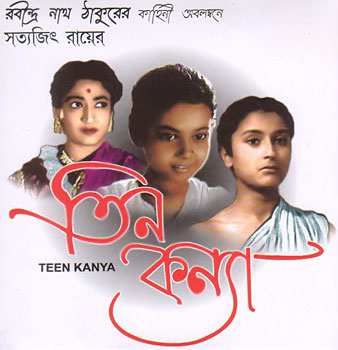
Sunil: So your first film was Teen Kanya (3) .. did you realize at that time that you were working with the great Satyajit Roy?

Teen Kanya, Satyajit Ray - DVD cover
Aparna: Not really. I mean, I knew that he was a big director, but for me, more than anything else, he was a friend of my father. It was a lovely story that I had read recently at that time and I had liked the story very much. I liked being Mrinmoyee.

It was very exciting, but for me it was more like a picnic. I didn't have to go to school, no exams. So it was lot of fun.

Sunil: And going back to school after doing the film, how was it? Had you become famous?

Aparna: School was awful after that. After all the excitement, the routine of the school was terrible and there were people who made fun of me, made little remarks and all that.

I had also missed my exams. I went back to school in time to give exams on 2-3 subjects. I did very well in those subjects. I was very good at English and history. I think that probably I came first in those subjects, but on the whole, I was no where because I had missed on so many subjects. We had a kind of marks reading meeting at the end of the year and when the principle read my marks, she said something like, "Oh, so we are more interested in our acting than in our studies", or something like that, sarcastic, and I was close to tears.

Sunil: You spent part of your childhood in a place called Hazaribag?

Aparna: My grandfather used to live there. He was a Brahmosamaj missionary  and he had a nice interesting, charitable dispensary over there. It was a beautiful house with a garden, very simple and austere, but very beautiful. We used to go there every year during our holidays. For our holidays we always went there to Hazaribag, especially in winters. It was lovely.

Sunil: You have done lot of films. Was there a character you hated doing, which you thought was completely unlike you?

Aparna: Sometimes you had to do films as a mainstream actress where you didn't like it and you were doing it just for the money. I did a film called Abhichar in Bengali, I didn't want to do it, so I asked for a huge sum of money. But they said yes, and so I had to do it. But I didn't like it at all, I hated every minute of that role, it was directed by Biswajeet Chatterjee.

Sunil: Biswajeet the actor, Prasanjeet's father?

Aparna: Yes he directed it.

Sunil: Your mother was cousin of a well known poet ..

Aparna: Yes, Jibananda Das.

Sunil: Did you write poetry too?

Aparna: Not really. I mean I wrote poetry like everyone does in their youth but it was nothing important. Jibananda Das was one of the great poets after Tagore and he was my mother's second cousin. He was also very close to my parents.

Sunil: Did your mother write as well (4)?

Aparna: Yes, she wrote short stories.

Sunil: Did you feel that you were not very successful in Hindi cinema?

Aparna: (smiling) I didn't try very hard, my heart was in Bengal. I always made my Hindi films for the wrong reasons. Like when I had an income tax installment to be paid or needed money for a car ... I never did a Hindi film for the right reason!

Sunil: Thanks Aparna ji.

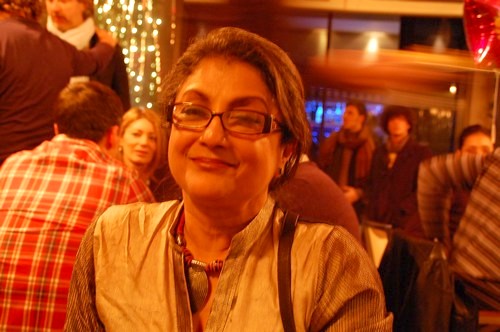
Aparna Sen, Florence Italy, December 2010

PS: Actually I had prepared lot of questions to ask to Aparna Sen, but there was not enough time for a proper discussion. On lot of different things, I would have liked to ask more and understand more. However I was very much aware that in another ten minutes, Onir's new film "I Am" was going to start and we both wanted to see it.

And I was also a little overwhelmed by the idea of being with my teenage crush!

May be there will be another opportunity to meet her and to interview her with more in-depth questions. Inshallah.

Notes:
(1) Battleship Pottemkin and Ivan the terrible were both Russian films directed by Sergei Eisenstein
(2) Passion of Joan the Arc, silent film in French by Carl Theodor Dreyer,1928
(3) Teen Kanya: directed by Satyajit Ray, came out in 1961 when Aparna was 16 years old; the film was based on works by Ravindranath Tagore, it had three stories and Aparna played the role of tomboyish Mrinmoyee in third story, Samapati. On that same story, Samapti by Tagore, Rajshri films had made "Uphaar" in 1971 where the role of Mrinomoyee was played by Jaya Bhaduri.
(4) Aparna's mother was Supriya Dasgupta.

***

Rump steak, anyone?

Raja Sen reviewing 7 Khoon Maaf on Rediff.com writes about Priyanka Chopra:
Eyes well up with hurt, thick lips quiver in pouty indignation, and subtlety is thrown to the hounds as the actress flounders, trapped inside a bewildering character significantly out of her league.. Priyanka tries her best, but is simply not a good enough actress to justify being in a role this nuanced and demanding. It is a fantastic character, one deserving of a Sofia Loren or a Penelope Cruz or a Waheeda Rahman, and try as Ms Chopra might, she never comes close to being convincing. She turns hints into signals, happiness into hysterics, her every movement an act. She looks her best when sternly strutting into a hospital, occasionally gets a line right, and her acting highlight comes with her resigned yet in-control body language as she sees off Annu Kapoor to his car. Yet these are but a few swallows, and she's an actress unworthy of this season.
If I was Priyanka Chopra, and I read a review like this, probably I would look for a hole where I can hide and lick my wounds. And, probably, I won't come out of the hole for along time. Fortunately for her, other film reviewers, though not very happy with the film itself, are not unhappy with her performance. Like Taran Adarsh on Bollywood Hungama who has written:
Always ready to accept challenges in her career [AITRAAZ, YAKEEN, FASHION] and raising the bar with her performances, Priyanka accepts the challenge to portray ages from 21 to 65 in 7 KHOON MAAF. It must've been an arduous task to get the different age-groups right, but she proves her infinite acting potential yet again. Known to be an actress who stays true to every character that she is portraying, Priyanka delivers yet another sparkling, award worthy performance this time. There are several love-making sequences with her husbands and Priyanka has handled those [bold] sequences without inhibitions... Ideally, I would've given a two star rating for this film, but I am going ahead with an extra star for Priyanka Chopra's sterling performance!
Other critics may not be so gushing, but they have liked PC. Here are some more examples of critics' opinions about PC.

Namrata Joshi on her blog on Outlook, writes: "Priyanka, confident but made to age abruptly with bad, patchy makeup... "

Mayank Shekhar on Hindustan Times is happy with her performance, "For Priyanka Chopra, who plays the Anglo-Indian protagonist, this is unquestionably a role of a lifetime. She has you by the eyeballs. So does most of the movie."

Rajeev Masand from IBN is dismissive towards the movie but accepts that PC tries her best, "Priyanka Chopra dives courageously into her role, sacrificing vanity and pride to play Susanna at different ages of her life and in often humiliating conditions."

Appreciating art, like the person you fall in love with, and probably like pretty much else in life, is something unexplicable, irrational. Therefore, even if the whole world including the professors of Pune Film and TV Insitute, give a gold medal to PC for her work in 7 Khoon Maaf, I think Raja Sen has every right to continue to feel that PC was not just good enough in the movie.

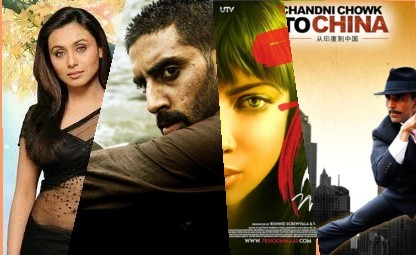
However, it made me reflect about the press coverage all famous actors and directors, sooner or later get and how they deal with it. For example, I remember reading some terrible stories about Rani Mukherjee some years ago. I also remember some of the reviews about Abhishekh Bacchan in Raavan and about Akshay Kumar in Chandni Chowk to China. Actually when they are praising you most, they are also getting ready to pull you down most brutally. Thinking of all the adulation Aamir Khan has received over past few years, I am just waiting to read the kind of bad press he is going to get, the day one of his movie is unsuccessful, how he doesn't understand movie-making, etc.

collage of different films

Everybody knows that movie business is a savage business. The industry forgets you, the day you stop selling. When that happens, film journalists are waiting, ready to pounce on you and sink their teeth in your flesh. The more successful you were, more vicious will be their attacks.

Of course it is not something new. Romans had the colosseum where you had to fight it out with the lions and talibans have public executions where you can take a stone and smash a person's head. All societies have such ways of public fun. We have our actors and directors.

However, I was wondering, how do these actors and directors deal with these kind of stories or reviews? Working in films is considered as glamour, with thousands (or is it millions) of hopefuls dreaming on the sidelines to become famous.  But I think that it must be incredibly stressful.

A big high profile film coming out seems to me like a Board examination. Actually it is worse than that, as there will be different marksheets about the same work. Even if some give you a gold medal, there will be others that will fail you.

How would you deal with it? I can't imagine myself putting in months of hard work and then put myself with my butt in the air, so that critics can do their knife throwing practice on me, carving out rump steaks, if they so desire.

In my office, if I give judgements like this on my colleagues or subordinates, probably I will be hauled before a labour tribunal and told to pay damages. You are suppose to respect human dignity of your fellow workers. Even film critics must be asking for dignified treatment from their bosses and their colleagues, where they work. But all these rules don't apply to public figures and artists, who can be mocked at will, their work can be laughed at.

The more vicious you are in criticising, more people will come to read you. For all the frustrations of our lives, we need to see persons who can be kicked at till they bleed. If they are richer, more famous and more beautiful/handsome than us, the better we feel.

So perhaps the trick is not to take it too personally! That review is not about you. It is about us. Just chill and enjoy your fame while it lasts.

***

Sonali and Roberto story - more details

More than two years ago, in May 2008, I had written an article about the love story of Sonali and Roberto Rossellini. Following the first article, I received many emails from different parts of the world, some of which were from persons who knew other details about the story and shared those details with me. Thus, an updated version of the article was prepared in July 2008.

Over the past two years, my interest in the events linked to Sonali and Roberto story in India during 1956-57 has remained constant and I wish I could write a book on this story from Sonali's point of view. Some months ago, I did write to her daughter to ask if Sonali would agree to meet me, but I have not received any answer.

However, recently I did receive some more information about the days when Sonali and Roberto had come back from India and this post is about that new information.

***

A few months ago, a person shared some letters and other documents of Roberto Rossellini with me and gave me the permission to write about these.

The letters were written in November 1957, around the time when Roberto and Sonali had left India and were living in Paris. It was the time when their daughter Raffaella was born. The handwritten letters written in Italian are addressed to "Aldo and Giuliana", persons probably living in India at that time, who seem to be confidantes and friends with Roberto.

In one letter dated 17 November, Roberto excuses himself for not having written earlier "because he was being followed by journalists and photographers". He also says that he is preparing a return to India in the beginning of December. He mentions some financial problems. At the same time, he is "excited about restarting my life at 51 years".

He awaits anxiously for the arrival of documentary films from India for completing the work. He asks, "what does Jennifer say? .. What does Blitz say? He asks his friends to telephone (Rambir) Haksar to present his (Roberto's) apologies.

In another letter dated 7 December, it seems that Roberto's financial problems are continuing and he writes of selling his car. He seems to worry about gossip, "the truth is that people love to gossip and make things seem more drammatic, even when there is nothing to drammatize..". He mentions lack of news from "our lawyer in Bomaby" and he continues to wait for those "damned documentaries".

He also seems upset about reactions of certain persons "because I have separated from my wife? How does that concern him? ... I believe that people become easily hysterical, without understanding ... I don't think he understood what I had to go through to resolve the questions here."

He mentions a visit to Rome "for the separation from my wife".

Among the other documents that I have received, there are some telegrams from Roberto (in Rome) to hotel Suisse in Delhi. The telegrams mention Rambir Haksar and arrival of Mrs. Selznick (Hollywood actress Jennifer Jones who was married to director David Selznick at that time), who is arriving in India. Roberto asks  in the telegram to make arrangements for her stay in Maidens (hotel in Delhi), avoid publicity and inform Menon so that Jones gets all assitance on her arrival in Bombay airport.

Among the papers, there is also a list of expenses for reimbursement for a total of 910 Indian Rupees, that includes the following items:
7 Rs for taxi on 29th October to film division
6 Rs for taxi for Indira Gandhi on 26 October
20 Rs for taxi to Palam for taking the monkey on 4 November (probably the monkey used in one of the documentaries)

Comments: I think that the expenses for reimbursement covering the period from 22 October to 22 January, relate to the period after Roberto's arrival in India in October 1956, when his love story with Sonali had not yet started or was just starting.

I am not sure about the telegrams concerning Jennifer Jones. Did she play a role in the documentaries made by Roberto in India? Was he planning to make a film with her in India, after completing the documentaries? If so, probably he was underestimating the strength of public scandal in India and didn't imagine that he would have to run away to Euorpe with Sonali? From the letter dated 17 November 1957, it seems that he was still hoping to go back to India in December.

Rambir Haksar, who was assisting Rossellini in India, mentioned in these messages, could be related (?) to P. N. Haksar, who was in foreign service in that period, and later became personal assistant to Ms. Indira Gandhi (?).

Pandit Nehru's daughter Indira, who had married Firoz Gandhi in 1942, had separated from her husband and was living with her father in Teen Murthy during 1956-57. That Prime Minister's daughter travelled in a taxi, is a reflection of those times, when security was not an issue and leaders were closer to the people. Her personal involvement in the supporting Roberto's visit, also reflects on the importance given by the Nehru family to Rossellini visit in India.

The letters do not mention Sonali nor the birth of his daughter in Paris in November 1957. This could be an indication of his relationship with Aldo and Giuliana, who were probably more informed about his business issues than personal issues. His mention of gossip in Blitz, shows that he was concerned about the Indian press. Blitz was among the most active Bombay newspapers of that time, protesting loudly about Roberto and Sonali love story, describing it as an attack on India's morality and asking for Roberto's expulsion from India.

***

When I had found that the famous Bengali actor and director Aparna Sen was coming to River to River film festival in Florence, I had immediately thought that she would know details about the Sonali and Roberto story. She is daughter of Chidanand Dasgupta, who was close friend of Satyajit Ray, and since Sonali's ex-husband, Harisadhan Dasgupta was also colleague and friend of Satyajit Ray, my conclusion was they all must have known each other. In 1956-57 when it had all happened, Aparna must have been 11-12 years old, so I had thought she will remember things from that period.

Aparna did confirm that her father and Harisadhan knew each other. She said that as a child, Raja, Sonali and Harisadhan's elder son, used to come to their house. But she didn't know much else. There hadn't been much discussion about this subject in her family in that period, and Harisadhan's family had been very discreet about the whole issue, so she couldn't say much about it.

You can imagine my disappointment!

***

Reliving teenage dreams in Florence

Even after decades, can we ever forget those first giddy confused times, when our bodies changed, hormones were raging and suddenly we thought that we were in love with some one, and the world seemed stronger, sharper, more colourful?

And then, how does it feel when many years later, suddenly you find yourself sitting in front of one of your old dreams? It happened to me yesterday and I felt confused, stuttering and giddy, as if I had gone back to being sixteen once again.

But let me start from the other things, before telling you about my meeting with my teenage crush.

Yesterday, 8 December was the day of Rahul Bose and Onir's new film, "I am" in River to River film festival in Florence, Italy. River to River is the most important festival of Indian films in Italy since 2001 and is directed by Ms Selvaggia Velo. This year it has an important retrospective of Satyajit Ray's films.

Rahul Bose has five of his films in the festival this time - Split wide open, Every body says I'm fine, Mr. and Mrs. Iyer, I am and The Japanese Wife. I had already seen Every body says I'm fine and Mr. and Mrs. Iyer but still it was good to see them again.

I had not seen Dev Benegal's "Split wide open" and I loved it. It has plenty of scenes that usually create great scandals in Indian media including, plenty of Hindi cuss words, two integral nude scenes of Bose, a steamy sex scene and even a scene where the mumbai mafia don takes out his dick hanging it in Bose's face. So they must have talked a lot about this film when it had come out in 1999. However, I hardly knew anything about it and so had started watching it without too many expectations. If you have not seen it, get hold of a DVD and watch it.

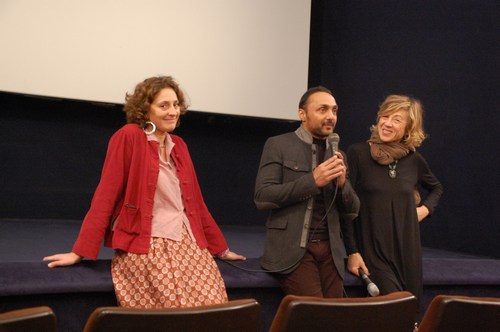
River to River festival 2010, Rahul Bose, Selvaggia Velo

In the picture above, Bose is answering questions by the audience after the film. Next to him are Selvaggia Velo, festival's director and the English/Italian translator (sorry for not asking her name).

I had a conversation with Bose, that focused mainly on his involvement in the NGO called The Foundation, and touched superficially about his films.

Coming out of hall, I ran into Rizwan Siddiqui and Vijay Singh. I had seen Rizwan's short film "Kharboozey" on 7th. Vijay introduced himself and told about his works including a film called Jai Ganga. I need to look for his works and see them. Rizwan lives in Lucknow and Vijay is based in Paris.

River to River festival 2010, Rizwan Siddiqui and Vijay Singh

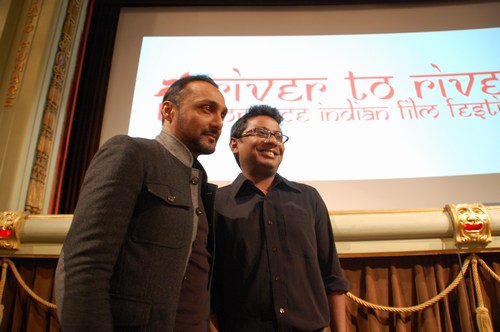
Then it was the time for the Italian premier of Onir's film, "I am". Here are film's director Onir and one of the actors, Rahul Bose.

River to River festival 2010, Rahul Bose, Onir

The film is beautiful and as usual for Onir's films, has beautiful music. Made of four inter-related stories, characters from each story spill off into others, the film touches on some of the sensitive issues including child abuse, homosexuality, artificial insemination and conflict-religion issues. The stories are based on real life incidents. Onir was telling that it will probably release in India in February 2011. Don't miss it.

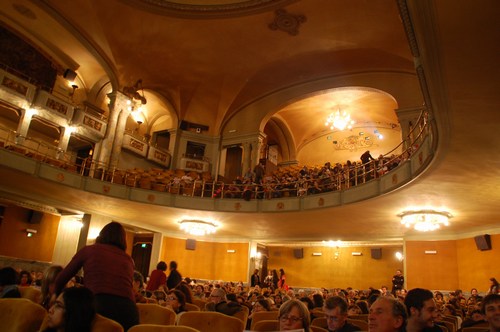
The cinema hall where they are holding the main festival, Odeon, is one of the historical old-style theater of Florence. Yesterday, for "I am" it was full.

River to River festival 2010, cinema Odeon Florence

Now about my coming accross one of my teenage dreams, Ms. Aparna Sen. Her "Iti Mrinalini" opened the festival and her "The Japanese wife" is going to close the festival today evening (9 Dec.).

I had read lot of her interviews and had thought of asking her a lot of questions. But in front of her, I felt confused and forgot half of my prepared questions. I don't remember what she answered and probably I was a very distracted interviewer, asking something, then interrupting her, and all the time sneaking looks at her! Hopefully she is used to men like me and didn't take me for being exceptionally stupid or clumsy.

The evening after talking to her, passed in a daze. Couldn't have asked for more! Thanks Ms. Sen.

River to River festival 2010, Aparna Sen

If you wish, you can see Aparna Sen's Question-answer sessions after Mr. and Mrs Iyer at the festival on Youtube. On the same page, you can also find links to videos of Rahul Bose answering questions.

***

The hero and the villain

I like mystery stories in books and films. When you start with them, you already know that the author/director is going to plant red herrings along the way, and you have to constantly second guess them, and not to get distracted. Finally when you are able to guess the plot and the mystery near the end, or when the author/director manage to surprise you in the end, it can be very satisfying.

In Ravan, director Mani Ratnam behaves in the same way. He makes you think that you are going to watch a certain kind of movie, while showing you a completely different one.

Yes, finally I saw Mani Ratnam’s Ravan. And I loved second guessing his motives while making this movie, and I loved that he managed to surprise me in the end.

The reviews of the film were so harsh, especially about Abhishekh Bacchan. They said things like “he has single handedly destroyed this film”. Some people have even watched both the versions of the film (Tamil and Hindi) and are all praises for Vikram in the Tamil version, and thus, the condemnation for Abhishekh Bacchan seems even harsher.

I am not very fond of the Junior Bacchan. But after reading all those reviews I was left wondering if Abhishekh was so clearly bad in that film, how come the director and the different technicians couldn’t make it out while they were shooting the film or editing it? After watching the film, I feel that Abhishekh was good in the film, not exceptionally great, but good enough for Mani to plant his red herrings and create confusion.

Mani Ratnam's Ravan

For the last few years, I find difficult to sit through most bollywood films. So, after reading all the reviews and comments about Ravan, I had first thought that I will not watch Ravan. Then after some time, I thought about Mani's other film, Yuva. I had loved it and I had loved Abhishekh in it, so I decided that I had to find out for myself, how could both Mani and Abhishekh get it so completely wrong like the reviews seemed to suggest?

I didn’t like the beginning of Ravan. A collage of shots mixing up Beera (Abhishekh) standing on the top of the cliff, the policeman (Vikram) giving the speech in some military academy kind of place and the porcelain beauty (Aishwarya) on the boat getting kidnapped, looked pretentious and tiring. Perhaps Mani sir is too high on pretentious camera angles and confusing techniques, and that is why ordinary viewers have been put off by this film, I had thought.

Yet, within ten minutes I was hooked by the film, and watched it till the end without feeling bored for a moment. I think that it is a clever film with Mani Ratnam playing with the human biases and using them to cheat & confuse the viewers. Very thought provoking. However, may be I can understand, why it may seem off-putting and tiring to most viewers.

The archetypal revenge stories of Bollywood: The basic story of the film is nothing new and has been shown many times on Indian screens in many variations.

The revenge story involving cops has two main versions:

(1) Poor ordinary man and the corrupt cop story: The poor good guy is the hero and corrupt power-mad cop is the villain. The villain kidnaps and rapes the good guy’s sister/wife and the good guy takes up arms for revenge. At the end of the film, the villain is thrashed, jailed or killed.

(2) The honest cop and cruel ganglord story: An honest cop is the good guy. Somehow he manages to irritate the hoodlum. For revenge the hoodlum decides to teach the policeman a lesson and kills his family or kidnaps his wife/sister and rapes her. The honest police officer, goes after the hoodlum and in the end, kills him.

Mani takes these two versions of the story and mixes them up. The film starts as the type 2 story, that is “honest cop versus cruel ganglord” story, with kidnapping of honest cop’s (Vikram) wife (Aishwarya) by the cruel ganglord (Abhishekh). Almost halfway through the film, you realise that perhaps it is type 1 story, a “poor ordinary man and the corrupt power-hungry cop” story. However, Mani continues to create confusion by planting his red herrings.

Mani Ratnam’s question to the viewers seems to be: are you sure that you are supporting the right and the just side or you are letting your inherent human biases guide your feelings for the wrong side? I think that this question is very topical if you think of some issue of contemporary India like big dams, exploitation of tribals, beneficiaries of economic development, etc. It seems that if you have nice names like Vedanta or if you can use nice words like development and "India the new super-power", you can get away with exploitation, destroying the homelands of rural poor and triabls and worse. Mani uses similar techniques – mythology, looks, names to create a hero and a villain, who are not what they seem to be.

Story: On one hand there is a local tribal hoodlum, a kind of Robin hood helping poor oppressed tribal villagers. Other tribals, poor and uneducated people say good things about him (“He is like water, transparent”). He is secure in his world, not worrying about the new police officer appointed to his district and is busy in his siter’s wedding, whom he loves because “she is the independent kind, the kind who stands up to him”. He is probably a small time local crook, as there are no armed guards protecting him.

On the other hand, you have an ambitious police officer, appointed to a district, who decides to shot at the unarmed local hoodlum-Robinhood, while he is busy with kanyadaan of his sister. It is a little strange that hoodlum is loved by locals, yet police can come to his village, to his sisters' marriage and yet he and his men are completely unaware about it. This also points to his being a small local fish. Police officer's brother and other policemen, take the bride to the police station and rape her. The smart police officer, must have been aware of that? He has a nice looking wife, and when she is kidnapped by the men of the hoodlum, he goes after the tribal gang, refusing any comprise, killing as many as he can.

Treatment: Mani Ratnam takes the ordinary man versus corrupt power-hungry cop story except that he doesn't explain much about the motives of the cop and uses all the tricks to confound the viewers, so that cop is treated like a hero and the poor man like a villain.

Tribals in the film are not the cute bum-shaking, singing villagers of Bollywood, they have mud, ash or yellow paste of haldi streaked on their faces. Their clothes have black streaks, their eyes are circled with black, to make you think of devil or Shiva’s Yam-doots. Beera is made to look repulsive. He even mentions that he has ten heads like the demon king Ravan. He also has a habit of changing his expressions, and usually ends up with a crazy glint in his eyes. Just in case you didn’t get it, his hands move on his head like wings of a fluttering bird, making you feel that he is mentally unstable.

Mani Ratnam's Ravan

The other guy (Vikram) is macho, good looking, educated, apparently in love with his beautiful wife, a regular city guy, a hero material. His wife is cute, does lovely dances, surrounded by small children. His name is Dev, and there are different indications that he is like Ram from Ramayana. His relationship with his younger brother (Nikhil Diwedi) reminds you of Ram-Lakshman relationship. If you still had any doubts, there is Sanjeevani (Govinda), the forest guard who makes you think of Hanuman from the way he climbs on the top of roof-tops and swings from one tree to another.

When the film starts and you feel that it is story number two, the honest Ram like policeman fighting for his honour, fighting the cruel uneducated tribal bad man to save his beloved wife. As the film moves, the lines between good and bad are constantly blurred and only when the Jamuna (Priyamani) story comes out, some doubt creeps in and you start thinking that perhaps the cops are not the good side in this film.

Even then Mani Ratnam does not make it easy for you. Events unfold in such a way that every time you can feel a twinge of sympathy for the poor Beera, the director makes sure that you feel a little repulsed about him, by playing with the prejudices of urban film goers about rural unkempt, mentally ill, black and ugly uneducated persons. He plays dirty by highlighting everything that can look bad for Beera.

It is only at the end that you understand the way the policeman manipulates everything cold bloodedly, uses even his wife and her emotions, to get his own way. He does not hesitate from trapping and killing Beera, even while he knows that Beera has been good to his wife and has even spared/saved his own life. May be in the background you have some mining company or some other big company, who want the tribal boy out of the way, but Mani does not tell you about it.

I think that Abhishekh is brilliant and courageous for accepting to come out so strongly in being repulsive and crazy. Actually I liked everyone in the film, except may be for Aishwarya Rai. She does try hard enough, but she does not create electricty with Abhishekh, their vibes are not hot. I would have preferred someone more earthy and intense like Rani Mukherjee, the way she had portrayed Sashi in Yuva. Or Nandita Das or Konkana Sen. Aishwarya looks beautiful, but she vibes better with Vikram, like in the dancing song, “Khili re”. And she doesn’t fit with the wild jungle and thumping waterfall (photographed beautifully).

Mani Ratnam's Ravan

The week points about characterization of Beera (Abhishekh) are his hands, his legs, his teeth. His fingers seem too well kept, clean and manicured, and his teeth too white for being the tribal ganglord. I also felt that Mani went a little overboard in asking for his repulsive makeup. Like, in the dance “Thok de killi” with blacks streaking his clothes and around his eyes, looked too theatrical and obvious.

Some parts of the film, like the whole sequence at the end, with Ragini (Aishwarya) getting down from the train, coming to look for Beera, their meeting at the cliff top and their getting surrounded by police, seem very implausible. What kind of villain is this? He comes without a gun, does not even know that hundreds of policemen are following the woman in his jungle? But looking for that kind of logic does not help to appreciate the film. In any case, I think that the film was not about logic or believability of the story, but about archetypes of good and bad in Indian unconsciousness, and using them to raise questions about our inner prejudices.

I feel that with this film, Mani Ratnam throws a challenge at the viewers, that he will turn upside down your ideas about the hero and villain, he won’t let you identify with the hero, and then he seems to ask, tell me does it make you uneasy? Going by the general response to the film, it seems film goers have taken him on his words.

Think of Yuva, by no stretch of imagination, you can call Lallan a good person, yet in Yuva you can understand his compulsions and even identify with him. In Ravan, Beera is a much better character compared to Lallan, yet Mani does not let you feel any empathy for him. That required courage or may be it was foolishness? In my opinion, he does merit an accolade for making such a thought provoking film about how we make assumptions on superficial grounds about people and classify them as good or bad.

I don’t think that the Ram or Ravan of the film are in any way about Ram or Ravan of Ramayana. But rather, film uses ideas about Ram and Ravan to create confusion in our minds, to make it more difficult for us to decide who is good and who is bad. Yet, if I think of the scene where Nikhil Diwedi pulls at Priyamani’s nose at the wedding mandap and then she is gang raped by the policemen, it creats some unease in my mind. Is Ramayan also talking about something more sinister when it says Lakshman cut Surpanakha’s nose, I ask myself. Or may be I am reading too much in what Mani Ratnam wanted to say and provoke with Ravan?

Kurbaan and the Muslim Reality

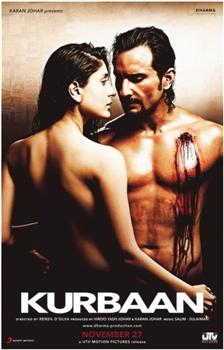
I was determined to see at least one Hindi film in a proper cinema hall. The last film I had seen at a cinema hall was Jodha Akbar. In Italy, where I live, Bollywood films are not released and I have to wait to come to India to see them in a cinema hall. Last week I was in Bangalore for work and one evening, after the work finished, I walked into the theater and I saw Kurbaan.

Even though I had read in some newspaper that this film has flopped, at least that particular day when I went to see it, the hall in Forum mall of Bangalore, was quite full. Perhaps it was a hit in Bangalore?


Film: Given a chance, I wouldn’t like to see Kurbaan again, even though it did have lot of plus points, especially in terms of acting from the main actors. I liked all of them, especially Kareena Kapoor. She looks good and is great overall, even more in the emotional scenes. Saif, Vivek and veterans like Om Puri and Kirron Kher, all give credible performances.

The plot of the film is tight, it is fast-paced, so the time does run very quickly. The music and the background score are lovely. "Shukran allah" song is my faviourite. Cinematography is wonderful and shots of the explosions and shootings are done like in Hollywood films.

I had read about some debate about the explicit sexual scenes between Saif and Kareena, and indeed there is one such sequence. I think that it is great that Kareena had the strength to do this scene, since in India, all things related to sexuality are usually shrouded in hypocracy. With a clever use of “Rasiya” song in the background, the scene communicates an underlying sense of danger and pathos, even while stretching the limits of sexual moments shown in Indian films.

At the end of the film, from so many scenes, the images of Kareena remain with me. Like the closing image of the film with the unshed tears in her eyes!

Loops in screenplay: Yet there were times, that I felt like laughing in the film, because of its screenplay - it was all a bit childish and unbelievable. Like the reporter deciding to become a part of the terrorist group or the way American policemen were so easily outsmarted by a lone terrorist or the way FBI is shown  as clueless, running in circles.

After watching scores of Hollywood dramas about the global reach of American secret services, it does seem different to see them as bumbling idiots. The terrorist can run away from scenes of shootings, even with a bullet in his chest, without the police being able to do anything. May be, as a sign of Indo-American friendship, we can send some sniffer dogs from India to the New York Police department.

Avantika (Kareen Kapoor), the Hindu ladylove of the terrorist, wakes up night to call the reporter, but when she goes to a supermarket with her Appa, why she can’t stop a policeman or a security service person to say that the lady accompanying her is her jailor? And when the old lady is whisked away, she can run to the reporter to cry and plead to him for saving her, but can’t just walk away? Or, even when she knows that men are carrying bombs (while she is unaware that her own bag has one bomb), why can’t she talk to persons in the train or security at train station? If at least they had shown that Appa was carrying a gun and had threatened to kill her, her silence could have looked more believable (Appa does carry a gun but Avantika does not know about it).


So while the film looks and sounds good, if you think about the story, it does seem full of loopholes and not very credible.

Film’s message about Muslims: I had read in some reviews that the film tries to be neutral and explain both the sides, and the reasons of anger among Muslims. However, I found the film’s depiction of Muslims a bit problematic. I felt that the film explains the apparent reasons given by fundamentalists to justify themselves, but it ignores the point of view of the silent majority of Muslims.

Almost all Muslims in the film are shown to be sympathatic towards terrorism and justify it by the American and European greed and barbarism. The only “good” Muslim in the film is the reporter Riyaaz Masud (Vivek Oberoi) along with his girl friend, but even he can’t articulate himself when his father talks about the superiority of religion. His fight seems more motivated by feelings of personal revenge because of death of his lady love in a bomb explosion, rather than from his beliefs.

Reporter’s father (Kulbhushan Kharbanda) clarifies that “for Muslims religion comes first” and the terrorist mastermind (Om Puri) says, “No American is ready to sacrifice himself for his God, as Muslims can do”.

It is true that the Muslim characters shown in the film are limited and the film does not really show the views of other Muslims, who do not believe in terrorism. But, in my opinion, it would have helped to show some Muslims who could articulate that religion is not more important than their country and that no matter what, killing innocents can’t be ever justifed.

Thus the film is a story of a few persons, and can’t be generalised to all Muslims. But at the same time, the film’s take-home message seems to be: you can’t really rely on Muslims. Here some examples of how this message is given in the film:

One of the women in the house is murdered at home and her body is still lying in the basement. Her husband complains about the bad smell, but other ladies in the house can’t smell it and go on with their daily khanas and teas. The message is that Muslim women are all afraid and submissive or die-hard fanatics themselves.

There is a university professor, who helps to get a job as a university professor to a Pakistani terrorist in St. Stephen’s college in Delhi. This same kindly looking professor, who likes to spend hours playing chess in the teachers’ room in the college, happily goes to guard an old man in his house to help the terrorists and smiling threatens to “take care of him”. The message is that even cultured and peaceful persons, are in reality hidden terrorists.

And the Pakistani terrorist, is himself talking about the peace messages in holy Kuraan and about promoting a dialogue among university students about Islam. At the same time, he happily shoots American Policemen and unarmed civilians in his free time. He doesn’t feel pain and can stitch the wound on his chest without fainting. But The brutal assassin has a saving grace, in spite of himself, he is in love with his Hindu wife and in the end, he forgets his bombing mission and kurbaans (sacrifices) himself for his love.

There is the elderly woman (Kiran Kher), wife of the terrorist mastermind. She does not have any qualms in putting a gun on the head of pregnant woman who calls her Appa (elder sister) and who has been living in her care for some days, because “no one is really innocent” and “it is all justified by the American bombings in Afghanistan and Iraq”. Why couldn’t she carry the purse with the bomb herself, you may ask, it would have achieved the same end, without risking to have it on a person who is likely to run if she gets a chance?

When the film finished, I felt that its over-riding message was that no Muslim can be really against terrorism, that you can’t even believe those Muslims who talk about peace and against terrorism. It is great pity that the film gives such a message.

The unrepresented Muslim: On yesterday’s International Herald Tribune, there was an article of Tariq Ahmed, a doctor of Pakistani origin, working in Brigham (USA) titled “The price of being born a Muslim”, where he has written:

The reality is that the vast majority of Muslims are secular. We do not pray five times a day, do not read Koran and have not spent much time inside a mosque. We only turn to Islam when a child is born, someone gets married or someone dies. ... We certainly have no interest in participating in civilizational battles. We are in fact loathed by religious minority. And yet we have no clear voice, no representation and no one in the Western world appears to be aware of our existence. Every time a terrorist attack occurs, we suffer the most.
I feel that there is need to represent these persons in film and to help express their point of view.

For majority of people in the world, it does not matter if they are Hindus, Christians, Jews or Muslims, religions and religious books are important in certain moments of their lives, but their lives are not limited by what these books say or do not say. They do not follow everything said by those who claim to be their religious leaders. Kurbaan does not say much on behalf of these persons.

Bollywood has arrived in Italy

These days there is a Bollywood wave in Italy after a series of Hindi films were shown on Italian national TV channel on prime time.

Compared to some of other western European countries like UK, France, Germany or Netherlands, Italy has a limited population of Indians and perhaps for this reason, Bollywood films were almost unknown in Italy till recently. There were persons who liked Bollywood and who watched Hindi films with English sub-titles but their numbers were extremely limited. On the other hand, there have always been some persons interested in world cinema, the kind of persons who go to film festivals and many of these persons were aware of the realistic films that usually make it to film festivals but they were not into the usual masala films of Bollywood.

During the past twenty years, I am only aware of two occasions when Indian films made it to the Italian TV and in both instances these films were broadcasted late in the night – one was Kagaaz ke phool by Gurudutt and the second was Lagaan by Ashutosh Gowarikar.

Italy doesn’t have a culture of subtitled films and all films must be dubbed into Italian. Many years ago a dubbed version of Deewar was released in Italy but it didn’t find any audience. More recently Lagaan, Mission Kashmir and Sawaariya were released in dubbed versions but none of them made it to any cinema halls and were only released on DVDs.

Perhaps the change came with the films made by expatriate Indian film directors like Mira Nayar, Deepa Mehta and Gurvinder Chadha. Mira nayar’s Salaam Bombay and more recently, Monsoon Wedding & The Namesake, Deepa Mehta’s Water and Gurvinder Chadha’s East is East and Bend it like Backham, all had theater releases, DVDs and TV broadcasts.

Then in the TV “dead-season” in summer 2008 the national channel RAI had shown 3 Hindi films (“Cheeni Kum”, “Hum Tum” and “Aur ho gaya na”). In summer, Italians go on holidays and TV viewership goes down and that is the time when usually old reruns of TV serials and films are shown. In 2008, there was some awareness of Bollywood first created. Then in 2009, this experiment was repeated and it started in July with “Namastey London”. The waves this year have been much bigger since the film topped the viewership ratings of the Saturday primetime.

Since then, on successive Saturdays, it has been Bollywood time on RAI and each time it tops the viewership ratings. Thus the series that was supposed to stop at end of July was extended to mid-August and now it seems it will go on till end of August. The other films shown so far in this season include – Fanaa, Salaam Namastey, Jab We Met, Laaga Chunri Mein Daag and Mujhse Dosti Karoge. Next saturday will be the turn of Dil Ka Rishta.

Suddenly people want to know about Hrithik Roshan, Saif Ali Khan, Rani Mukherjee, Preity Zinta and Kajol. My Italian blog Awaragi, where occasionally I wrote about Bollywood films, used to get about 10-15 hits a day and now on Sundays after the the Bollywood nights, the number of hits reach upto 700-800. Suddenly as an "expert" on Bollywood I am in demand with people writing in to ask about meanings of the words of the songs or other things related to Bollywood.

The Hindi films shown on RAI are reduced versions from which most of the songs and some scenes are removed. They last around 1 hour and 40 minutes so that with the ad-breaks they finish in 2 hours. For example in Salaam Namastey, the whole Javed Jaffery track and parts of the final hospital scene were removed, along with the songs. Unfortunately, even those background songs that are left in the film, are without subtitles so people write to ask for meanings. Initially, especially in 2008, the dubbing was strange with persons using sing-song voices, sounding caricatures of Indians like Peter Sellers in The Party, but that has improved considerably. All these films are mainly romantic films and perhaps for that reason, majority of feedback I have received is from women.

I think that this opens up a new market for Hindi films in Italy, especially in terms of DVDs. Right now, no Hindi film has proper Italian subtitles – most Italian subtitles in Hindi DVDs seem to be done with automatic translation software that often butchers the meanings. Italy is flooded with low quality pirated Hindi DVDs aimed at Indian, Bangladeshi and Pakistani emigrants. People write to me asking for Bollywood films dubbed into Italian or with proper Italian subtitles, but I don’t have any clue about what to advice to give to them.

I hope that Indian film-makers and international distributors can read it and take necessary steps to safeguard the interests of the Indian film industry.

Films at Bologna HRN Film Festival 2009


This year I am president of the jury judging the short films at the festival, plus I must go to work during the day, so that leaves little time for doing much else. Still I am trying to catch as many films as I can. Here are some comments about the films I have seen this time:
I bring with me what I love (director Chai Vasarhelyi, USA 2008, 80 min.): I loved this film about the Senegalese song writer, composer and singer Youssou N’Dour. The film chronicles his search to express his sufi Muslim faith through his music and his encounter with the the more fundamentalist positions in the Muslim world that see music as against Islam and feels that as a pop singer, Youssou N’Dour doesn’t have the right to sing about Senegalese sufi saint and freedom fighter Bamba and Islam.

94% of the population in Senegal is Muslim but they follow a sufi version of the religion characterized by tolerance and openness. Senegalese women do not cover themselves with black veil.
The film shows Youssou N’Dour’s journey from his Griot (traditional storyteller-singers) family background, his early attempts to sing in Gambia, his slow success and international fame and finally in 2000, his desire to express his sufi spiritual feelings through music in collaboration with a group of Egyptian musicians, that culminates in a music album called “Egypt”.
While in Senegal, “Egypt” is rejected outright without anyone ready to listen to it as religious “leaders” have expressed against it, he takes it abroad in his music tour. In Ireland, as the Egyptian musicians refuse to play till alcohol is removed from the tables, Youssou N’Dour says with a smile, “For me it doesn’t make a difference that there was alcohol, I would have sang all the same.”
He tries to take his music to Touba, to the shrine of saint Bamba but rumours of his show having nude dancing girls, creates riots and he is forced to withdraw. Still Youssou N’Dour refuses to give up. As his album receives the Grammy award, finally he finds acceptance for his music in Senegal.
The film offers a rare glimpse into Youssou N’Dour the person and has added bonus of listening to his music from different famous albums that are considered as part of the music history.
Reel Bad Arabs (director Sut Jhally, USA 2006, 50 minutes): The film based on a book of the same name by Dr Jack Sheehan takes a systematic look at Hollywood movies since the silent film era in early twentieth century right to our days, to see how American and European cinema have used particular caricatures and stereotypes of Arabs, Muslims and Palestinians over the years. These stereotypes show Arabs as rich, stupid, vicious, cruel, unethical and unsocial starting from the Disney cartoons right down to serious and pulp cinema.

While similar stereotypes were used in the past about Jews and Blacks, these have been overcome over the previous decades while Arab stereotypes continue and have been enlarged to include the ruthless terrorist stereotype. Thus while Arab women were and are mostly shown as black burqa covered submissive kinds, a ruthless terrorist Arab women figure has been added to this repertoire.
The film ends with a hopeful note citing films like Syriana and new young film-makers who are looking at the middle-eastern world with more open eyes and less prejudices.
The film is interesting in terms of its message and the examples it shows from different films. At the same time, it feels a bit monotonous and boring after some time, since all the film is made of Dr Sheehan speaking about the subject, interspersed with movie clips. Having some voice overs, having other persons say something, getting reactions of persons linked with films, especially persons from Middle east, would have made it more alive. Sheehan is good in explaining but there is too much of him, which in the end detracts from the film’s message.
Russia 88 (director Pavel Bardin, Russia 2008, 104 minutes): The film is a fictionalised account of a Moscow based Russian extreme right skinhead gang called Russia 88. Film’s hero is Sasha (Blade for his gang members, played very well by Pyotr Fyodorov) leader of the gang and the film is seen through the eyes of a half Jew boy, Abraham (Mikhail Polyakov), who longs to be accepted as a true-blooded Russian by the group but is not hard and tough enough.

Abraham is shooting a video to explain the gang’s philosophy and ideas for putting them on Youtube. Slowly the gang members get used to having him around with his camera and thus become unself-conscious in front of the camera and explain why they feel and act the way they do. Gang has a woman, Marta (Marina Orel), Sasha’s girl friend.
The film has used authentic right wing clothes, songs, etc. to present their world, as the gang plans to throw out all emigrants from Moscow, as they participate in army-camps, to aim for a “Russia for Russians” as the foreigners are “hungry and angry, ready to take away their jobs”. The main target of their anger is market where most of the shops are by emigrants. There are conservative party persons who believe in similar philosophy and want to use the gang for their political aims, but Sasha believes that they can get a better deal and is not willing to sell his services cheaply.
Tragedy  comes in the shape of Robert (Kazbek Kibizov), a Tajiki emigrant with whom Sasha’s sister Julia (Vera Strokova) is in love, leading to the death of Kliment (Archibald Archibaldovic), the ideologue of the gang. As Sasha grapples with revenge, the group scatters.
The film is an interesting view into the world of extremist right wing groups and is accompanied by good acting from the main actors. The only aspect that seemed weak to me was the depiction of mindless violence and hate usually surrounding such groups, so in the end, you don’t really feel afraid of Sasha and his gang members and you feel sympathy of his dilemma.
Film’s official website says that they are not fascists, but I feel that film has been made in a way that creates sympathy and understanding for the cause of right wing conservatives. Their concerns and fear seem understandable, while their victims, specially the emigrants, except for Robert, seem like shadowy figures, not real persons.
Waltz with Bashir (director Ari Folman, France-Germany-Israel 2008, 87 minutes): The Golden Globe award winning film does not need introduction. The film is about persons who had participated in a war twenty years ago and their nightmares. As layer after layer of memories is peeled away, the horror of the war time memory comes out.
In 1982, Israel had helped Christian militia leader Bashir Gemayel to become president of Lebanon. On his assassination, Israeli soldiers had arranged for angry Lebanese Christian militia men to kill civilians, including women and children, in the Palestinian refugee camps of Sabra and Shatilla near Beirut, in which about 3000 persons were killed.

The film is stunning in its visual imagery and merciless in showing the human cruelty. You can find more about the film at its official website.
On one hand, it made me rethink about the killings of Sikhs in Delhi after the assassination of Indian prime minister, Indira Gandhi. It also made me think of the reports in the press about the recent Israeli attack on Gaza strip, during which it seems that Israeli soldiers were given the “freedom” to shoot on all “targets”, including women, children doctors, sick persons, and destroy hospitals, houses, schools while newer chemical weapons were tested.
Jihad for Love (director Parvez Sharma, USA-UK-Germany-France-Australia 2007, 81 minutes): The film was presented at the gender-bender festival of Bologna last year but I had missed it at that time, so I was happy to have this opportunity to see it.
The film explores the conflicts and contradictions when  you try to bring together the issue of homosexuality with that of Islam. By presenting the stories of Muslim men and women from countries like India, Egypt, South Africa, Turkey, Pakistan, Morocco, etc., the film looks at the different facets of the issues people face.
The South African story is about a gay Imam (Muhsen Hendricks), as he talks on radio to explain his situation and struggles to keep his role as Imam and his relationship with his two daughters. A learned Maulana answers his quest with cold logic, “The only answer is death, while there is some disagreement about the way the person can be killed.” His daughter half-jokingly says, “Papa, if they kill you by throwing stones, I hope you will die with the first stone and not suffer.”
A group of Iranian friends exiled in Turkey wait for the UN High Commission for Refugees to decide if they will get political refugee status, while they miss their homes, friends and families. The Egyptian young man Mazen exiled in France misses his mother too and breaks down as he talks about his rape in the Egyptian prison.

The young man Ahsan from North India also wants to find answers from a learned man of the religion, “What can I do, I was born in Muslim caste, I have to follow my faith”, he says. The answer he gets is to read holy Koran, it will take away all wrong thoughts from your mind. When he persists, he is asked to consult a psychologist and get treatment for his “sickness”.
The young women (Maha and Maryam) in Cairo, hold each others’ hand. One of them is filled with guilt. It is wrong to feel like this, it is against our religion, she sobs. The other one reads an Islamic text to her and tries to consol her, “See it says if there is no penetration, it is not a serious sin.”

The only happy couple in the film is in Turkey, where the two women (Ferda and Keymet) joke outside the mosque and kiss each other.
I was surprised by this continuous struggle of Muslim men and women of trying to find some way to reconcile their sexuality with their holy book, shown in this film. Are there Muslim gays and lesbians, especially young men and women growing up in the west, who don’t feel guilty because Koran forbids it and can live in peace with themselves?
I don't think that any religion in the world really accepts homosexuality. Still persons from different faiths, Hindus, Christians, Jews have raised their voices to speak about their human rights. Among the gay persons I have known, I had never met someone who was struggling so much with his/her own sense of religious guilt and shame in the way shown in the film. Probably some young Catholic gays face something similar.
Hindus have some mythological stories that talk of male gods taking a female form or the figure of Shiva seen as Ardhnarishwar (half man and half woman) that can be constructed as religious sanction for homosexuality. In any case, Hindus are not bound by any one single religious text. Christians are bound by Bible but at least in Europe, the idea of following something because "it is written in Bible" wouldn't be acceptable to most young persons. So to find young Muslims in this film feeling that way about their holy book surprised me a little.
To me it seems obvious that if our religion does not abide by the notions of human rights, we should fight to change them. Religious books were written centuries ago, how could they understand the issues of today and give answer for every thing?
The film made me reflect on on other issues as well, like how can Muslims change such laws that relate to homosexuality, to women’s education, to women’s dress codes, etc. if they can not question the views written in their holy book? I feel that Muslims themselves, especially those who are struggling with such issues can propose answers to these dilemmas, though they are going to have a long and tough path in front of them.
Parvez Sharma is a strange name, as it brings together a Muslim name with a Brahmin surname, and I am a little curious to know the story behind it. Perhaps he is related to the well known Hindi writer with a similar sounding name, Nasira Sharma?
In any case, it requires huge courage to make a film like this. About 50% of the persons in the film never show their faces, that makes you understand the risks in raising such uncomfortable questions. Parvez's blog shows how he is still being threatened by persons, who don’t share his views. Such persons have even started hate groups on Facebook. I hope there would many more who would start groups to support the issues he is raising.