Showing posts with label Development. Show all posts

How to become a fighter?

I was in Bidar district in north Karnataka (India), to evaluate the disability programme of ORBIT an organisation working for different groups of marginalized persons and watershed management. I went around the villages to meet the self-help groups of disabled persons.

Faint echoes of the anti-corruption campaign launched by Anna Hazare reached us, while I had my personal encounter with the small level corruption that permeates the life in India. It was difficult to find someone completely blameless in the corruption cycle. Is corruption justified if you are so poor that you can't have a life of dignity?

The Indian law asks for 3 percent of Panchayat budget to be reserved for persons with disabilities and persons with certified disabilities have right to receive pension, based on the degree of disablement.

"Persons in the Panchayat want bribe for giving any funds from the 3% reserved budget", "to get disability certificate you have to pay bribes", "to get disability pension they ask for bribes", were the frequent refrains. But persons asking for bribes were not just petty officials who rule the village lives. They were also village rehabilitation workers, persons who also had disability and who knew the challenges faced by other disabled persons in those villages.

And the poor disabled persons in the villages, if they could, were some times happy to manipulate and tell lies, so they could get additional benefits. How do you eliminate this corruption that does not spare anyone?

"But you are not few, if you all unite and ask for your rights, can't you fight this corruption?", I asked to one group headed by a small woman with sandalwood marks on her forehead, whose son was disabled.

"Alone we can't do any thing. We are weak and we need your help", she said and other persons in her group nodded in agreement.

Yet there were persons like Hashmat Bi, an elderly woman heading a group in another village. A childless first wife who also had disabilities due to leprosy, she had an infectious laugh. "I always fight, till they give up", she said simply, a natural leader. The bus drivers didn't want her and other disabled persons in their buses, but she fought till they gave in. Panchayat and district officers, in the end everyone gave in to her determined fights. In their group, everyone gets pension and she has used the Panchayat funds for starting different schemes in their village.

Hasmat bi, Bidar district, India

How can you make people become fighters for their rights like Hashmat Bi?

***

Rahul Bose - Florence Interviews (2)

Rahul Bose, 43 years old, is known for his subtle and understated roles in many films such as Mr. and Mrs. Iyer, The Japanese Wife, Shourya, etc. He had directed "Everybody says I am fine" and is supposed to direct, "Moth smoke" (based on a book by Mohsin Ahmed). He has also played in the Indian national Rugby team for many years.

Rahul Bose, actor and director from India
I had the opportunity to meet and interview Bose during the River to River film festival in Florence (Italy) in December 2010. In the festival there was four of his films - Split wide open, Every body says I'm fine, The Japanese wife and I am. I had spoken to him before "I am" was shown in the festival.

Here is a transcript of my talk with him, that focused mainly on his work with voluntary organisations and only briefly touched some issues related to his films.
***

Sunil: I am curious about your role in Onir's "I Am". I know the screen play of "I am" because I did the Italian subtitles of of that film. It has four stories - Afie, Megha, Abhimanyu and Omar. In which of these four stories you play a role?

Rahul: I am in "Omar" but I am not Omar, I have the other guy's role.

Sunil: Can you say something about this role?

Rahul: This part deals with homosexuality, related to the judgement on the abolition of section 377, which decriminalized homosexuality in India. My part of the film looks at that. It looks at life before the judgement and after the judgement. It is about the discrimination and terror inflicted on homosexuals.

Sunil: This is not your first time with Onir, you were also there in "Bas ek pal"?

Rahul: No, this is my first time with Onir.

Sunil: I read your article in Tehalka magazine a few months ago, about raising funds through an auction. Then I also read about some work that you did in leading a group of non-governmental organisations (NGOs) in Bombay.

Rahul: That was the "group of groups". We had formed it after the tragedy of 26/11 so that we could get together and speak with one voice to the Government. There were a lot of groups that were speaking at that time, but we were all speaking with different voices. So our attempt was to get everyone together. We had worked very hard and in the end we had 52 groups under one umbrella. But like all things, the work needed to keep something like this going on, is so tremendous that after about 6 months, it fell apart.

Sunil: What kind of things this group was trying to achieve?

Rahul: So many issues linked to 26/11, like asking for police reforms ..

Sunil: In the sense of the outcry that happened after 26/11?

Rahul: Yes, but we wanted to give it a more secular and tempered response, by looking ahead and not reacting in a knee-jerk manner by blaming people and other nations unnecessarily. So it's aim was to try to speak in one voice and to speak in a temperate reasonable voice as citizens of a city that wants to say things to the Government ..

Sunil: But the kind of things that are allowed to happen in Bombay, they are so negative, and where Government does not step in, it does not do anything to stop those groups .. so what can you expect from that kind of Government?

Rahul: Whatever the Governments do or don't do in Maharashtra, it is important that they are made aware that there is an active citizenry that is watching, controlling and is going to speak about it. Just doing that is important. I am not saying that it made a big difference, but our idea was to tell them that we are here, we are listening and watching, and that we are angry. We want good governance.

We don't need 26/11 to ask for better governance. The city has had a very patchy record of good governance. Politically it is a hot bed.

Sunil: Tell me about your foundation.

Rahul: My foundation is called "The Foundation". I was raising money for this foundation through India's first sports' auction. We had 25 pieces from 25 Indian world champions, and we raised money for the foundation.

Sunil: What does the Foundation do?

Rahul: It has two initiatives - REACH and HEAL.

REACH is about restoring equality though education for advancement of children. We have given scholarships to 6 children in Andaman and Nicobar islands, to study at the Rishi Valley school outside Bangalore. The idea is to empower children, who otherwise would never leave their communities. They are getting education at a world class institution, so that they can one day get into mainstream of India's economic life and hopefully they will also take their learnings to their communities, or they can go anywhere in the world. But we never see anyone from Andaman Nicobar in any jobs in mainland India. So it is my wish that these children will become a bridge between people.

But there are different ways to do it and there are different questions. One way could be to build world class schools in Andaman and Nicobar, but then that won't really bring those children out of Andaman to go to the rest of India and become part of mainstream economic life.

Now we are looking at supporting children from another part of the country that is also disfranchised, we want to send children from there to world class schools. The schools have to be chosen carefully and the entire thing takes almost a year to be organised.

The other initiative is HEAL - help eradicate abuse through learning. It is about sexual abuse of children. 53% of all Indian children have some kind of sexual abuse.

Sunil: What kind of data you looked up on this issue? It sounds huge, like almost every second person in India is sexually abused?

Rahul: It is a police data, and it is absolutely shocking. Like most other countries, these are hidden statistics.

Sunil: How long you have been involved in the NGO work? How did it start?

Rahul: I have been involved in it since 2002, after the Gujarat riots. At that time, I began to work with a gender based NGO in Mumbai called Aksharma that worked together with Muslim girls and some Hindu girls, mainly dalits. The idea was to educate them with values of secularism and to empower them slowly, slowly expand their social orthodoxies so that they could attain some kind of status in their communities.

Sunil: This kind of involvement in different issues, has it changed the way you look at those issues, between 8 years ago when you started and today?

Rahul Bose - actor from India
Rahul: Yes, completely. I went into it with good intentions but with little knowledge. As you start to understand how social orthodoxies work, you start to respect the need to change things very slowly without antagonising the other side. For example, you don't want to antagonise the men in a girl's family. She has to go back and live with them, so it has to be done in a way that creates consensus, slowly. There can't be gender equality without men.

One learns, especially in India, that there are complex problems within the problems. It could be income, it can be health. You suddenly realize that the woman can't go out of the house because she is not well, she does not get right kind of food. India is a deeply humbling place, you think that you know things, but you don't. You start appreciating that to bring about any change, you need a long long time and it is never permanent, you always have to go back and look.

Sunil: The children you are supporting in Andman and Nicobar, they come from indigenous families?

Rahul: No, only one of them is half tribal. Out of 550,000 persons in Andmans and Nicobar, only about 35,000 are tribal and so there are about 8,000 tribal children. Rest of the persons came there in different waves of migration. All the children that we support come from modest socio-economic backgrounds.

Sunil: I am asking so many questions about your NGO work, because I work in a NGO too, an organisation that deals with persons affected with leprosy and disabled persons. I just came back from Guwahati, two days ago.

Rahul: I became familiar with Andamans after the tsunami. I made 23 trips there over a period of two and a half years, to organise relief and rehabilitation. I was representing a network of organisations called the Solidarity Initiative. We managed to do a few concrete things on the ground and it was satisfying.

Sunil: So many issues you are talking about and specifically in terms of secularism, how did you get there? What made you think about these issues in these terms?

Rahul: I think that part of it is do with the way I grew up. My family, the city, the milieu .. Bombay, where I grew up .. my friends - like I never asked why Nasir was Muslim, Vinay was a U.P. Brahmin, Cyrus was a Parsi. They were and remain my childhood friends. At that time, in our upscale economic circle, religion didn't play an important role. But it changed in 1992, when there was popular religious resurgence from all sides ..

Sunil: After the Babri Masjid thing?

Rahul: Not just that, it happened on all sides. Today we also have Christian fundamentalism, we have Hindu terror. You can see that today terror is polarised along religious lines.

Sunil: Let us leave this line of discussion, and to conclude, let me go back to the films. Your image has been that of an understated kind of actor, so I was a little surprised when I had seen "Split wide open", it was pleasant kind of surprise that you can play loud characters also.

Rahul: Thanks.

Sunil: Among all the roles that you have played, have there been characters that you didn't like becoming? Characters that made you feel uneasy?

Rahul: It was my role in Thakshak.

Sunil: The villain's role?

Rahul: It took me to some ugly places in my heart and I was afraid to be that ruthless psychopath, a complex person. It was very different, mentally very different from me as a person. Even the character in "Everybody says I'm fine" was very challenging.

Sunil: What was your role in "Everybody says I'm fine", I had seen it long time ago and I don't remember it.

Rahul Bose, actor and director from India
Rahul: I was the actor who has no work, a flamboyant character who wears all kinds of weird clothes. And, all his lies about how successful he is. (Smiling) In real life, I am not very successful, but I don't lie about it.

Sunil: But you are successful, especially in your own particular kind of cinema.

Rahul: Yes, I am happy.

Sunil: You also had some mainstream films. But were they not commercially successful?

Rahul: Hardly any of my films have been commercially successful! Perhaps Shourya, Chameli, Pyar ke side effects and Jhankar Beats had some commercial success. Two of my Bengali films, Antaheen and Anuranan had success in Calcutta, they ran for 100 days.

Sunil: And you are recognised as a good actor ..

Rahul: So I am happy ..

Sunil: OK, thanks Rahul for this chat. I greatly enjoyed it.

Note
I think that I was too much taken up by his work with NGOs that I forgot to ask all other things. Yet, I am happy that I spoke to him about NGO work and other social issues. He came across as a sensible and articulate person.

If I had more time, I would liked to talk more about their scholarship for poor children from marginalised groups such as from Andaman and Nicobar islands. I would liked to share ideas and experiences of organisations that I have visited in many countries that are concerned about making sure that children from marginalised groups are not made to feel ashamed about their original cultures and that strive to keep strong links between the children and their original communities.

I also wanted to know more about his parents, his schools, the things that influenced and molded him as a person, but there was no time for it.

If you have not read his Tehlaka article, I suggest that you read it. He writes really well.

***
Remembering Naidu

Naidu died on 15 March morning.

I had met Naidu only a couple of years ago. While planning for a workshop on mental health in Bangkok, someone had suggested his name. So we exchanged some emails. Then when I met him for the first time in Bangkok, I was immediately captivated by him. He wanted to be called only Naidu.

D.M.Naidu, Bangkok, February 2009
There are people who tread softly in life. Naidu was like that. Treading softly, always gentle, positive and understanding. He had that smile that spoke of a life of suffering, but he never talked of his own problems.

He advocated that persons with mental illness should have the right to decide and take decisions about their lives. Most persons in the workshop were not convinced. How can mentally ill person think and take decisions?

"All right, sometimes there is no choice and you have to safeguard the lives of the persons and of those surrounding them, their families and friends, so you make decisions for them, but it must be for a very limited time. Every one, even those who seem like they are having severe problems, have their moments of lucidity and they can understand and make their decisions. This is a human right of everyone that we decide about our own lives and they must also have it", he had gently explained.

He worked for Basic Needs an organisation based in Bangalore (India), and practiced what he preached.

We had continued to exchange emails once in a while, and I had met him twice more, in India. Last month, in our research project, he had decided to come and share his own experiences with persons who get convulsions. He had talked of his own fight for dignity and independence, after polio and convulsions.

Common friends told me that he had problems with his kidneys but he refused to have a kidney transplant and in the last days, he didn't want ICU, he wanted to be left to die peacefully.

I know Naidu that all those persons for whom you were a friend and patient listener, who matter so little for the society, they are the ones who will miss you most. I am happy that I had the opportunity to know you a little bit. Where ever you are my friend, I know you will continue to tread gently.

***

For what?

A friend has sent this message about a consideration made by the Brazilian nobel prize winner Dr. Drauzio Varella:

"En el mundo actual, se está invirtiendo cinco veces mÃis en medicamentos para la virilidad masculina y silicona para mujeres, que en la cura del Alzheimer.
De aquí a algunos anos, tendremos viejas de tetas grandes y viejos con pene duro, pero ninguno de ellos se acordará para que sirven".

It means:

"In today's world, they spend five times more for virility medicines for men and silicone for women, than for curing Alzheimer. In a few years, there will be women with big tits and men with hard dicks, but they won't remember, these are for doing what!"

***

Heartless cities

I was reading about the report of Smita Jacob and Asghar Sharif about the homeless persons dying everyday in the streets of Delhi and their conclusion that up to 10 homeless persons die every day and that most of them could be starvation deaths among men of working age. I am a little sceptical about these conclusions, even though I do believe that our cities can be terribly heartless places for the poor.

I remember reading about Delhi Government's decision to "send back" the beggars in Delhi to their original places to prepare for the Commonwealth Games. And I was trying to think, in what way this was different from the witch hunt against Bihari bhaiyyas living in Mumbai by the goons of Nav Nirman Sena? Beggars are not persons who have come to earn their living? Isn't Delhi their capital too and don't they have the constitutional right of all Indians to live where they wish? People who were indignant about Mumbai antics of the Thakre family and their followers, didn't seem much bothered by Delhi Government's decision about the beggars.

I am definately not looking at beggars from rose-tinted glasses. However, I do believe that if they are part of an organised racket, those who earn most from it must be respectable citizens who can afford to move around in big cars and who definitely do not need to be afraid of being sent away from Delhi. That racket must be paying hefty fees to the whole series of paymasters, starting from the police to the politicians.

No, my scepticism to the conclusions of Jacob-Asghar report comes from other considerations. I don't think that if people are dying of hunger, the majority of it them will be working age men. It does not seem logical. I think that the city does offer opportunities for working age men to find some work, at least enough for eating, and if homeless persons in Delhi are dying, I would expect them to be mainly elderly persons, women, children or sick persons.

I think that the Supreme Court and we all need more answers and they should not be too difficult to get. Delhi has four medical colleges. Ask them to organise autopsies for all unidentified dead persons in Delhi for ten days, as a pilot study. It is not so much extra work, just 2-3 extra autopsies per day each medical college for just ten days. Perhaps the medical colleges already have this information and somebody just needs to involve them in the discussions?

If there are an average of ten homeless persons dying every day, in ten days of pilot study, the medical colleges can do 90-110 autopsies and it will give us hard data about the ages, gender, other diseases and nutritional status of the people who are dying on the streets of Delhi. Then Supreme Court can take a better decision.

Women changing rural India: Sarpanch Sahib

Common perception is that in spite of poverty and under-development, women in South Asia have played a much more active role in leadership and politics of their countries and their communities than in the western “developed” world. Persons like Sirimavo Bhandaranayike, Indira Gandhi, Sheikh Hasina, Benazir Bhutto, Mayawati and Aung San Kyi are responsible for this common perception. Yet, those who know the reality of our world, know that for most women, especially in rural areas, their lives are often closed in the boundaries of traditions, hidden behind veils, bound by rules of caste and class.

India started an experiment in 1993 to change this apparently immutable world of rural women by reserving certain election seats at village council level (Gram Panchayats) for them. At that time, many persons had thought that this would not change anything, men will continue to decide and rule as usual, using their wives or mothers or daughter-in-laws as a cover.

Initially almost all the women who entered the poltical arena because of this policy, were in some way forced by their families. Most of them did not receive any training for the roles they were asked to take on. Almost fifteen years later, it is perhaps time to take stock and understand how this change has worked out in practice and if indeed there has been a change?

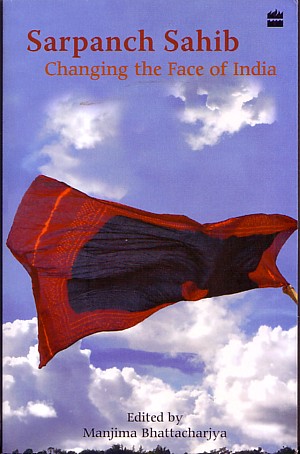
Yes, in spite of all the cynicism and active obstruction by old political power-brokers, the experiment has started to bring about a change. “Sarpanch Sahib – Changing the face of India”, edited by Manjima Bhattacharjya (Harper Collins India with India Today and The Hunger Project, 2009), tells the stories of some such women who became presidents of their Gram Panchayats (village councils).


The stories of the book are told by women like Manju Kapur, Indira Maya Ganesh, etc. and are immensely readable. They talk of villages from different parts of India. To understand what these women went through and continue to pass through, what it means for them to live lives of poverty and yet strive for better governance against all odds, makes for a humbling experience.

I liked all the stories. They are succcess stories, even if they show that nothing is easy and at times, the idea of “success” does not quite express what they have achieved. They show that change in the unchanging world of rural poverty, could be almost imperceptible. Like the story of a person like Kenchamma, a dalit woman, who continues to shell betel nuts for a living, even while she is into her second term in the Gram Panchayat. Like this passage from her story:
Quite far removed from the Kenchamma of 1993, who cried in humiliation as she returned from her first meetings, bewildered and frustated at not being able to say anything. We were walking through the village and my eyes fall on her callused hands. She points to the skin of betel nut strewn in piles every where. She did four sacks yesterday. At 50 rupees a box she makes 200 rupees for the day. ...An uneducated Dalit woman has done for her village what seasoned political aspirants have not. But what has she got in return? What does one make of this strange sort of limbo? Thins have changed so much over one generation – from Cariappa’s to his daughter-in-law’s, yet they remain disturbingly unchanged.
Kenchamma has been president of the panchayat twice and is now a grudgingly respected member of the village community – respected by Dailts and Lingayats. But she is still a poor Dalit woman. As if being any other way would be improper. Improper not to live in a thatched, leaking mud hut, or to plaster her house, to not struggle for daily wages, improper to imagine other livelihoods, work not just for the village but make a career out of governance and use the 10 years of hands-on learning she has had. The boundaries have been pushed, but still only from the limits of the home to the village. Isn’t it enough that you have been allowed to reach this far, the voices seem to suggest?
I think that Kenchammas of this world are wise, they know that entrenched social hierarchies can react back with terrible fury if they feel that the status quo is being challenged. They know that they can not count on any one else to protect them. So they bide their time, they accept to continue to living lives of poverty and marginalisation, even while achieving small changes, providing education for their children. They are not aiming for revolutions, they are aiming for a change. Most of us from worlds far away from theirs, including many development experts, are frustrated with this path of slow change.

Perhaps we, or some of us, would have preferred revolutions?

I would recommend this book to everyone, especially those who think that they know India, that they are building the modern new India, that they are bringing in the progress. It would bring a sense of balance in what they think about themselves and gain some respect for those Kanchammas, working in far away places to bring small changes in rural India, taking personal risks that most of us wouldn't have the courage to take.

Dr Binayak Sen gets bail!

It has been a tough and despairing struggle. To know that Dr Binayak Sen was being left in jail in spite of his long work for oppressed and marginalised, in spite of there not being any kind of reasonable proof against his being a Maoist spy, had been a sad comment on the state of Indian democratic system and the state of its institutions that are supposed to protect the citizens.

In the last one year of the trial, the State authorities had not been able to present any conclusive proof, nothing to justify why it was using a draconian anti-terror law to silence and punish a person like him. If State could do something like this to an internationally known person like Dr Sen, you can only imagine the kind of things that can happen to those are poor and powerless.

Finally today the news that Supreme Court has accepted these arguments and ordered his bail. I feel a sense of anger and frustration, that it had to drag for so long and against all ideas of common sense and decency! Still at least it has happened.

Sonagachi prostitute and the yellow turbaned Sarpanch

Have you seen the posts on India Yatra series on the Hindustan Times webpage? I think they are wonderful in getting a feel of India as it readies for the 2009 elections.

The yellow turbaned Sarpanch in the Maharashtra village has a masters degree and practices participatory democracy and development, bringing prosperty to the village and to them the national elections are not so important, the Gram Sabha is much more so.

Durbar, the NGO set up by a group of prostitutes from Sonagachi in Kolkatta is the only organisation providing support to the tribals in an area that saw starvation deaths. To those tribals, the politicians mean nothing, they only see hope in Durbar.

In UP the internet surfing farmer is a millionaire and is providing new agricutlure knowledge to many other farmers. To them the new eight lane highway that is coming up next to their village is their road to prosperity and rather than look at the Ram mandir issue in Ayodhya, they would rather look westwards to Punjab, Haryana and Maharasthra for better agriculture.

In Andhra Pradesh, the world-class road is just a confirmation of the State priority in fighting the Naxalites and it fuels the desire for the separate Telangana state. Prosperity will come with their own state, they are convinced. People are calculating which politicians are likely to support them to realise their Telangana dream.

In Bihar the bicycles for the high school girls may be another round of chess moves between Nitish Kumar, Ram Vilas Paswan and Lalu Prasad, but girls are feeling more confident and see a hope for their future.

These are some of the examples of the stories under India Yatra.

HT has 30 correspondents travelling all over India and collecting stories from places that usually are forgotten in newspapers and TV news. It gives me an opportunity to go beyond the usual media representations of India, to a more varied mosaic of the country. Great stuff and interesting as well.

Defeating fundamentalism

The new issue of Outlook magazine from India has a wonderful essay by the historian and writer Ramachandra Guha about the chances of India to become a superpower. Guha argues that there are a number of factors including the threat from the violence of extreme left maoist groups known as naxalites, the threat of religious fundamentalism especially from Hindu conservatives, lack of a principled party from centre especially in congress party, the large and increasing gap among the rich and the poor, that will not allow India to become a superpower. He also argues that perhaps India need not aim for becoming a superpower but try to be a country that makes sure that all of its citizens can live with dignity.

Guha is a wonderful writer, very easy to read, and logical. He also adds that special point of view of historians that is usually missing from such debates - these debates are usually dominated by economists and financial experts. I also liked that Guha has quoted his teacher Dharma Kumar in his essay.

However, there is a part of the essay that provoked some reflections from me. Here is that part:

There is, indeed, a reassertion of religious orthodoxy in all faiths in modern India—among Muslims and Christians as well as Sikhs and Hindus (and even, as it happens, among Jains). It is the illiberal tendencies in all these religions that, at the present juncture, are in the ascendant. The mullahs who abuse Sania Mirza or Taslima Nasreen, and the Sikh hardliners who terrorise the Dera Sacha Sauda, are also wholly opposed to the spirit of the Indian Constitution. But simply by virtue of numbers—Hindus are, after all, more than 80 per cent of India’s population—and their much wider political influence, Hindu bigotry is indisputably the most dangerous of them all.

....... For the middle class, the threat from the left is wholly hidden. They do not see or confront it in their daily lives. They can go to work or college or shop or play without ever seeing a single Naxalite, or a single adivasi either. On the other hand, they do know of the threat from the right. Yet, they tend to disregard it. Some middle-class Indians are converted Hindutvawadis anyway. Many others naively hope that the mask will in time become the real face, and that with economic modernisation the BJP will be able to successfully distance itself from the RSS.
I feel that religious fundamentalism is one crucial area in which we see a marked deterioration in India over the past couple of decades. Increasingly all religions take rigid stand against any debate and dissent against the views of its more conservative members, make shrill threats and often attack property and persons to beat them into fearful obedience.

With Globalisation, perhaps it is inevitable that the narrow conservatism of montheistic religions that insist on only their view of world as dictated by their prophet in their sacred book being the correct way, also infects the Indian way of thinking, that has over millenniums evolved into acceptance of contradictions and different world views, religious views and social norms. Thus today conservative persons from different religions in India are increasingly trying to browbeat everyone into their view of sacred and just.

There must be many reasons for this change, including the economic implications of ideas of equality and human rights. Groups who had been marginalised for centuries such as dalits, adivasis and women now demand this equality. With globalisation, new technologies, spread of media and increasing awareness, such groups are increasingly aware of their rights and their collective power, threatening social structures of traditional societies. Thus, rising religious fundamentalism may be strategy of the powerful to conserve their power and religion is used as a means to this end.

Attracting bigger numbers of followers is equally imporatant for the power of the religious leaders, while in today's world, new technologies and social changes can make religious affinities weaker and decrease that power. Promoting conservative views to attract specific groups of followers can thus be a deliberate strategy by religious leaders and political parties.

However, perhaps we also need to reflect more on the reasons behind "Some middle-class Indians are converted Hindutvawadis anyway." During my journeys in India, I have been surprised more than once to find persons I knew as reasonable and open minded persons, are increasingly pessimistic about a dialogue with Muslims and expressing at least some support or understanding about Hindu conservatives. They may not condone the violence of Bajrang Dal or Vishwa Hindu Parishad but they perceive that State has given into obscurantists from Islam and other religions and that rights of Hindus are being eroded or are being treated unjustly.

Could this be partly be because of the thinking that considers "But simply by virtue of numbers—Hindus are, after all, more than 80 per cent of India’s population—and their much wider political influence, Hindu bigotry is indisputably the most dangerous of them all"?

Everytime you try to say anything about Hindu fundamentalists, there are persons who attack you, abuse you and send threats. Why are you not talking about fundamentalists of other religions, they are doing worse things but no one talks about that, they say. I am not talking about these persons. But there are saner educated, thinking persons who feel that there is a large part of Indian accademics, activists, opinionists, writers, who have double standards, "they are very vocal in denouncing the evils of Hindu bigotry but are silent about bigots from other religions".

Perhaps it is correct that by sheer numbers Hindu bigotry is indeed more dangerous but the strategey of condemning only Hindu fundamentalists, may not be the best way to go about it!

I personally feel that all fundmentamentalists and bigots are same, they have same narrow and fearful way of thinking, fighting against all changes perceived as attacks on traditions, and it does not matter that they are Hindu, Muslims or Christians or Sikhs, or whatever. But every time the State gives into or plays silent spectator, not raising a single finger to stop the attacks on legality and human rights enshrined in the Indian constitution, it creates a vicious circle, where some more persons from that religion get converted to the cause of fundamentalism, as they see that fundamentalism pays. At the same time, persons from other religions feel offended and some of them move towards their own fundamentalisms, while moderate voices of all sides become more fearful and silent.

Every time the State allows a Taslima to be made a prisoner and exiled while her attackers roam free and make death threats in TV and State Assembly, every time the State allows goons to ransack libraries and destroy manuscripts, or threaten a person like M. F. Hussein, India becomes weaker, fundamentalists become more confident and reasonable persons are forced to withdraw in their shells.

Guha sounds very pessimistic that in the near future any Government will have the courage to take a stand on this. With coalition governments, and polarising vote banks, perhaps the wish to have principled politicians is an empty dream.
He suggests that we all should do our part, push for small but consistent change by making a stand. But how can individuals act for stopping fundamentalism when Government seems passive and unwilling to make any stand? A judge can make the decision on M. F. Hussein case, but would that be enough to reverse this tide of increasing fundamentalism? And all those other instances that do not come to a tribunal, how can individuals make a difference about it?

Dr Binayak Sen in the Jail

I am deeply anguished that even after more than a year, a person like Dr Bianayak Sen continues to languish in a jail. Is is unbelievable that a person like him, who has spent his life working with the most marginalised rural groups in Chattisgarh through community health programmes has been labelled a "naxalite courier" and put into jail.

It was in May 2007 that Dr Mira Shiva had told me about it and I thought it was a mistake and that soon, courts will realise that this is only some kind of frame-work by persons irritated by Dr Binayak Sen's insistence on truth and human rights for every one including for persons killed in "encounters" and jailed as naxalites.


I personally do not belive or accept the naxalite ideology and I completely reject their violence, yet I thought that what Binayak was doing is the only option for a doctor and should be conduct of all persons who live by their conscience - you have to ask for respect of law and respect of human rights for everyone.

Yet, inspite of knowing that this is a blatant lie, the state continues to insist that Binayak was not really a doctor, he was a naxalite courier and treats him like a criminal. I hope that the highest authorities in India will take immediate action and free Binayak and ensure that he is given justice.

There is an article about Dr Binayak Sen in recent issue of Outlook. I hope all newspapers and journals will write about him and what he symbolises. If a person like him can be framed, jailed and denied justice, I shudder to think of what happens to common persons in India. The poor and marginalised tribals in India, what hope can they have for justice in India?

Dams, development and the poor: Medha Patkar

Medha Patkar, the famous activist from India fighting for the rights of poor and voiceless persons, was in Bologna at a meeting organised by CGIL, the workers union.


I agree with most of what she says regarding SEZs, the corruption that pervades most of our system in India, the lack of care about what happens to the poor and marginalised persons for most of well to do India, that is as self-centred like most well-to-do persons in the world. I also agree that the present dominating idea of development is result of a particular view point of developed world that has its roots in colonial past, industrialization and in a belief that nature is for man’s exploitation and thus for most persons the more things you have the better it would be. But I am not sure if poor, just because they are poor, would be happy with another idea of development, for example, the ideas of self-contained mutually dependent small communities with limited material needs envisioned by Gandhi and some other thinkers. Perhaps it is the globalisation or may be a sign of changing times, but I feel that all, rich and poor, share the kind of dreams that are based on material wealth. Perhaps I am wrong!

Here are some excerpts from Medha's speech.
*****

I come from the National Alliance of the People’s Movements in India and also from the struggles in the river valley of Narmada. These years and decades long struggles are still on and have been facing newer challenges because the whole paradigm to which the state and the corporates are committed to, is certainly bringing an onslaught on the population including the indigenous people, farmers, the working class people, artisans, the fish workers and almost 95 or more percent of the working classes.

But it is not only the case of a dam in one single river valley, apply it to various development projects. We realise it that people are bound to assert their right to the local resources which are taken away in the name of development. So sections of the civil society and of course the state, come out with certain symbols of development which fits in their paradigm like large dams or large factories. We question it, from the point of view of how the process of taking away the resources (works), and diverting of these resources from one kind of economy to another kind of economy. We raise this question.

We are also questioning the centralised-based development paradigm and planning process. When centres are in the capitals of the nation states, the communities, the rural as well as the urban communities questioned, “Who decides what is development”? And through what democratic or undemocratic procedures and processes do they impose these plans upon us? It was also bringing out the ultimate ways of managing the resources, beginning with their small units that are the communities, which are also the ecological units. So that there will be no displacement and eviction of people from their cultural, environmental milieu and also from there own kinds of life-styles and economies.

It was one story when this was within the boundaries of one nation state. With the whole paradigm of globalisation, corporatisation and privatisation, it has attained unprecedented scale and unprecedented force, including the use of physical force that the state maintained but also the various factories of the corporate powers which have infested the state itself. The nexus between the state and the corporate power, it wants every piece of land and they are eating our resources in the name of industrialisation, in the name of progress and development. It is not just the rivers, but also ground waters, reservoirs that are handed over to the companies such as Coca Cola, the mineral water bottling plants. The people living on the land with the water resources are waging battles, if not wars. In the name of industrialisation, in the present paradigm, the land is opened to all industries including like your Fiat company from Italy itself.


This has taken a new turn by the states announcing the policies and laws of Special Economic Zones (SEZs). These are officially known as “foreign territories” within Indian territory. These SEZs are large chunks of lands which are acquired partly by the state and partly purchased by the companies, who can purchase not just small farms but whole districts, areas as big as the regions (in Italy) including hills and valleys, because they have already earned so much profit. These zones are the ones which give all concessions and not less than 21 laws for the corporates. They are cutting on the labour legislations which were earned through decade long struggles by the labourers and workers.

I belong since birth to the family of a labour union leader, who was freedom fighter as well and hence I know how hard earned are those labour legislation and yet with the rush of a pen, the legislations are declared “not applicable” to the corporates, that are allowed to operate not just with free trade but also with free operations. With special judges, with no local self-government, even those elected and recognised are not allowed to function in these zones, like the Panchayats. So with these kinds of zones coming up the corporates are not just confident, but are arrogant and aggressive in taking away the lands and every thing attached to the lands.

West Bengal is a left front ruled state for the last more than 30 years. We have always been allies of the left front parties. At the world social forum, at various for a where we raised our voice jointly against the neoliberal paradigm. If you want to have a look at the resolution passed by the parties, various partners and allies in the left front in India – Communist party of India Marxist, Communist Party of India CPI, the Revolutionary Socialist party, the Forward Block, if you look at these four parties, you will find that they unequivocally question the neoliberal paradigm. They question the World Bank, IMF, WTO, they support Cuba and Venezuela and the changes in the Latin American countries such as Brazil and they vow for the people’s rights and the non corporated state.

And yet in West Bengal problems are there, coming up in place to place. In Singur there was a forced acquisition of about thousand acres of land, 997 acres, for a project that was known as Tata’s small car project.

The industries minister of West Bengal told us, when we held the public hearing on the invitation that came from the people, myself along with Mahashweta devi, the well known literary person in India, others like former justice Sengupta and also the radical left wing intellectuals, we all held a public hearing and heard the people. The people had an unanimous voice in opposition to the project. People said that whatever needs to be done, has to be done. The corporates and before the corporates, the faith has to come to us, we are the communities, we have the power and democratic constitutional right and they should say what it is that they are wanting to have, why that project, what is that project going to bring to the nation and to themselves, how are they going to get a share, whether they are going to get it or not? But the Government absolutely said no, that they are not ready to disclose the information. So we as the members of the panel placed our demands to the industries minister and had dialogue with the chief minister also. We were shocked to get the answer such as, “Oh in the neoliberal economy, after all what can we do? We have to bargain with the companies, if at all. We have to accept the land which they choose, we can not choose the land to be given to the industries. If we don’t allow them to get the land which they want they would go away to some other state. Even for the rehabilitation, we have no policy as yet here. We will in the process try to talk to Tata so that we can have some package evolved..”. We were shocked to hear this from the left front leader.

As the struggle began, it has already faced some repression, some of the opposition political parties were involved, so the Government started saying that this is all political. When we came in as people’s movement, they could not say that because we are not for the typical political or electoral politics. We are in the people’s politics. But we don’t consider the parties as untouchables, but we feel that movements are political in themselves. When we as the farmers, fish workers, the displaced people, some of the unorganised sector workers, unions, some of the organised sector worker union, we all said raised the voice of support to people of Singur, they started directing the repression to us.
*****

You can read the full text of Medha's speech and listen to her voice if you wish, on kalpana.it

Police, writers & peace keepers

I don't usually associate the words like writers or poets with police. Not that I ever knew any one from the police but it was about their image. It is true that I had read of well known police woman like Kiran Bedi and she is not the usual image of police, but in my mind, without ever consciously thinking about it, she was some thing exceptional.

Priyanker had written to me about his friend Mahendra, that Mahendra from the police services was coming to Vicenza in Italy for some training and that Mahendra was also a poet. That intrigued me, a policeman and a poet? Poetry means sensitivity and understanding of human pain and suffering. Police duty means bringing criminals and law breakers to justice, where there is not much space for senstivity or understanding. That is what I thought and the apparent contradiction, intrigued me.

It would have been lovely to meet Mahendra but the only problem was to find an opportunity. "We are busy throughout the week, and next two weekends we also we are busy", Mahendra had said. I only these two weekends free and then I am supposed to go to London for work. Probably it will be difficult to meet him, I had thought in my heart.

And then he sent a message yesterday that today, Sunday 25 November evening, their group was passing through Bologna and stopping at one of the local police offices for dinner, on its way back to Vicenza. And so I asked my son to accompany me to meet Mahendra.

There are thirteen persons from different police related services from India, who have come here for "training of trainers" course for UN peace keeping. Apart from Mahendra Singh Poonia, suprintendent of Police at the Government Railway police in Siliguri, I also had a brief opportunity to meet Satya Narayan Sabat, DIG Police UP. Like Mahendra, even Satya Narayan is into creative writing. His book 'Bharatiya Sanskriti Mein Manavadhikar ki Avadharana' (Ideas of human rights in the Indian culture), which deals with human rights in the light of Indian culture and stresses how it directly and indirectly is influenced by the same, received a national human rights commission award in 2004-05.

It is not often that I get an opportunity to meet creative persons involved in Hindi writing and it would have been wonderful to know them better but the time was short and soon we were surrounded by other persons from the Indian group, including three women. I heard the introductions, Simla, Himachal Pradesh.. Chennai, Tamilnadu... Rewa, Madhya Pradesh, ...CBI, CRPF, ... but the there was no time to learn their names or to know them as persons.

Soon their instructors were telling them to get ready for the journey back to Vicenza and we said hasty goodbyes. As I came back home, I was thinking, how often we tend to categorize persons by mental stereotypes and yet when you know the real persons, they are very different from those steroetypes. My perception of persons in the security forces has changed from this brief encounter.

Here are two pictures from the evening. In the first one, from left to right, it is Satya Naayan, I, Mahendra and my son Marco Tushar; the second picture is of some members of the Indian group.


Guntur comes to Bologna

Mayor's office from Bologna had sent me an invitation explaining that mayors from Indian city of Guntur and Philippines province of Bahol were coming to Bologna as jury members for an ecological project. It seems that Bologna with funding from European Union and in collaboration with a swedish city was promoting this project for the improvement of environment and ecological sustainability and had started with the two pilot projects in India and Philippines.

These days when they speak of global warming and climate change, often they end up by saying that enormous growth in India and China is going to put additional pressure on the climate and that the developing world should look for some alternate paradigm of growth. I find that extremely hypocritical.

The other day I was reading that USA alone consumes hundreds of time more energy than all of Africa and if China and India continue to grow the way they are, by 2020 they will be consuming 20% of the USA energy level. So it is not about reducing India or China's energy use, it is about reducing their own energy use if they are serious about climate change and global warming. In the end every drop counts, but isn't it a little shameless to not to look at oceans and focus only on drops?

European energy consumption is not at the American level but it is probably not too much far behind. How much success have they achieved in reducing their own energy consumption?

I feel that in USA and in Europe, the trend is towards more efficient use of energy, less polluting ways of using energy and there is no attempt to change the general paradigm of living that is based on intensive use of earth's resources. Almost everything, from cars to computers, are going towards "use it and throw it" kind of mentality. So how can they preach to developing world about what others should do?

If the developed world is really keen on reducing pollution in the developing world, they should be willing to waive copyrights and protectionist measures to share ideas, efficient technologies with the developing world, and not allow their own multinationals to shift their polluting businesses in developing world without proper technology improvements.

In Bologna itself, there is lot of pontificating about using bicycle and public transport and not using cars but in reality the city does everything to discourage people from using bicycles and promotes use of cars. In my opinion, as someone who goes regularly to work on bicycle, in the last ten years the number of bicycle users in the city has decreased and number of cars has increased many folds.

I had all these thoughts in my head when I went to this meeting. Fortunately they did not give any hypocrite speeches about climate change and global warming. The emphasis was very much on ecology for improving the lives of people who live in our cities, about improving water supply, solid waste amangement, traffic, greenery, etc.

Kanna Nagaraju, mayor of Guntur was there with his wife, Kirti. Nagaraju a BTech in mechanical engineering was in real estate business when he entered politics 2 years ago and at 25 became one of the youngest mayors of India (or may be in the world?). Kirti is also a BTech, is still studying, doing MBA and the couple do not have a child yet.

Nagaraju's was not a very fluent or coherent speaker but his presentation was good. He presented some big successes in Guntur after this project - they are now testing water supply for pollution and making sure people get drinkable and pollution free water, they are almost near to achieve 24x7 iuninterrupted water supply, they have a new system of solid waste collection from the house holds that is separated for recycling, Guntur is now a garbage free city, they are managing traffic better, building more parks and greenery, etc.

Is the change real or is it just big politicase speech giving by exaggerating whatever little has been done, only persons from Guntur can say. I hope some bloggers from Guntur will send comments.

In the meantime, some pictures from yesterday: (1) Nagaraju (right) with Pamela Lama (Bologna Mayor office), Anna Patullo (Bologna counsellor) and representatives from Phillipines (2) Sogni d'oriente, the Italian-Persian music group that presented some fusion music, (3) products from Guntur on exhibition (4) closeup of Nagaraju with interpreter and Ms. Lama.


Ignorance is better?

We were in a rural area. It was a refugee camp and I was there with a delegation of United Nation High Commission for Refugees (UNHCR). We were looking at issues related to persons with disability in refugee camps and before that visit, I had already been to some other refugee camps in Africa.

The road leading to the refugee camp, left the city to meander through fields dotted with small huts. Thin and dirty children in tattered clothes occasionally stood by the roadside to look at our big UN vehicles passing.

If outside was poverty, inside the refugee camp seemed like the land of plenty. There were lot of international non-governmental organisations (NGOs) with lot of expatriate staff. In the health centre, their was plenty of staff and no medicines seemed to be lacking. I had a long conversation with an Australian speech therapist working with children who had speaking difficulties, asking her about the general conditions inside the camp and the different services available there.

"What about the local people living outside the camp?" I had asked. Persons outside had looked malnourished and without any services, left to fend for themself in an isolated remote area. "No, we can't provide any services to the locals", I was told. It was because of policy decision by government here. UNHCR staff and international staff were responsible only for the refugee camp and they were prohibited from having any kind of interaction with the local population.

But international NGOs could have started separate projects for the surrounding countryside, I had insisted.Isn't it terrible to pass in front of those huts everyday and see them so poor and so vulnerable? There are only funds for emergency, no one gives money for ordinary poverty, they said.

The person showing us around took us to the high school in the refugee camp. It was a wonderful place with nice uniforms, a large field where children were playing, and some committed expatriate teachers, who explained their work including the use of internet to bring the world to the refugee camp.

I was a little upset. I thought it was discriminatory with all these resources they had in the UN, giving the world to the refugees inside the camp walls, while just outside those walls, people of same skin colour, same language, similar facial traits could die of hunger, their children faced malnutrition, and died of usual simple illnesses like diarrohea and mealses. So perhaps, I was condescending in my interaction with the students of 12th standard. I don't remember the exact words of my question. Perhaps it was something to do with their future.

A young man sitting at the back stood up to answer me. I think that he said some thing like, "We are prisoners in this cage. This wonderful school, these wonderful teachers, our learning internet, our learning French and English, what use is it? It only serves to make us feel worse. We have no future. UNHCR can provide only school education. There is no university here and I can not go outside the walls of this camp. And, after passing 12th, all these wonderful programmes finish. Then we go back to our families in this camp, to work in the fields. For working in the field, I don't need any of this knowledge that I have got, it will only serve to remind me about the wretchedness of my life, to know how much we are missing. It is terrible to know what we could be and be forced to be nothing."

I was suddenly reminded of this episode while reading the story "Sudama's children" about poor kids in rich private schools in Delhi in the latest issue of Outlook. "There are two kinds of pain—the pain of growing up in a jhuggi with little hope of change, and the pain of adjustment in studying with well-off kids in a private school. How do we know which is worse?"

I think of that youngman's heartbreaking answer in the refugee camp and the choices he had. Yet, compared to the life of living in poverty, outside the refugee camp, where hunger and disease are likely to kill you young and at the best, you will grow up to eke out a miserable and difficult life from the fields! What would you choose if you had this choice? I don't have a doubt, give me the gilded cage of the refugee camp.

Democracy and extremism

Yes, I know it is long time since I wrote anything on this blog except for publishing friends' appeals from Nepal. Now it seems the King in Nepal has decided to give in to the people's movement and peace may return to this beautiful land.

I am thinking about Maoists and if they pose a threat to the country.

I have always maintained that dialogue and democracy are the best way to deal with extremists - by extremists, I mean, those who believe in extreme changes, not necessarily violent. In that sense, I don't agree with repression, banning, jails and fighting to overcome or to contain those we consider "extreme". I believe that if extremists can be made to participate in the democratic dialogue and if they find public support, to be the government, their extremism will be tempered and they will need to become less extreme to fit in with the system.

The increasing forces of globalisation, meaning increasing inter-links between people and countries, should be a safeguard since extremist governments, even if elected, can not break those links and live in isolation.

Another aspect of globalisation is the increasing presence of media, so that when "news" happens like dead bodies floating in Victoria falls in Rwanda, the world will see it. Thus violent abberrations, sooner or later must go away other wise you become an international pariah.

Unfortunately, both aspects of globalisation can be easily manipulated. When economic interests are there, other countries become tolerant of dictators and murderers, and close one or both eyes. And, the international media is fickle, it comes to catch the goriest pictures but here the supply is greater than demand, so it soon leaves to catch other gorier pastures.

So I think that maoists should get a chance to participate in the elections and if they win the elections, they can get a go at the system. Yet, I am worried if the democracy rules are valid for everyone? How about people or groups, that think that they don't believe in democractic ideas but play along only to get into power and then start their dictatorship and repression? And if we end with a Pol Pot and millions of dead, whose fault was it? Or with Talibans?

Appeal from Nepal

This arrived today from friends in Nepal:

"Yesterday, after demonstration of more than 200000 people in Kathmandu, more than two million people all over Nepal, and pressures from foreign countries (India and USA), the king, Gyanendra made announcement that he was ready to accept Prime Minister nominated by the Seven Parties. But it was already late, people felt it was not enough, they wanted democracy without king or king with no power. They were not ready to trust king, his cronies, and army. Right after the announcement, people came out in the street and warned the political parties not to give in without election for the constituent assembly and full democracy.

This morning all the parties had their own meetings and also a combined meeting of seven parties which decided that king has not changed and there is not a real change towards democracy so they decided not to accept the king's lollipop and to continue non-violent action. At the same time; people started coming out on the street against the king's announcement. People came out from all over. All together, there may have been more than 300000 people congregated and they were trying to go to the main centre. However, the army and police fired on them and threw tear gas without warning. Hundreds of people are again injured. There is also rumour of some death and bodies being taken by the army. The helicopter is flying over our head. People are still on the street.

India, USA, EU, Canada, UK, UN have taken the king's announcement positively without considering people's grievances against the king and royal family in Nepal. They are afraid of communist take over which I do not think is possible. People are fed up with lies and show off of the royal drama. I think the agitation will continue and there will be more death and repression because of premature support from foreign government to the king. Hope you will understand our situation and try to do something. Thank you very much."

The burning Nepal

I have just come back from Mozambique today. In my mailbox found this message from my firneds in Nepal:


"You have been receiving news from Nepal. We are going through a very difficult time but Nepalese people are prepared to have a long lasting solution. I hope and wish we will do so without too much of blood shedding. Please help us in our endeavour. We are as usual against any kind of brutalities, exploitation, suppression, dictatorship, looting, and so on.

It is about the time that we need your help wherever you are by letting others know what is happening with peace loving Nepalese.Thousands of people are wounded seriously by brutalities. All the hospitals in Nepal are full of them. They need blood, medicines and other services. Our staff in its meeting has decided to support them by allocating Rs. 50,000.00 from Staff Welfare Fund. We will try to help as much as possible for people who are beaten and shot. Wish the New Year will give us courage to speak up and do something. Thank you very much."

Nepal Diary

I am here for a women's orgasnisation working with women from "low" castes in rural areas of Nepal. I was worried about coming to Nepal with all the news about maoists' attacks and the imprisonment of all the political leaders by the king.

In fact tourists have all but disappeared. Thammel, the old part of Kathmandu full of narrow alleys bursting with tourist shops frquented by europeans and americans, seems a little desperate. I was told that guest houses and small hotels have been forced to close.

Maoists have declared a complete block of Kathmandu from 13 March and some big action by 4 April, so things may get even worse.

This means that it is easy to find a cheap room in a good hotel.

People speak about the BBC interview of Prachannda, the head of maoists and his assurance for maoists' willingness to renounce the path of violence and to be part of the political system. Yet, everyday there are news of new fights, bombs, and people dying.
****

I have been told that from some angles, I look like Prachannda. That really makes me afraid. I am suppose to travel in far away rural areas, some of which are close to maoists strongholds and theatre of their fighting with police and military. If they decide that I am Prachannda and decide to shoot me?

In the some of the rural areas that I visit, poverty and oppression are deep-seated. Most of the maoist boys come from these homes I am told.

With some friends, I discuss the revolution of maoists. I agree with their desire of human dignity, social justice and equity. But I don't think that violence or revolutions change things. Because, human beings are human beings and they want comfort, money, good things, power, etc. A few committed and idealists don't run the revolution, it is ordinary persons in villages, small towns and communities, the frontguards of the revolutionaries, who make a new system, replacing the oppressors of the past with new oppressors.

I understand their impatience with slowness of change and yet, I don't think that there is any alternative to dialogue, empowerment and slow change from within.
*****

Lovely green fields with women in colourful clothes makes for pretty pictures. The women mostly wrap the saries over the lower half, keeping the upper halfs covered only with blouses. To Indian eyes, it makes them look more defiant, less shackled by the veils of modesty.

This picture was taken after a meeting with a women's group in Chaimalle. The women were from Danuvar community, struggling for survival.


*****

The bridge hanging over the waters is on Bhagmati river, about 35 km from Kathmandu. It is made of iron plates with gaps between them, and as you walk over it it moves and shifts like a sleeping snake, waking up and moving under your feet. Looking at the boulders and rushing water through the gaps gives me vertigo.

In Kathmandu, the river is filthy drain. Behind Pashupatinath, as people give the last bath to the dead bodies of their near and dear ones, before placing them on the funeral pyres, it seems that they can't see the thick filth in the holy waters, folding their hands in the sacred prayers.

It is like Jamuna in Delhi. Not the Jamuna of my childhood, when we played in the sand behind I.P. college. Wonder if Jamuna is still like that or they have been able to clean it!

Any way back to the frothing waters of Bhagmati, away from Kathmandu, crashing on the boulders, raising up a spray, it seems like a paradise. As I cross the river, I realise to my horror, the shining white froth on the water is like thick soap, probably coming out of some factories or drains.

Some persons stand in the middle of the river. Are they fishing, I ask. No, there is no fish in this river, not any more, according to the two women accompanying us. Those people are mining sand, they will sell it.

Do their legs get sores and rashes, standing in the middle of the soap foam of the river for hours, I ask. The women shake their heads, not understanding my question.


****
Why do they carry things this way, holding the strap on their heads, I wonder.
Men, women, children, all of them. Small bags, big baskets full of green vegetables and fodder, bundles of wood, sheets of iron, logs. People walk bent forward, the straps straining on their foreheads.
It has been years since I trekked in the mountains. I feel fat and undignified, moving like an elephant while they move quickly and nimbly as goats or deer. The stones push through my Italian shoes and hurt my feet, they walk in rubber flip-flops careflessly. They chatter and I gasp like an asthmatic.
I look up with despair. The climbing never seems to end. Far away I can see the ribbon of the path, hugging the mountain, going down towards the river bed. We walked all that. Now this path going up.
They, the women, they made this path, Sarmila tells me. It is a narrow path on which stones have been placed. It is not a paved path, they have just been thrown there, one above another. I can understand that in rainy season, walking on these paths must not be easy and to have stones under your feet that stop you from slipping down, must be helpful. If you fell down, obviously you have greater chances of breaking your legs over them, I remind myself.
Each stone must weigh half a kg, how much time did it take for them to do it, to line this path? I imagine myself, going down the path, down to the river where we started, pick up a few stones and then climb up to this place. It is too tiring, I give up imagining.
Has anyone ever had heart attacks while climbing these mountains, I want to ask, but I am afraid that asking such questions brings bad luck. So I keep my mouth shut. Rather, I am too busy gasping to ask stupid questions.

*****
We are staying with an old woman in her hotel at Biplate village in Okhaldhunga district. Her hotel has two rooms. A big room where she has the kitchen and the women's dormitory. The next room is men's dormitory. For breakfast we get roasted potatoes with chilli sauce. The toilet is a bit lower down, behind the house. After dinner I have taken my usual diuretic for the blood pressure and I need to pee, holding a small torch, I go out. It is pitch black and the idea of going down the hill to search for the toilet makes me shudder. I finally decide to cross the road and pee over the deep valley below. Above, the sky is full of stars. I feel like a naughty child, peeing in the open like that.
In the morning, there is a procession of donkeys going up on the mountain behind us. Tens or twenty of donkies with bells around their necks. Followed by a lonely man or sometimes by a boy. It is a 3-4 days journey they tell me, going to the Salu, some place in high mountains in Himalaya.
A man carryng a huge bundle of boxes who had slept in our hotel comes out and starts walking on the same day. For four days of walking to deliver those boxes he will get 450 nepalese rupees. For food and sleeping on the way he will spend about 400 rupees and after four days of back-breaking work, he will earn 50 rupees. I can't belive it. One Euro is about 81 rupees.
Then came this boy following his buffaloes or are they yaks?

*******
It is the day of the sex workers they tell me. I am curious to see the sex workers, so I go their meeting. Where are the sex workers, I look around. I don't see them. I see young women, sitting together. Some of them have their children with them.
They talk about the difficulty of convincing the clients to use condoms. They talk of violence. They talk of discrimination, of being blamed for spreading AIDS. They talk of selling themsleves for a plate of momos, when children are hungry. They talk of dignity. They talk of coming out and raising their voices.
Do you want to say something, they ask me. I am used to talking but for once, I can't find the words. I mumble something, feeling inadequate.

*******
They sit on the ground, patiently for hours. I squirm and shift. Move my legs this way and that way. I wish there was a chair. How can you eat this way, I ask myself, trying to reach the thali on the ground.
They talk of domestic violence, alcoholism, poverty, hunger, saving money, second wives, going ahead even if men of their communities do not agree.
Her husband cut the big toe in her right foot with a knife, Sarmila points out towards the woman who is speaking. He was drunk and angry. She is talking about the importance of her women's group, importance of her chicken raising, importance of not giving in to the threats of the men from the village.

Happy 8th March, even if I am late.

Pinter breathes fire

When I first heard that Pinter has won the 2005 nobel prize for litterature, I thought they were talking about Luigi Pintor, an Italian writer who had died earlier this year. Pintor, a rebel, was ousted from the Italian communist party and established his own newspaper and magazine, il Manifesto. He wrote simple, small books, that are a real delight to read with their profound insight into human psyche.

I vaguely knew about Harold Pinter, the British playright. I had not seen or read any of his plays, but I had seen him on the "HardTalk" on the BBC in December 2004, when he had said that both Bush and Blair should be tried for their war crimes. This interview and the episode of HardTalk can still be seen through internet.

His acceptance speech for the Nobel prize is equally hard hitting. He feels that while there has been lot of debate and discussions on effects of Soviet empire and communist rule, similar debate has not touched on american activities of "eliminating people-friendly democracies" by declaring them communists and killing innocents till such countries have despots friendly towards multinationals and american products and at that point, they are called democracies. He gives some examples of Latin America, before talking about Iraq. This speech can be read on internet.

*****

I am sure that Pinter is a wonderful writer and does deserve his nobel prize. Yet, I also feel that Nobel prize committee is biased towards writings in European languages. Otherwise, I can't imagine, how writers of stature of Mahashweti devi can be ignored?

Yet the painful truth is that writers in "local" languages spoken by millions of persons are ignored, till someone can translate them in more "mainstream" languages and then they can be "discovered".