Showing posts with label Archeology. Show all posts

Ancient World history in Indian Scriptures - Context

This is part 2 of an article in three parts, about the ancient world and Indian history in ancient Hindu sacred books, based on the works of eminent Hindi writer, Acharya Chatur Sen. Part one of this article introduced the writings of Sen. This second part examines the context of writings by Sen. The third part presents the events described by Chatur Sen in his book, Vayam Rakshamah.

All writers need to do research, when they are writing about something with which they are not familiar. Thus, for all historical novels, writers need to research that particular historical period. Probably Acharya Chatur Sen started his research when he decided to write about "Vaishali ki Nagarvadhu", or perhaps the research was started for some other book, and then it led to writing of this book.

If there was ten years of research in the ancient Hindu sacred books, you don't really see it in "Vaishali ki Nagarvadhu", because the book is true to its fiction form. The result of the long studies is reflected in the background and characterization, but it is not flaunted.

Six years later, in 1955, when "Vayam Rakshamah" came out, the situation had changed. The book is presented as historical fiction about the life of Raavan, son of an Aryan, Polsatya muni, and a Daitya girl. Yet, after the initial chapters, the book forgets about Raavan and starts with other stories about origins of different clans and their movements in different parts of the world. Entire chapters are devoted to explanations that have nothing to do with Raavan's story. In that sense, the historical research is not just for bringing authenticity to a historical novel, but is an integral part of the narrative, making it a mix of fiction and non-fiction. I can't say if it was because the writer was not able to control himself or it was a deliberate attempt to mix what he perceived as "real history" with the fiction of the story, so that it is read by larger number of persons?

In fact, while reading Vayam Rakshamah, at times I was feeling a little disoriented at the sudden intrusion of long descriptions of different clans and who married whom, etc. Sen tries to explain the history of world, how ancient people spread out from central Asia to Indonesia, Australia, Norway and central America. Another proof of this mixture between historical research and fiction writing is the publication of the companion volume with explanations about the research, something unknown in fiction world of Hindi literature.

Sen did not limit himself to study of ancient Hindu books, but also looked at historical and archaelogical publications of his time. In Vayam Rakshamah, he mentions about the findings and theories of eminent archaeologists and historians of his time like Dr D. Tera, Dr. Frankfort, D. Morgan, Dr. Landon, Sir John Marshall. Then he writes:
Now I am daring to contradict the theories of these archaeologists. I want to take the places described by these western experts such as Susha, Elam, Saptasindhu, Pralay and their descriptions of different groups of people living there, together I also want to take more disorderly descriptions in ancient books like Rigved, Brahman, Vishnu-Puran, Matasay-Puran, etc. Then on the basis of these considerations, I want to make some foggy word-pictures of pre-vedic times. I will describe these people who were living in those times, friendly or warring, their names, habitates and Jaati, as given in our Puran but that also find an echo in ancient histories of Persia, Arab, Africa, Misr (Egypt) and central Asia.
He links ancient Indian mythological stories such as that of Narsimha, Hiranyakashyap and Prahalad to the archaeological findings in Assyrians, that also talk of Narsimha, as shown in some images of engraved panels from Assyrian culture in the British Museum of London:

Assyrian engravings

Assyrian engravings

Assyrian engravings

Some clarifications
Before proceeding to the descriptions of Sen's world history, it is necessary to make some clarifications. Acharya Chatur Sen was not a scientist or a historian, and the history he presents in Vayam Rakshamah has its share of contradictions, specially in terms of names of people and the timeline of when the events happened. This may be because the sources of his information are themselves contradictory.

Another problem is caused by persons of same name, who are apparently alive after events that must have taken centuries to unfold. This could be because they are using clan names, where same name continues though it refers to different persons.

Understanding the relationships between people is very difficult and Sen explains this a result of possibility of getting married or having children among different family members, including sons with their mothers or brothers with sisters. For example, Varun, the eldest son of Aditi is both, Surya's elder brother as well as his uncle (father's elder brother). The initial societies are described as matrilineal.

Timeline itself is a problem and Sen recognises it by saying that the times described in Puran are exagerated hundreds or thousands of times. He has resolved this issue by estimating the time of events described in different Puran during the first six generations of Manvanter (children of Manu, who had some kind of leadership role), and using that as a yardstick for calculating times of all other events. In this way, the period of what ancient Hindu books call "Satyug", is about 1300 years.

Sen has given names of different places that he talks about, asserting that similar names still exist in those regions but through Google map, I was unable to find those places. For example, Atri river in Aryaviryan (Azerbaijan) near Kashyap sea (Caspian sea) described by Sen is supposed to have given the name Atraman to that region, but I couldn't find any such river or place in Azerbaijan. This could be because Sen is taking names from Arabic or Persian sources while the names in English or other local languages of these countries may be different.

In the book Sen presents all the characters as ordinary living beings, though many of them are today known as religious characters or gods in Hindu mythologies such as Varun, Brahma, Vishnu, Indra, Narad, etc. Basing himself on ancient descriptions in the Hindu sacred literature, some of his characters seem to be in contradiction with their present images. For example, Indra and to a lesser degree, Vishnu, are both presented as clever and ruthless persons, who are willing to adopt any means to gain power and wealth. This could have another reason, why Sen was worried that some persons may not like his depiction of Hinduism in this book.

One final point about calling the texts consulted by Acharya Chatur Sen as "ancient Hindu texts". This is because these are part of Puran, Brahman, Upanishad and Ved, etc. the texts safeguarded by Hindu Brahmin traditions, though they actually talk of periods centuries before the establishment of "Hindu" traditions, in much later Aryan and Anaryan people in what came to be called Bharat Varsh.

He locates the origin of different groups of persons living in India to the region south of Kashyap sagar (Caspian sea), where he identfies geographical places that are part of Hindu mythology such as Ksheersagar and Vaikunthdham. He also explains the ruins of Harappa and Mohan Jo'daro as ruins from attacks of Indra on the kingdom of Vritra. The images below showing the seals from Harappa and Mohan Jo'daro are from British Museum in London:

Indus valley seals

With this background, now we are ready to move into the actual, though grossly simplified, descriptions of the world history and more specifically Indian history in Acharya Chatur Sen’s writings.

Ancient world history in Indian scriptures - Introduction

This is first part of an article in 3 parts on ancient World History and Indian history. It looks at the ancient history of world and India, given in Hindu sacred books including Veda, Puran and Brahman stories, based upon the works of an eminent Hindi writer, Acharya Chatur Sen (1891-1960). Part 2 explains the context of writings by Sen, while part 3 presents the main ideas of world history in Sen's work.

Introduction to some works of Acharya Chatur Sen

Acharya Chatur Sen, a trained Ayurvedic doctor, was a prolific Hindi writer and published 186 books including 32 novels, more than 450 short stories, and many non-fiction books on themes as diverse as politics, history and Ayurveda. Apart from a strong interest in ancient Hindu sacred books, he also wrote about hisotry of Islam in India.

Acharya Chatur Sen, eminent Hindi writer

I have read two of his works related to ancient India -

(a) Vaishali ki Nagarvadhu (वैशाली की नगरवधु, The courtesan of Vaishali, first published in 1949 by J. S. Sant Singh and Sons Delhi for Hindi Vishwabharati) about a courtesan called Ambapali during the time of Gautama Buddha, a few centuries before Jesus.

(b) Vayam Rakshamah (वयं रक्षामः, We are Raksha, first published in 1955; from the edition published by Rajpal and Sons, Delhi 2009) about Raavan, the mythological king from Ramayana.

Each of these books carries a long list of ancient texts that were consulted by Chatur Sen for writing that book. Vaishali ki Nagarvadhu, the first book in this series, was dedicated to Jawaharlal Nehru and in preface of this book Chatur Sen had explained that though a work of fiction, the book was attempt to remove the "black curtian that has hidden the defeat of religion, literature, royal governance and culture of Aryas, and the win of progressive cultures of mixed races, during thousands of years, that have not been tackled by historians." He had also explained that writing that book had taken "ten years of research in the cultures of Aryas, Boddh, Jain and Hindus".
dedication to Nehru, Vaishali ki Nagarvadhu, Chatur Sen
By the time, "Vayam Rakshamah" came out in 1955, Chatur Sen was 63 years old and not keeping very well. In the dramatic preface of this book, Sen declared that "he had put in all the learnings and knowledge, both emotional from his heart and logical, from his brain, into writing this book and he had no more left to contribute." About his own mental condition he had written, that like horses, bulls and donkeys, who can die while pulling heavuy burdens, he might also die because of burden of writing this book."

At that time, he was also worried that his depiction of ancient history of Aryas and other races may not be accepted easily as it touched on areas that can be seen as obscene. At the same time, he felt that he had to speak the truth as he had understood it from the studies of the ancient Hindu books:
In this book, I have presented the forgotten word-pictures of different human clans such as Nar, Naag, Dev, Daitya, Danav, Arya, Anarya, etc. from pre-vedic times, who had been seen through the coloured lenses of religion and mythologised into gods of the heavens. I have the courage to present them as human beings. "Vayam Rakshamah" is certainly a work of fiction, but at the same time it is the result of deep study of Ved, Puran, philosophy and foreign texts ... it the summary of my life's work.

Cover, Vayam Rakshamah, Chatur Sen
This book was accompanied by an accompanying explanatary book, to justify and reference whatever he had written in the book, with notes from different sources that Sen had studied.

Upinder Singh in "A history of ancient and early medieval India" (Dorling Kindersley India, 2008) had written, "History is not one but many stories, only a few of which have yet been written. ... there are two parallel images of ancient South Asia - one based on literary sources, the other on archeology." About the ancient texts, Singh wrote, "Ancient texts are much older than their surviving scripts, and have alife of their own. They have grown and changed over time, and this process of growth and change - the period of composition - could in some cases have lasted for hundred of years before they were compiled or given a more or less final shape."

The descriptions of ancient Indian and world histories, from analysis of ancient Indian texts, have been attempted many times, by scholars from different disciplines, from India and many other countries. Continuing archeological excavations as well as new technologies such as satellite mapping imaging, have provided new corroborative evidences to the the different theories.

Still I think that it could be interesting to look at the conclusions about the ancient world events during prehistorical times, at which Acharya Chatur Sen had arrived through his decades long studies. I don't think that people have seriously taken a systematic look at the literary works of Indian authors writing in Hindi or other Indian languages, in terms of analysing their ideas and their implications.

This article is mainly based on the descriptions in Sen's book, "Vayam Rakshamah".

(End of part one of a three parts article)

Note: Special thanks to Sanjay Bengani and Sameer Lal for the image of Acharya Chatur Sen!

Must see places in Bologna

Are you planning a visit to Bologna and would like to know what places you should visit? Or, you have looked at the tourist guides, but you would like some thing more? Often people coming to Bologna ask my advice. Naturally my advice depends upon my interests. When I visit a place, I like understanding about local history, and arts. I also like visiting any sites of archeological interest. This list reflects these interests.

Places to see near Bologna:

Let me start with two places that are not in Bologna but are very close and can be a great for a half day trip: Marzabotto and Dozza.

(1) Marzabotto is a small town, to the south of Bologna, at the foothills of Apennine mountains. Marzabotto is a stop on the Bologna-Porretta train line and there are frequent trains from the Bologna railway station.

On one of the hills called Monte Sole, not very far from Marzabotto, during the last phase of second world war, there was a massacre of civilians by German troops. Between 29 September to 5 October 1944, 770 civilians were killed including 216 children, 316 women and 142 elderly persons. You can still hear echoes of that massacre in the ruins of houses and churches on Monte Sole.

However, the place I would like to suggest you to visit is the Etruscan necropolis, close to the city. Here was one of the largest Etruscan settlement in this part of Italy and its pre-roman ruins are breath-taking including the strange tombs with round stones. Close to the necropolis, there is an Etruscan museum.

Etruscan necropolis, Marzabotto

(2) The second place, outside Bologna but not very far, that I would like to suggest for a half day trip is medieval town of Dozza. It is to the east of Bologna, on the road going towards the seaside towns of Rimini, Riccione and the small mountain country of San Marino. Located on a small hill with a medieval castle, surrounded by gentle hills known for their San Giovese vineyards, Dozza is like a small jewel. Some decades ago, the old city decided to reinvent itself by inviting artists from different countries to come to the city to paint or to draw murals on the houses. Over the years, a large number of houses in the old city present those artwork in a permanent open-air art exhibition.

Walking on the cobbled streets, surrounded by colourful paintings and artwork is a wonderful experience. The basement of the medieval castle of Dozza holds the regional Enoteca, vine tasting and selling centre with the possibility of trying some of the best vines from Emilia Romagna region.

Cobbled streets of Dozza

To go to Dozza, you can take a bus going towards Imola from the regional bus station of Bologna, not very far from the central railway station.

Places to see in Bologna:

Now we come to my favourite places in the city. These places may be mentioned in some tourist guidebooks but usually these are not considered important. Some of them may not be there in the tourist guidebook, or at least not in the way I want you to look at them. I am going to start from the southern edge of the city and work up my way towards the north and east. Thus the order of the places I am suggesting is geographical and not because of their importance or beauty. Most of these places do not require a ticket, they are free.

(3) Third place on my list is a hiking trip near Parco della Chiusa (Parco Talon), a huge park and protected forest around a small dam on the river Reno located in Casalecchio di Reno, a suburb on the southern edge of Bologna.

Take the road next to the church, without entering the Park and walk up. This place has bomb shelters from the second world war, when many persons from Bologna had taken refuge there. In two minutes you will find yourself in a protected forest and the first of the “cross-stations”, the small altars along the mountain track to commemorate the 12 places where Jesus had stopped before his crusifixtion.

Hiking near Parco Talon

The hiking trip is for following the trail of the cross-station altars to reach the San Luca church at the top of the hill. Views from the top are beautiful and hike itself, in the middle of protected forest area is wonderful. At places the climb is a little steep, but for most parts it is fairly easy. Remember to wear sturdy shoes, take a wind-cheater or a jacket with you and do it in company, don’t do it alone.

For coming down from San Luca try the stairs and the covered archway that starts from the city centre and goes up all the way to the church.

To reach Parco della Chiusa, take a bus like 20 going towards Casalecchio and get down at the bus stop just after the park.

(4) Fourth place on my list is the Certosa cemetery near the city stadium. The 2000 years old cemetery is built on an old Etruscan archeological site and requires at least half a day for a proper visit. It is divided into sections and is full of “monumental graves”, graves built like monuments with beautiful sculptures representing ideas and fashions of different historical periods.

Certosa cemetery

It is like a huge open air museum. I have been there many times, but still there are parts of the cemetery that I have not yet explored.

To go to the cemetery, take any bus going towards the stadium (14, 20, 21, 89, 94) and get down at Certosa.

(5) Fifth place on my list is the old port of Bologna, that goes back to the time when the city was criss-crossed with canals. After the second world war, unfortunately most of these canals have been covered for making parking places and roads.

Inside the old city, there are a number of places where you can go down for an underground visit to the old canals including some Roman ruins. Usually you need to book these tours in advance and pay for them. However, the place I am suggesting is just outside the old city and here the canal comes out in open.

You can start your visit from the corner between Via Minzoni and Viale Pietramellara, the circular ring road surrounding the old city. Here you can see the Salara, the salt house of the old port. It now hosts the Bologna Gay, Lesbian, Bisexual and Transgender (GLBT) centre with a wonderful library on GLBT themes and a very lively restaurant in the basement, inside the moat, venue of many cultural events in the evening.

After the visit to Salara, we need to go to the old port. The ruins of the main port are close to via Gagarin. You can take bus 11A or 11B going towards Via Agucchi and get down in Via Gagarin and look for the canal. On one side of the road, next to the canal is Villa Angeletti, a beautiful park. On the other side, there are apartment buildings and an unimportant looking small track that goes along the canal. Take this unassuming track and a 5 minutes walk will bring you to a wonderful place hidden from the main road – the ruins of the old port.

Old port

Behind the port, the canal is divided into two parts with a long and narrow island between the two sides. Stairs go down to the island and is a wonderful place for a walk and for bird watching. If you feel like it, you can even walk along the canal to the “chiusa”, the place where boats were lifted up for moving in the canal. You can also visit the industrial museum close by.

(6) Now we start moving towards the centre of the old town and I suggest a stop at St Francis church at Piazza Malpighi. One of the earliest buildings of French gothic architecture style in Italy, it was damaged during the second world war and you can make out the repair on its façade. It was used as a customs house during Napoleon’s occupation of Bologna in eighteenth century. Used as a meeting place for the arts students in medieval Bologna, it is worth visiting for the graves of law teachers. There is a wide variety of statues, lying down, busts, reading a book and many more, above the graves. There is the grave of a heretic Pope, Pope Alexander V, also known as Anti-pope. The slender bell tower is very beautiful.

St Francis church

The cloister of St Francis church has one of my favourite engravings of a classroom scene from medieval Bologna. It shows that bored teachers and playful students haven’t changed after so many centuries.

(7) From St Francis church let us now move towards the central city square, Piazza Maggiore. Just let me mention the wonderful Sala Borsa, as you enter the square near the Neptune statue. Sala Borsa’s last incarnation was as the Bourse or the share market, but before that it was a general market, a park with a water reservoir and fountains, a botanical herbal garden of monks and even before that an old inhabited site with two thousand years old Roman ruins.

Sala Borsa now holds the central library of Bologna. Its wedding cake like balconies with a beautifully painted roof is worth a look. But even more important is to look down through its transparent floor, where you can see the old ruins from different archeological periods.

Sala Borsa

(8) After Sala Borsa, enter the Palazzo d’Accursio next door and walk to the wonderful stairs at the back, that were made for horsemen to gallop up the two floors without slipping. Go the second floor for the Municiple art collection of Bologna. The second floor main hall is wonderful with its frescoes in different shades of browns. Take a look at medieval frescoes in the Sala Farnese and you will feel like standing there and gazing at them endlessly. (If you have problems in climbing the two floors, you can look for the elevator).

However, don’t get lost with Sala Farnese, remember to go to the Municiple art collection (you will have to collect a free ticket). If you don’t have the time to go through all the collection, ask one of the volunteers there to guide you to the Pelagio Pelagi collection. This rich nobleman of Bologna has left his art and sculpture collections to the city and a key part of his collection are his own works. I love his paintings and I think that he merited more appreciation. Probably he was dismissed for being a “rich art lover” and never got his due as an artist.

Pelagio Pelagi art collection

(9) After you are done with admiring the square and the cathedral, I suggest that you move to Santa Maria della Vita church on Via Clavature, 5 minutes walk away from the square. This church was part of the oldest hospital in Bologna and you have time, you can take a look at the old hospital museum next door. But don’t miss the “ugly Marias” of Bologna inside the church, in a side room, that can be reached by small stairs next to the altar. These are a set of terracotta figures made by Niccolò dell’Arca showing the dead Christ and the grieving Marias (Mary, Christ’s mother and Mary Magdalena), their mouths open in a silent scream.

Ugly Marias of Bologna

They are incredibly moving, though Bologna men are known for calling any ugly looking women as “like the ugly Marias of Bologna”.

(10) The next on my list is the small St. Cecilia chapel on Via Zamboni, 10 minutes walk from Via Clavature. You will see the faded frescoes on the outside wall of St. Cecilia church and underneath the archway, desperate looking signboards asking you to visit the chapel. For once, it is not a ploy to lure unsuspecting tourists to some mediocre sightseeing visit. The chapel is worth a visit and it is a pity that it is so little known.

Via Zamboni and St Cecilia church

If you follow the signs and go through the side entrance, you will find yourself in a passageway with a small door pointing towards the chapel. The shock when you enter the chapel after such unassuming entrance is worth the visit. The bright coloured frescoes covering all the walls are like a hallucination. It is a small chapel and yet the quantity of images and colours it contains is very impressive.

(11) Now we move to my last stop for this Bologna trip. This is another climbing trip. Walk back to the twin towers in the centre of Bologna and enter the tower of Assinelli. There is a three Euro ticket and the climb up the narrow winding stairs is tiring. Every now and then, depending upon the state of your lungs and body weight, you will need to stop, catch your breath and look out of narrow windows at the panorama of Bologna.

But the view from the top is really great, it is literally breath-taking, and it makes you understand why Bologna was called the city of towers. Most of the towers are gone now, but still hidden among the buildings, there are enough of them to justify this name.

If you are in Bologna on a snowy winter day, the view from the top becomes even better with snow covering the roof gardens of old city.

Snow and christmas lights from top of the tower

Conclusions:

There are many more places that I love in Bologna. When I had started to write this post, I was thinking of mentioning seven best places, but I just couldn’t decide which ones to leave out. However, I can easily add another 11 places, and I am sure that there are many more things to do in Bologna, that I still need to discover.

If you do come to Bologna and this post is useful in some way, please do remember to tell me about it.

You can also download a PDF version (without images) of this post for printing and carrying with you to Bologna.

Off the beaten track in Delhi

It was almost a year since I had been in Delhi. Usually, everytime I reached Delhi international airport, I felt cheated that they hadn't improved on the rotting structure that does not go along with the image of "Shining India". However, this time I was coming from Bangalore. Compared to Bangalore's "international" airport, Delhi's national airport was reassuringly spacious, nice and clean with working luggage delivery conveyor belts.

The prepaid taxi service from the airport still works well, even if everyone seems to be in a hurry, trying to push forward from all sides. This pushing and hurrying is part of Indian way of living now, everywhere on the roads and queues in public spaces, people seem irritable and hurried, ready to honk, accelrating if anyone tries to cross the road in front of them. Fortunately, this hurry seems to vanish as we go back to our private spaces. As I paid 180 rupees at the prepaid taxi booth, I mentally converted the amount to euros - it seems that I can think only in euros and everytime I pay for something, I can't stop myself from converting it into euros - just little more than 3 euros for almost 20 km of journey, I thought gleefully, remembering the 30 euros paid in Bologna for the 6-7 kms to the airport.
****

Travelling on the outer Ring road is relatively smooth with all the flyovers, with only a few red lights on the way. It is still not the wonderful wide highway of Beijing or Bangkok, but it is a vast improvement on the chaos of a few years ago.

The familiar landmarks on the way are changing so quickly. I was here only one year ago and yet I can see so many changed buildings. Simple plain houses are transformed into multistorey posh apartment buildings (mostly without any garages so that all the new cars then spill on the roads) and new malls and shopping centres are mushrooming, while streets have problems in expanding and accomodating all the new cars and SUVs. In fact, as soon as we leave the Ring road, the traffic slows down considerably.

With the metro, travelling in Delhi has been transformed. Reaching Delhi university from C.P. or going to far away places like Tilak Nagar are swift, comfortable journeys. Coming out at Chawri Baazar from the deep metro tunnel is like being in "Back to the future" - 21st century meets 17th century with narrow winding streets, running sewers, people spitting paans and other things, rickshaws blowing bhompoo and a spiderwebs of thick naked wires running around the shops and houses like those thick gold chains that Circuit sports in Lago Raho Munnabhai.

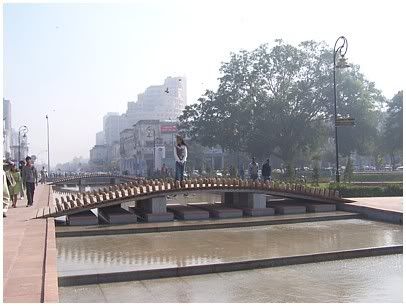
The central park in CP is finally reincarnated and is an improvement on its previous birth with lovely green grass and a zen fountains and gentle flowing water-fall used by pigeons as their private hammam and vaguely japanese looking wooden bridges.


I have finally understood the trick of finding autorickshaws in C.P. - roads going in different directions come out like rays from the outer circle of C.P., like spooks of a bicycle wheel and you need to walk to the spook road that leads to your direction. For example, for going to south Delhi, it is useless to try to find an auto on Baba Kharag Singh Marg or Madras Hotel, you must walk to Janpath and then search for the auto. Because I was mentally converting all the fares in euros all the time, I never needed to bargain with autos about the fare - I am sorry Delhiwallas if I have spoiled so many autowallas by paying whatever fare they were asking!
****

Travelling always by taxis, autos and air-conditioned cars, I felt that I was missing something. It was kind of antiseptic and unreal. No pushing, no squeezing, no fighting, no sweat, no gaalis, no loud songs ... it was unreal. So I got in a DTC bus. The old man sitting next to me smiled at me and started talking to me. When I told him that I lived in Italy, he told me about his journey to Rome some fifty years ago as part of his government service. "I am retired now", he explained sadly, underlining the loss of social standing that retirement seems to bring.

I was wearing a khadi kurta and suitably shabby, so curiously I asked him, "How did you realise that I am not local?" "Your smell is nice and different", he smiled again. It was the fault of deodorant & Kenzo eau de toilette that had given me away? Delhi bus travellers don't put those kinds of things! Or perhaps, it was just my luck that he was more aware compared to average bus travellers?

Persons in the bus are different compared to co-travellers in Europe. Apart from the fact that in a bus the space is limited and often you are squeezed with others poking in your ribs and blowing garlic fumes in your face, persons behave differently in India. Even in a metro. Persons look at each other openly and don't remove their gaze if you look at them. Of course there are those that gaze outside the windows lost in their thoughts, but they laugh and talk without worrying about other passengers.
****

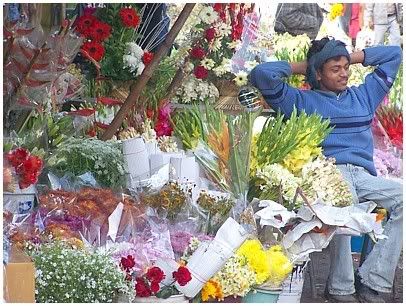
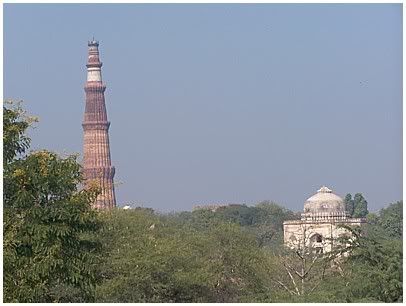
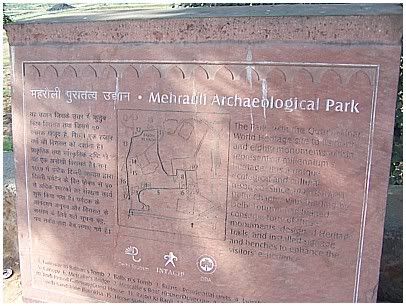
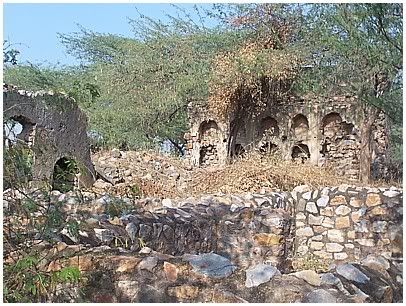
Are there any places in Delhi that I have never seen? Answering this question, I found myself in Mehrauli archeological park, close to the mehrauli flower market, not very far from Qutub Minaar.

If you haven't been there, go and take a look at it. Entry is free. At the more famous monuments, I feel that entry tickets have a reservation system based on the colour of your skin. If you look Indian, you are Indian and you pay about 20 cents for entry. But if you are white or black skinned, you are easily taken for a foreigner and you must pay about 4 euros to enter. It seems like a way of saying that we are a poor country and we can't afford to ask our own citizens to pay so much, but because for us all foreigners are rich so they should pay more. However, you can be someone from Jhumaritalayia or Ambani or Ratan Tata or a NRI and still pay 10 rupees and you can be a rich tourist or a student from Ethiopia or Europe and you must pay 250 rupees. China had similar system till late nineties. As a foreigner, an Indian paid more than what a Chinese paid to see the Forbidden City. Then, probably they decided that they were enough developed and scrapped the system, making everyone pay the same amount. Perhaps one day India Shining will also make India a developed country, and so we will not need to ask foreigners to subsidize the upkeep of our monuments!

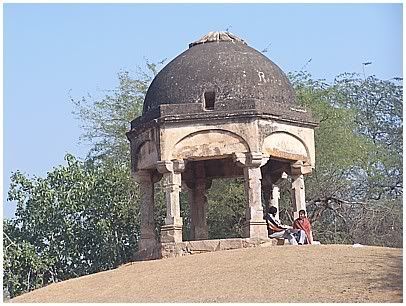
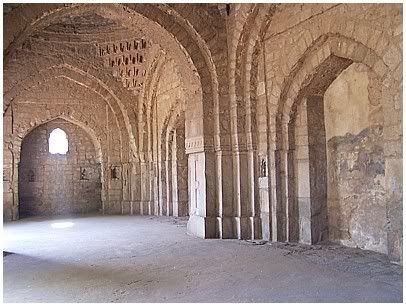
Anyway, sorry for the digression and lets go back to Mehrauli archeological park. The whole area has been restored thanks to funds from Agha Khan foundation. Metcalf's chattri (also called Metcalf's follies), the twin graves of Kaamali and Jaamali, the ruins of turkish slave Balban who had become the emperor ... there is lot to see.

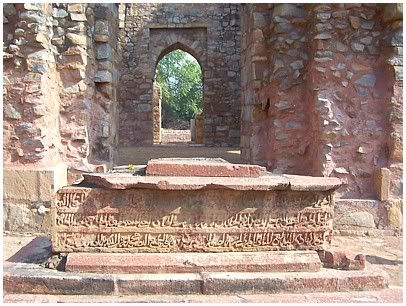
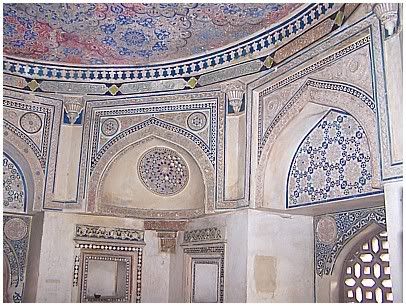
The explanation board at Jaamali Kaamali mosque describes Jaamali as a well known poet while it says that Kaamali was someone unknown. "They were lovers and because they don't want to admit that there were gay relationships in India, so they are glossing about it", someone says. The twin tombs lying close to each other inside the beautiful building with blue tiles and wonderful mosaics with romantic couplets of Jaamali all around on the walls do seem very romantic.

Flower market at Mehrauli

Qutub Minaar seen from Mehrauli archeological park
Map of Mehrauli archeological park
Metcalf's follies

Balban's tomb

Jaamali Kaamali mosque

Beautiful room with poetry & twin tombs of Jaamali & Kaamali
Ruins of Balban
So if you haven't seen it yet, find time to go and have a look at Jaamali Kaamali at Mehrauli archeological park, next time you are in Delhi!

Notes from London

Once again in London! What more can be threre to tell about it?

I know the feeling. Every thing that could possibly have been said, has already been said!

Yet, I did have some new experiences. Reality is supposed to be subjective, so even if everyone else has already written about London, my reality of it will be different and it will be different from the last time I was there 4 weeks ago, since in 4 weeks, I have changed. So bear with me, even if I will understand that you might decide to skip this one and to spend your time better!

****
Going to British museum in London reminds me of eating a banana split ice cream at Nirula's in Connaught Place in Delhi. In the end, it was difficult to finish that banana split and the sweetness of it gave me nausea. Every time I finished eating one, I would say "For one month, I am not going to touch ice-cream again".

Going to the British museum is like that. So much to see that in the end, it all gets too much. Entry to the museum is free and there is no prohibition on taking pictures. I especially love the Assyrian section.

But even the new dome covering the central space is so beautiful. The christmas lights in the shops in the museum were so beautiful. In the end, my head was bursting with things I had seen and my arm had cramps from the contant clicking that I was doing. I don't think that I will be back there any time too soon.


There was a wonderful new exhibition on death rites and death linked mythology from around the world. The masks below are from our own Andaman and Nicobar islands, some what similar to the Mau Mau in the Toraja tribe in South Sulwesi (Indonesia).
*******
On Saturday afternoon, the meeting finished earlier than the plan. "I want to walk along the bank of Thames", I thought and off I was to the Hammersmith bridge. I had been to a pub around there for a dinner once and it was lovely to sit along the river, sip some beer and chat with friends in the summer. Probably that was not the right kind of memory for deciding about the walking trip in December, but that thought came to me much later!
The Thames path, goes along the river and then at some places, where private buildings block the way, it goes in between houses, waiting for the next point where it can rejoin the river. At one such point, I found myself in Bishop's park with boys/men playing football and american soccer. I like the funny clothes they wear for soccer, with puffed up shoulders and sleeves. I also like the ritual of everyone putting together their heads as the ball is launched. I don't understand the rules of the game but that does not stop me from admiring ther game!


Anyway, I walked and walked and walked. It was lovely. In the end, when my legs were almost giving up, I thought it was prudent to go back. "I will try to find a short cut for going back to the hotel", I told myself. And, so I walked and walked and walked. "I won't ask anyone for directions", I told myself, "that is not good for my self esteem". However, I had to ask someone for directions, since I seemed to going around in circles. My short cut was taking me further away from my hotel, I was told and, it would be better to take a bus or a taxi.

When finally I reached my room, I felt like an old man, in terminal stage of some advanced disease, and I seemed to walk like a drunk sailor on a ship in a stormy night.

Don't ask me about my self esteeem. It is still sleeping.


This above is the lovely All Saints church near the river in Fulham. It had lot of old tombs with some interesting tomb stones. Like, "Here lies Susan Parkinson, loving wife of xxx and mother of xxx. xxx, xxx, left for her heavenly abode on 17 August 1759". I like cemetries.
*******
On Sunday evening, I had apparently forgotten about my decision to avoid museums for some time, and I was back at Trafalgar square to look at National Portrait gallery. Like British museum, it is also free but unlike B.M., here you can't click pictures of old masters like Van Gogh, as I discovered when I tried to do so!
Outside the sky behind the opera house was darkest shade of grey-black, producing a lovely light over Trafalgar square. The statute of a disabled pregnant woman in the square is provocative. With countries and societies often insisting on forced sterlisations for the disabled persons and promoting abortions if you think that your child could be disabled, to put such a statue in the main square makes you question some fundamental beliefs, I hope!

The newspapers on Monday were about the big blast in the petrol depot, 30 miles from London with a 75 km wide black mushroom cloud. I wonder if that black cloud visible in Trafalgar square was because of it?
*****

Saw this funny ad about condoms in an underground station, with digital ducks wearing condoms on their head-plumes.
Reminded me of an ad I had once seen in Salvador de Bahia in Brazil about noise pollution and loud music in cars. "Show your virility in the bedroom, not on the streets. People who can't do it in the bedroom, tend to make more noise on the street".