Years ago, when I started this blog, I had told myself that it does not matter, who reads my blog or if someone reads or not. I had told myself, I write for myself.
Then I found a widget for a "Hits counter" and I added it to my blog. Every time, I opened my blog, often I found myself checking how many persons had visted it and seeing the number of visits gave me a kick. I thought, yes, people do come here to read what I write, so I must be good.
Then a few months ago, I discovered Google analytics, a way to check, how many persons from which parts of the world came to my blog and what were they reading. And discovering this has delfated my ego a bit.
I found that new posts get 10-15 visits for a day, but there are a few posts on my blog that get get daily visits of 10-15 persons, people coming mostly through the search engines, and all these persons are looking for things connected with sex and sexuality. Many persons come looking for images in these posts about sex and models. The most popular posts are:
New Italian sex symbol is a cow?
Sonagachi prostitute and the yellow turbaned sarpanch
Sexuality in Pelagio Pelagi collection
Defining human sexualities
Sex and hypocrisy
Sex and the gods
Hiding the body
Italian sex symbols
I am no prude, and I think that sex is wonderful and an important part of our lives. Yet, to find that out of about 200 posts that I have written, all that can get readers are these few posts about sexuality (actually most of them are about art, sexual identities, sexual repression, and not explicitly about sex) does not feel very nice.
Anyway, I think that knowing what sells, what brings people, corrupts. I find myself thinking that perhaps I should write more such posts, so that more people come to read my blog, even while knowing that this is hogwash, people looking for sex are not likely to glance at any of the more serious stuff.
A sobering thought! What do you say?
Showing posts with label Sexuality. Show all posts
Showing posts with label Sexuality. Show all posts
Hasn't mother already seen it all?
I was reading a story about a new film called Pankh. It was clearly written to titillate and to shock. At the same time, it raised a few questions in my mind. Here is what it said:
If his mother was taunting him about not being a man, perhaps she was talking about his personality or his behaviour?
So there I am, a bit confused, waiting to hear more about it, when the film comes out. I don't know, how does the screen play deal with this sequence, but in real life, I can imagine a today's urban mother, when she sees her teen age son nude like that, is likely to say, "Jerry, didn't I tell you to change your underwear everyday? How long you have been wearing those dirty undies? and don't stand there like that, you are going to catch penumonia!"
What do you say?
PS: I have read another story about the film. It is an interview with the leading actor of the film, Maradona Rebello, and that clarifies the situation. In the film Jerry is traumatised by the experienced of being cross-dressed by his mother in his childhood. Thus, perhaps the scene described above, can be explained.
Actually I am glad that Pankh is attempting to touch on another aspect of human sexuality. Though debates tend to focus on the gay-lesbian-straight issues, in reality, the issues related to human sexual identity are many more, perhaps infinite. Our identities in terms of "to be a man" or "to be a woman", depend very much on the kind of sexual orientation we feel inside us, but also on expectations and attitudes of other persons surrounding us. Expectations and attitudes of key figures like parents and siblings are probably even more important in this sense.
Thus, I can understand that a child to be cross-dressed by his/her parents when he/she is too small to understand or pose resistance, may be equally painful as those children who feel that they belong to the other sex, but are forced not to cross-dress by their parents, fearing ridicule of others.
So kudos to Sudipto Chattopadhyaya for touching on this sensitive theme and best of luck to Rebello for daring to go into uncharted territories in bollywood world, as an actor.
Director Sudipto Chattopadhyaya is extremely miffed at the lurid bent given to Pankh...The nude sequence will qualify as the boldest ever in an Indian film. It comes at a time when the boy-hero must prove to his domineering mother that he is, after all, a man.
Says the director, "I've never spoken about this sequence before because the content is bound to be projected out of context. It's actually the climactic moment when the hero Jerry (Maradona Rebello) can no longer bear with his mother's taunts about his manhood. Jerry takes off his trousers to show his mother that he has a d...k like any man..."Do you think that such a thing is logical, that a guy has to show his dick to his mother to prove that he is a man? I mean, hasn't his mother given birth to him, wiped his potty when he was a baby, given him bath? Didn't she know already that the baby had the necessary appendage?
If his mother was taunting him about not being a man, perhaps she was talking about his personality or his behaviour?
So there I am, a bit confused, waiting to hear more about it, when the film comes out. I don't know, how does the screen play deal with this sequence, but in real life, I can imagine a today's urban mother, when she sees her teen age son nude like that, is likely to say, "Jerry, didn't I tell you to change your underwear everyday? How long you have been wearing those dirty undies? and don't stand there like that, you are going to catch penumonia!"
What do you say?
PS: I have read another story about the film. It is an interview with the leading actor of the film, Maradona Rebello, and that clarifies the situation. In the film Jerry is traumatised by the experienced of being cross-dressed by his mother in his childhood. Thus, perhaps the scene described above, can be explained.
Actually I am glad that Pankh is attempting to touch on another aspect of human sexuality. Though debates tend to focus on the gay-lesbian-straight issues, in reality, the issues related to human sexual identity are many more, perhaps infinite. Our identities in terms of "to be a man" or "to be a woman", depend very much on the kind of sexual orientation we feel inside us, but also on expectations and attitudes of other persons surrounding us. Expectations and attitudes of key figures like parents and siblings are probably even more important in this sense.
Thus, I can understand that a child to be cross-dressed by his/her parents when he/she is too small to understand or pose resistance, may be equally painful as those children who feel that they belong to the other sex, but are forced not to cross-dress by their parents, fearing ridicule of others.
So kudos to Sudipto Chattopadhyaya for touching on this sensitive theme and best of luck to Rebello for daring to go into uncharted territories in bollywood world, as an actor.
New Italian Sex Symbol Is A Cow?
Yesterday’s news papers had a picture of the new Italian sex symbol – Cristina del Basso. Miss del Basso became known to the Italian public as one of the participants of the last season of Italian reality show Grande Fratello 9 (Big brother 9) and was immediately noticed for her very generous attributes.
It seems that ever since, Miss del Basso’s fame has been growing and her pictures with these huge tits hanging out were splashed all over newspapers yesterday because she is the new calender girl for the Panorama magazine 2009-2010 calender that came out yesterday.

These huge mammeries are not how the nature had made them, they have been surgically enhanced, but then in todays Facebook-Twitter era, the competition to get noticed is so high, that all help is welcome. I don’t think saliva-dripping hormone strung guys are complaining. I am just a little bit worried about her gravity-related problems, but probably I need not worry as she must be using some strong back-support to compensate for the forward-downwards pull.
Watching Miss del Basso’s pictures, I was reminded of a programme about cows with massive tits and fast-growing huge chickens that I had seen on Italian channel Rai 3 sometime ago. “Report”, this programme goes behind the scenes to dig deeper and understand the issues. They explained that in the Agro-food industry, to earn profits by supplying to big supermarket chains, one must increase production to very high levels.
So they have these Dutch Frisona cows, that stand in rows whole day, blocked above troughs carrying their food, munching antibiotics and hormone enriched cereals mixed with some other things (cow bone powder is no longer given to them after the mad-cow disease scare, they assure), and automated milking machines are attached to their tits so that each cow gives up to 60 to 90 liters of milk every day.

These cows never see those green grassy hills, where they shoot the lovely milk advertisements for enticing public to drink more milk. Within one or two years, these cows are literally pumped out completely, they can’t have any more calfs and their milk production goes down, so they end up in steak houses. It is a factory line production, where new cows come and old ones go to the butcher.
There are chickens as well. Thousands of chickens closed inside enclosures, packed tightly so that they look a beautiful furry carpet and like the cows, they spend all their days eating the feed fortified with antibiotics and hormones. In just 3 weeks they weigh 3.5 to 3.8 kg, ready to be packed and put on the supermarket shelves.
It is not very clear what those antibiotics do to the human beings who eat this meat but they are probably not very harmful as there is no ban on using antibiotics in animal & bird feeds.
If the idea of fucked up cows and chickens excites you, you can watch that episode of “Report” on their website. In the mean time, you can search for more pictures of Cristina del Basso or become her fan on Facebook.
After all it is just a question of markets. While Cristina del Basso may have decided to get screwed out of choice to enhance her attributes, while the dutch frisona cows have no choice but to be part of assembly production line, in the end both, the sex symbol and the cows, are praying to the same market god.
Delhi's Coming Out
I had heard about the Delhi Queer Pride parade, planned on 28 June 2009. But it was going to be in Connaught Place and it was supposed to start at around 5.30 PM, which probably meant that it wouldn’t start moving at least till 6 PM. So I was sure that I could not participate in it. I was in Delhi to look after my mother, who can’t be left alone. After preparing the dinner, the maid usually leaves around 7 PM and there was no way to go to the parade and then be back in home by 7 PM.

That whole week had been terribly hot, just putting the head out of the door felt like being a cake getting cooked inside an oven. And I was sweating so much! 5 minutes after coming out of the house, I was already looking like Shiv ji who has just received river Ganga on his head, streams of sweat running all around me. Probably in all these years of being away from India, my body mechanisms have forgotten how to deal with the Delhi summer, since I couldn’t see anyone else around me sweating so much.
Thus the heat was another reason, I felt that I couldn’t go the Delhi Queer Pride.
I wanted to. I had not been in Delhi in June for the past 25 years and I am not likely to come back here again in June (if I can help it)! So this was my only chance to see it. I had been to the Queer Pride parades in Italy and I had loved it with their wonderful music and colourful floats.
And then on Sunday 28, we woke up to a cloudy sky. During the night, the breeze coming in from the window had turned very pleasant. It was still a little hot and humid, yet the clouds were a sign of hope. The morning newspapers had talked about the Pride but didn’t give any practical information about it. However a search on internet took me to the Delhi Queer Pride website, that had all the practical information. People were supposed to collect at the Tolstoy Marg-Barakhamba road crossing at 5 PM.
What if I leave home around 4 PM, reach Tolstoy Marg-Barahkhamba road crossing by 5 PM, stay there for about 30 minutes and then, come back home, aiming to reach home by 6.30 PM, I thought. OK, I will take the decision in early afternoon, finally I decided. If the clouds stayed, it was a sign from the heavens that I should go, I told myself.
The heavens were definitely in favour of my going, and they showed it by a small shower in the afternoon, and I was there at the starting venue just before 5 PM. There were no floats, and compared to the Pride Parade in Bologna, which is a city of half of million persons, the group gathered there was really tiny. but persons were in high spirits and it was colourful with masks and all kinds of shining-feathery dresses. It was still very hot and some of the heavily made-up drag queens were literally melting down, but still they were busy laughing and preening themselves, like peacocks forced to hide in the darkness of caves, suddenly out in the daylight and enjoying this day of freedom.

There were a lot of policemen all around, but they were relaxed. There were even more journalists, TV reporters, video-cameras and photographers, who were busy looking for persons willing to talk in front of the cameras.
The Pride manifesto explains the basic issues facing the sexual minorities in India:
“400 years ago, the word “queer” meant odd or unusual. 100 years ago, the word was used as an insult for anyone who was different from the society’s norm of gender and sexually “correct” behaviour. It was used to demean and marginalise people. Today, people across the world have reclaimed that word to empower, celebrate and unite people of diverse genders and sexualities. With the rainbow as our symbol of beauty in diversity, we celebrate Queer Pride in solidarity with queer people across the world.Queer Pride is about celebrating who we are, whether gay, kothi, lesbian, queen, dyke, transgender, bisexual, hijra, butch, paanthi … whether manly looking women or men who sleep with men, whether sex worker or sex changer, Queer Pride affirms our diverse expressions and our everyday struggle for respect and dignity.Today in India, lesbian, gay, bisexual, transgender and intersex (LGBTI) people face violence and discrimination from different quarters. Here are some examples of our daily oppression:
- Lesbians are subject to violence, forced into marriage and even driven to commit suicide by their families.
- Gay men are blackmailed by organized scandals that often involve the police.
- Hijras are routinely arrested and raped by the police.
- Same sex couples who have lived together for years, can not buy a house together or will their property to each other or even adopt a child as a couple if they wish.
- LGBTI people are constantly mocked, demeaned and denied their basic human rights of self-expression.
All this is happening because section 377 of the Indian penal code treats LGBTI people as criminals. It has been used to arrest, prosecute, terrorize and blackmail sexual minorities. It has strengthened the already existing stereotypes, hatred and abuse in homes, schools, workplaces and streets, forcing millions of LGBTI people to live in fear and silence at tragic cost to themselves and their families.”
Thus the Pride is asking for change of section 377 as well for affirmative legislation to support the rights and dignities of LGBTI persons.
I also tried to identify some persons willing to talk and tell about their views. Most persons were shy, afraid, and some were clearly traumatised. Finally Anil and his friend agreed to say a few words. My initial questions got the usual answers that most young men with alternate sexuality give, “I am gay, I am proud to be gay and it is nice to be able to come out here but it is so difficult to find acceptance from parents and society.”
Anil is a counsellor for men who have sex with men (MSM) and are affected with HIV, and he works with a NGO. I knew a bit about HIV issues among women sex workers and I was curious to know about similar issues among gay men, “Women sex workers, even if they know about HIV, can’t always ensure that their clients use condoms, because they are powerless while clients can force them into unsafe sex. Does that happen to gay men also?” “Yes, it is exactly the same for gay men” he told me.
I also spoke to Ritu Parna who works for a women’s organisation. She was much more willing to speak and more articulate. Ritu said, “I am a queer activist. I have been actively involved in my support to the GLBTI movement and also involved in organising the Pride as part of a community, that is also the "Pride committee", as there is no formal organisation as such.”
“How do you form a community in a society like the Indian society?” I asked.

“It is difficult because there is social stigma against it. But we make community through bonding, through shared experiences, others they face our same issues, so we know there are other queer people, who will be with us. So it is an informal network. There also some formal organisations that are working in this area like Sangma in Bangalore that works for sexual minorities.”
“What are the strategic issues related to the women in the movement?”
“The issues faced by other women are also the issues of queer women. Like domestic violence. When a lesbian comes out in the family she faces more domestic violence. Or the sexual harassment, a lesbian women also faces the same or may be even more harassment. Because of the sexuality, they face greater challenges. In terms of gender, they are exploited by the society.”
“In terms of GLBTI movement, in Europe it is felt that transgender persons face greater difficulties and even among the movement they are marginalised. What is the situation in India?” I asked her.
Ritu was not so sure about this, “It might be relatively, but it may differ from place to place. The hetero-normative society discriminates against all those who are different and in that sense transgender persons also face discrimination. But in our movement, we don’t discriminate, and you can see how many transgender persons are there today in this Pride.”
Ritu agreed to give a small message to the Italian GLBTI movement, “We are all the same, we need your support, we are also with you, we love you all.”
It was nice talking to Ritu and I would have loved to speak to many more persons. For example, I would have liked to know if class and social backgrounds are also an issue in the movement, and how do they deal with it? I did try to speak to a couple of other persons, but they all seemed to be afraid of talking and in the end, I gave up.
My 30 minutes for the Pride were over so quickly and soon I had to look for an auto and come back home. On my journey back home, I was thinking about another group of persons, who face greater barriers in the GLBTI movement, not only in India but all over the world. That is, persons with disabilities. In the Delhi Queer Pride, I didn’t see any one on a wheelchair, or a blind or a person with obvious disability. Perhaps there could have been some deaf gay or lesbian persons, that I didn't meet.

Both, sexual minorities and disabled persons, face isolation, discrimination, stigma, barriers and violations of human rights. Disabled persons who are also sexual minorities face even greater barriers, more so if they are women.
However, I feel that India has a very strong disability movement and in some countries, transgender persons are a strong component of disability movement. I hope that the strong Indian disability movement and the budding GLBTI (Gay, Lesbian, Bisexuals, Transgenders & Intersexuals) movement will join hands and support each other. Fight against discrimination requires unity.
In the evening, the coverage in the 24x7 news channels was quite uneven. On some channels, the kind of language they were using, was aimed at sensationalising and a little bit offensive. Some other channels seemed more aware and used a more balanced language.
On one channel, a “swami ji” thundered about the “aprakritik” (against nature) practices and that "these are against our culture". I can’t understand this logic of aprakritik. Every thing created by nature is prakritik (natural) and you don’t really need to have genetically modified human beings to become gay or lesbian, because that would be aprakritik. If being gay or a lesbian is “against nature” simply because it is not the majority behaviour, then even being a swami or a monk is also aprakritik, so why discriminate only against gays and lesbians?
The morning after, the English newspapers were full of colourful pictures. The staid TOI even had a kissing gay couple, though not on the cover page. Jansatta, the Hindi newspaper was more restrained, it only mentioned about the Pride in one line, as an afterthought to a statement by the Minister Moily, and didn't carry any pictures.
May be the flamboyant pictures present just one facet of the GLBTI movement, most of the gay or lesbian persons, don’t go around wearing feathers or dress up like “rave party on the beach” - their daily lives also move around home-office-home routines like other persons in their communities, still I am sure that any publicity is good publicity at this stage of the movement. Thousands of persons who find themselves isolated with fear, can see those pictures and read about others like them who had the courage and the possibility to come out and be themselves.
It was just the second Pride in Delhi. In the first Pride in 2008, they just had 500 persons, this time they were supposed to 2-3,000. So the movement is growing and getting stronger. The wide publicity the parade received this time, will bring even more persons into open, the next time!
You can see some more pictures from the Delhi Queer Pride 2009 at my Kalpana webpage. If you are in a picture and wish to receive it (free) in higher resolution, send me an email at sunil (at) kalpana.it - if the picture can create any difficulty for you, let me know and I will remove it.
Sexuality in Pelagio Palagi collection
Probably most persons, even if they like art, have never heard of Pelagio Palagi. I believe that the man was grossly under-rated, probably because he was born in a rich family and dabbled in lot of different things. Fact is for a long long time Pelagio Palagi was not taken seriously, seen mostly as a collectionist.

To be a collector and spending your riches for bringing together treasures of art and at the same time, supporting lot of artists, is not to be looked down at. Most persons with their billions, if they did that, perhaps the world would be nicer place. Palagi was a good collector and in addition, a wonderful painter and designer.
Born in a rich family in Bologna in 1775, Palagi loved art. His paintings were not considered important for a long long time. He also collected antiques and art from different places including two important collections from Egypt and ancient Greece. During those years, antiques and art were not seen as national treasures but rich persons, especially Europeans could buy what ever they wanted. Thus important scultures, documents, paintings came to the colonial powers of Europe.
Palagi left all his treasures to the municiple government of Bologna and these treasures are important parts of different Bologna museums. Bologna, a comparatively small city in Italy, has been an important centre of culture and science, and has a huge number of museums that are all free for visitors and have a rich programme of guided tours for adults and children.
So if you are planning to visit Bologna, remember to keep a few days for visiting its museums and for discovering Pelagio Palagi.
In this post I want to touch on two aspects of Pelagio Palagi's works. The first relates to his paintings. I love his portraits and I like his technique of adding the big white/pale areas in the bottom half of the portraits, that some times give an impression of part of the canvass being torn off. Below you will find two of his portraits - the first is the study for the portrait of Major Lattuada done in 1819 done for hospital of Milan; the second is the portrait of his close friend Giuseppe Guizzardi done around 1808-09.


The second aspect is related to sexuality. Below you will find two examples -
(1) the first is a 4000 years old Egyptian stele from Palagi's collection showing a man called Aku praying to male fertility god Min. At the lower end of the stele behind the god Min, his phallus shaped temples are shown that remind me of Shivalings.
(2) the second is the painting of Sappho and Rodope done by Palagi around 1808-09 - Sappho and Rodope's painting is interesting as it shows the two women in loving embrace, that has been the popular interpretation to the Sappho legend. According to the Greek legends, Sappho was a poetess while Rodope was a slave girl or a courtesan in ancient Egypt (the legend of Rodope or Rodopi from ancient Egypt is supposed to be the inspiration for the Cindrella fable), who had an affair with Sappho's brother. Those initial legends depicted Sappho as having many lovers. However, later popular legends saw Sappho as a woman in love with other women and her island, Lesbo, also acquired notoriety, giving rise to words like Lesbians.

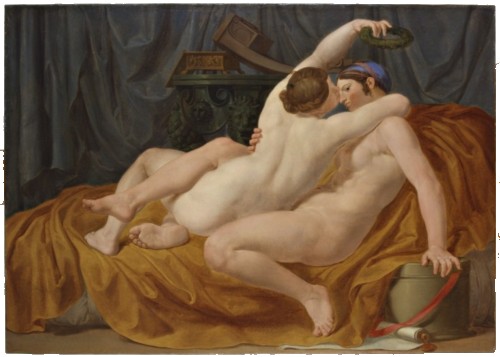
As you can see, trying to understand the art of Pelagio Palagi can take you in many interesting directions. Art museum, archelogical museum and medival museum of Bologna have thousands of works from Pelagio Palagi collection, some are his creations and others are his collections, remember that if you ever come to Bologna.
Defining Human Sexualities
On Shunya’s Notes, there is an interesting post about Sudhir and Katherine Kakkar’s recent book "The Indians: Portrait of a people" (2007), focusing on issues related to homosexuality in India.
I briefly met Kakkar earlier this year during a literary event organised by Grinzane Cavour Awards in north of Italy and I remember him as very likeable and soft spoken person. ‘The Indians’ sounds very interesting and I hope that it will be soon available in Italian as well and I will have an opportunity to read it.
To come back to the blog post on Shunya’s Notes, it mentions various differences between the Western and Indian attitudes and practices towards homosexuality, such as the following:
- Christian West, homosexual acts were persecuted as a sin against God (and less often, seen as a disease). Indians, on the other hand, denied the idea of homosexuality, while tolerating homosexual acts.
- Notion of a homosexual liaison as a proud and equal alternate to a heterosexual one doesn't exist outside a small set of urban Indians;
- (In India) Vast majority of even those who continue having sex with other men do not see themselves as homosexual
I agree that in India, persons deciding to live as overt gay or lesbian couples would have a difficult time, even if their public display of affection such as holding hands, putting arms around each others' necks, etc. would probably be seen as less problematic, since that is accepted behaviour for both men and women in Indian culture (but their kissing in public would be very problematic, but then even heterosexual kissing in public would also be equally problematic in India). And I also agree that for young homosexual Indian men and women, there would be tremendous family pressure for a “normal” marriage.
However, in my experience, there are infinite variations in the way people perceive, exercise and express their sexualities and I find a bit problematic this way of classifying persons in groups such as homosexual, heterosexual, bisexual, transgender, etc. If we look at life stories of persons spanning different decades, the variety of sexual behaviours and desires that usually comes out, are difficult to put neatly into a few boxes.
To restrict sexuality to sexual intercourse is another problematic area for me. During a research that I did almost a decade ago , the definitions of sexuality that had come up during discussions in a group of Italians, also included terms like intimacy, affection, feelings, closeness, etc. If we consider sexuality in these broader terms, then in my opinion, ideas of homosexuality, heterosexuality, bisexuality, etc. become even more problematic.
I think that part of the problem lies in what I call “western dichotomous way” or “psuedo-scientific way” of thinking, that is based on the assumption that every thing can be defined and classified, and if something is one then it can’t be another at the same time.
I believe classifying and putting everything in to neat boxes is fine if it serves as an exercise for understanding the key issues, the barriers, the oppressions, the violations, and finding solutions to these through laws and practices that respect dignities and rights of people. In that sense, I understand the usefulness and importance of categories like homosexual, heterosexual, etc. However, I have some difficulties when we start confusing the categories and boxes with people and how they are suppose to behave in their every day lives.
I think that like everything else, even human sexuality is a spectrum that varies from exclusively gay or lesbian to exclusively heterosexual in terms of sexual intercourse, but also in terms of psychological affinities and affective relationships, at different times & ages in our lives. In between these two extremes there are infinite variations. And if people do not wish to be put into a box or under a category, I think that it is absolutely fine for them to choose to do so.
In the post on Shunya’s Notes, the author writes, “While the Indian response reduces open conflict, the flip side is a muffled suffering: countless men and women lead double lives, hiding from their true natures and denying themselves the most precious of intimacies and self-knowledge”. While I agree that there are many homosexual men and women in India who are forced into marriages that create needless suffering for them and for their spouses, I also find such views problematic in terms of denying that there can be persons whose sexuality encompasses both sexes and can be forced into a corner because someone believes that “they are not aware of their true natures”.
Thus, I also think that overcoming barriers and finding solutions does not mean that all persons who enjoy homosexual relationships are all supposed to "come out" and be either gay or lesbian in the way the two distinct gay and lesbian cultures have developed in the west.
This is also because, I feel that people from different cultures fighting oppression and exploitation, can find and negotiate emancipation and self-expression in different ways. The gay and lesbian cultures developed in the west are legitimate and can be empowering, but this does not mean that they are the only path to sexual emancipation. Here I would like to draw parallels from works of Indian feminism activists like Madhu Kishwar, who have looked at the way women in India have negotiated spaces for their own emancipation and empowerment, in ways that are different from the way western feminists look at this.
The Indian (or perhaps I should say eastern) way of inclusive thinking, that looks for harmony among apparent contradictions is a different approach to life compared to the rational and scientific approach. While looking at issues of human sexuality, I would be cautious in throwing away the specific cultural solutions towards homosexuality that have been found over a period of centuries in the Indian societies . I would rather prefer to look at them critically, without the using western eyeglasses, but analysing them on their own terms and merits.
Such a critical appraisal of Indian responses to the issue of sexual diversity in India can’t be done by outsiders, but requires persons who face these challenges in India. Perhaps persons linked to GLBT (Gay, Lesbian, Bisexual & Transgender) organisations in India would take up this challenge (or perhaps they already have done such analysis, but I am not aware about it and such views are not well known internationally?)
Right to orgasm: National GLBT Pride 2008 in Bologna
I am back from Mongolia. I still need to sort out hundreds of pictures that I took during this trip. But back to Bologna, I was right in time for the annual national Gay-Lesbian_Bisexual_Transsexual (GLBT) pride march that was held here today.
It was huge and people had come from all over Italy with floats blaring music and showing dances or other body assets. It was lot of fun and I marched with the parade for the last part, starting from Salara where the Arcigay and Arci lesbica of Bologna have their office, right to Piazza 8 Agosto, where the parade concluded. I had asked Nadia to come with me, it is a question of human rights I had told her, but she thought that it was too hot and probably it was going to be too noisy, so finally I went alone.
Nadia was right, it was very noisy with loud music and lot of young persons drinking and dancing. There were gay couples. There were lesbian couples. Some even had their children with them. There were transsexuals and transgender persons. There were prostitutes with red parasoles. And there were lot of hetero couples as well. There were some wheel chairs as well.
In Piazza 8 Agosto there were speeches by presidents of different organisations. I liked the speech by the president of association of transsexuals and transgender persons. Even among the different alternate sexuality identities, we are forgotten and discriminated, she said. I also liked her reference to human right to orgasm.
There were other human rights organisations as well. Talking of emigrants and gypsy (Rom) children. There were some south asian looking men but I don't know if they were there to express their right to sexuality or only for curiosity. I didn't see any south asian looking women there.
Here are some pictures from the evening.


Sex and Hypocrisy
Everything related to sex is a taboo in almost all societies. Even those societies which apparently seem broadminded and liberated. Thus the subject is often linked with hypocrisy. Especially for persons who act moralist and indignant about the loose morals, those who talk of family values, religions, etc.
Here are two news items from today's newspaper that illustrate this hypocrisy:
In Tehran (Iran), Mr. Reza Zarei, head of the police department for ensuring proper moral conduct in the national capital, was discovered in the company of 6 sex workers. Mr. Zerei had become famous for his harsh stand on what he called "immoral behaviour" and had got arrested hundreds of young persons with this accusation.
In New York (USA), Mr. Eliot Spitzer, the 48 year old Governor of the New York state has been forced to resign because he was using his office money on sex workers. His bill for the prostitutes amounted to 80 thousand US dollars.
In India, persons who moralise are a plenty. Just think of the one in Maharashtra government who had banned the women in dancing bars. When people are so vehement about moralising, I always feel that they have something to hide! So I hope experts of investigative journalism and sleuths should go after such persons to look in their cupboards if there are any hidden skeletons!
And to celebrate openness, have a look at the Italian version of the Naked News that started today. This internet and mobile phone based TV channel has news shows where the newsreaders (strictly women) slowly take off their clothes, while reading the news. Obviously the TV channel is available only for paying clients.
I guess learning or practicing Italian with this news channel could be great fun - it would help you in staying awake while studying and increasing your general knowldge. Only problem is too much anything is not so good and probably once you have seen it a few times, you will be plain bored.
Sex and the Gods
I had heard about the temples of Khujaraho and Konark, where eroticism is mixed with prayers, but I hadn't had an opportunity to visit them so far. So when Dr Mani proposed that we make an early morning trip to Konark temple, I was very happy.
The entrance and the first glimpse of the ruins of the sun temple built around 1250 AD under king Narsimha with a tinge of morning mist was breath-taking.
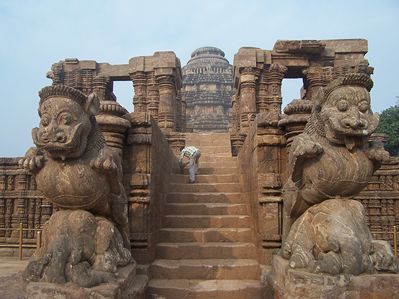

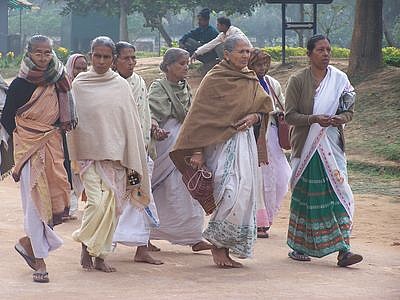
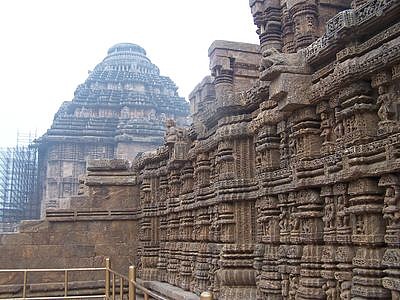 Pilgrims of all sizes and shapes, were every where reaching there in buses, perhaps stopping at Konark on their way to the more famous Jaggannath temple in Puri.
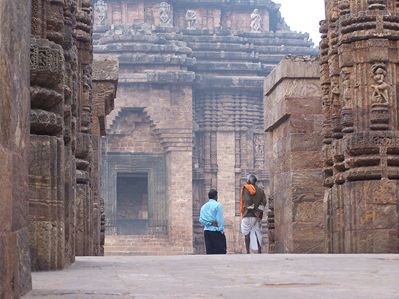
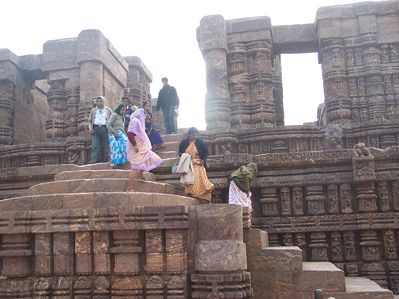
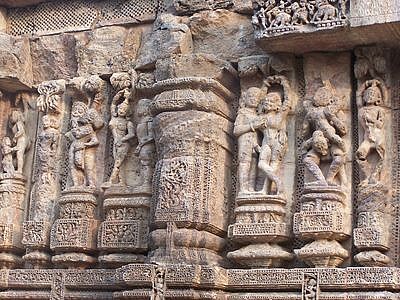
While the beautiful statues at the initial part of the Konark temple are innocous enough, the main temple building does not leave much doubts about its sexual component with huge erotic sculptures built high up from the ground, around what was the main entrance to the temple. Only if you look carefully you will see a number of smaller erotic sculptures around the big ones.

The sidewalls of the temple has smaller statues at eye level, organised in three panels. Most of the lower panels and middle panels do not have erotic sculptures and have more innocous gods, mythical animals and other figures. Erotic sculptures are mainly in the third level of panels. Dr Mani says that this was done in a way so that children coming to the temple will mainly see non erotic sculptures.

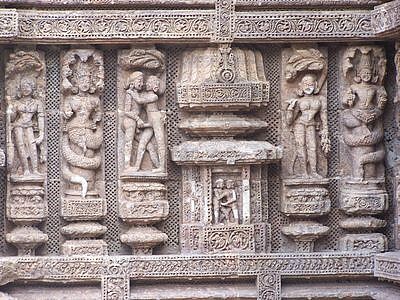
The sculptures are very explicit, depicting graphically the different ways of sexual enjoyment. There is oral sex including "69", there are old looking men and women, there are younger looking men and women, mostly couples but sometimes three figures (one man and two women) are also there together looking for orgasm. Thus almost whatever is described in Kamasutra, is expressed here visually in statues. The statues are very life like with expressions of joy and pleasure. At the same time, I think that the artists were asked to make sure that the sexual nature of the statues must be made very explicit and that can explain the unrealistically large penis in most of the statues, that are likely to give a sense of inadequacy to most of the faithful coming to the temple.
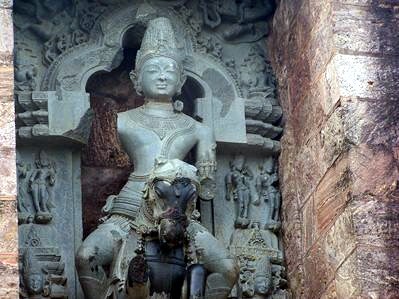
Konark is not just erotic art but is an incredibly beautiful structure. I really liked the three sun god statues, like this one below sitting on a horse.
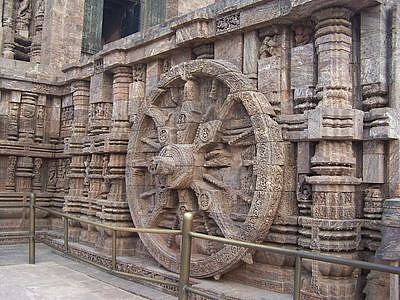
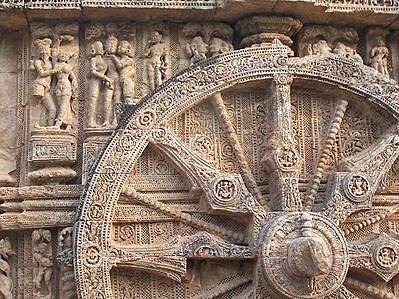
The whole temple is made like a chariot with twelve wheels, symbolising the twelve months of the year, pulled by seven horses, representing perhaps the seven days of the week (? I am not sure if ancient Indian calendar had weeks). The wheels, the statues, the carvings, everything is exquisite.
Thinking about the sense of shame usually associated with anything to do with sex, I was wondering about the impact of these erotic statues on the common pilgrims and school students. However, my impression was that barring a few men, who did look towards these panels from a distance, most of the pilgrims kept their heads down and took only fleeting glimpses of the erotic sculptures.
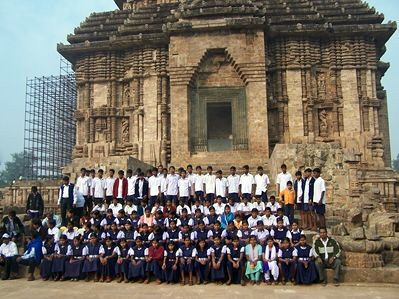
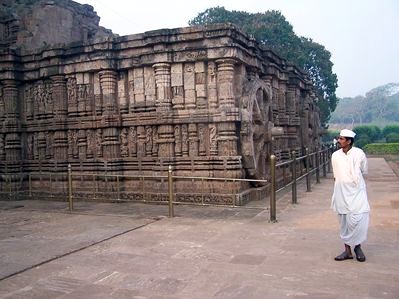
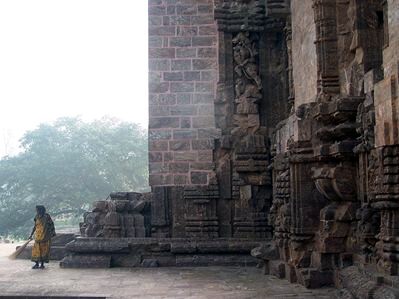
Why did those thirteenth century persons make these erotic sculptures in their temples? Was it a period in history when human beings in India had been able to shed off the prude taboos about sex to take a more direct look at life, sex and pleasures? Indian poetry in shringar ras can indeed be very explicit. People worshipping Shiv and Parvati in the form of Shivlings, were they initially more reverential towards the sexual act? Was it something linked to the tantrik marg to realization of God? I don't know the answers to these questions.

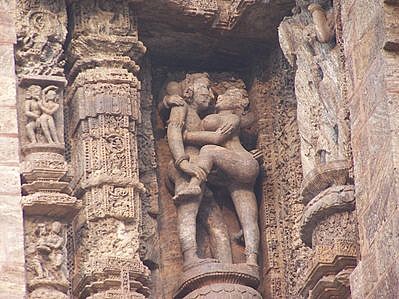
It was only while choosing the pictures for this post I realized that one of the small panels next to a big statue near the temple entrance (picture number 8 from the top) is a little strange - it seems to show two men and a woman (detail shown above). Actually the man on the right has femminine breasts, but s/he also seems to have an unmistakable penis. Could it be depiction of a hermaphrodite?
While visiting Konark, I had wondered if the statues had also depicted gay or lesbian sex, in terms of understanding the public perception towards these aspects of sexuality in the thirteenth century. Though there was no time to look and analyse each statue (and to be honest, looking at erotic sculptures, after an initial sense of novelty, is a bit monotonous and boring), my conclusion had been that Konark statues are about heterosexual love.
Now from this particular panel, perhaps we can deduce that people of Konark accepted the different variations of human sexuality?
The entrance and the first glimpse of the ruins of the sun temple built around 1250 AD under king Narsimha with a tinge of morning mist was breath-taking.
While the beautiful statues at the initial part of the Konark temple are innocous enough, the main temple building does not leave much doubts about its sexual component with huge erotic sculptures built high up from the ground, around what was the main entrance to the temple. Only if you look carefully you will see a number of smaller erotic sculptures around the big ones.
The sidewalls of the temple has smaller statues at eye level, organised in three panels. Most of the lower panels and middle panels do not have erotic sculptures and have more innocous gods, mythical animals and other figures. Erotic sculptures are mainly in the third level of panels. Dr Mani says that this was done in a way so that children coming to the temple will mainly see non erotic sculptures.
The sculptures are very explicit, depicting graphically the different ways of sexual enjoyment. There is oral sex including "69", there are old looking men and women, there are younger looking men and women, mostly couples but sometimes three figures (one man and two women) are also there together looking for orgasm. Thus almost whatever is described in Kamasutra, is expressed here visually in statues. The statues are very life like with expressions of joy and pleasure. At the same time, I think that the artists were asked to make sure that the sexual nature of the statues must be made very explicit and that can explain the unrealistically large penis in most of the statues, that are likely to give a sense of inadequacy to most of the faithful coming to the temple.
Konark is not just erotic art but is an incredibly beautiful structure. I really liked the three sun god statues, like this one below sitting on a horse.
The whole temple is made like a chariot with twelve wheels, symbolising the twelve months of the year, pulled by seven horses, representing perhaps the seven days of the week (? I am not sure if ancient Indian calendar had weeks). The wheels, the statues, the carvings, everything is exquisite.
Thinking about the sense of shame usually associated with anything to do with sex, I was wondering about the impact of these erotic statues on the common pilgrims and school students. However, my impression was that barring a few men, who did look towards these panels from a distance, most of the pilgrims kept their heads down and took only fleeting glimpses of the erotic sculptures.
Why did those thirteenth century persons make these erotic sculptures in their temples? Was it a period in history when human beings in India had been able to shed off the prude taboos about sex to take a more direct look at life, sex and pleasures? Indian poetry in shringar ras can indeed be very explicit. People worshipping Shiv and Parvati in the form of Shivlings, were they initially more reverential towards the sexual act? Was it something linked to the tantrik marg to realization of God? I don't know the answers to these questions.
It was only while choosing the pictures for this post I realized that one of the small panels next to a big statue near the temple entrance (picture number 8 from the top) is a little strange - it seems to show two men and a woman (detail shown above). Actually the man on the right has femminine breasts, but s/he also seems to have an unmistakable penis. Could it be depiction of a hermaphrodite?
While visiting Konark, I had wondered if the statues had also depicted gay or lesbian sex, in terms of understanding the public perception towards these aspects of sexuality in the thirteenth century. Though there was no time to look and analyse each statue (and to be honest, looking at erotic sculptures, after an initial sense of novelty, is a bit monotonous and boring), my conclusion had been that Konark statues are about heterosexual love.
Now from this particular panel, perhaps we can deduce that people of Konark accepted the different variations of human sexuality?
Violence of Language
I had seen the Colombian writer, Efraim Medina Reyes in Ferrara, a couple of months ago. He had been in a round table with Arundhati Roy, Gofredo Fofi, Elif Shafaq and Laila Lalami. He might have been a good writer but he did not seem to be a very good speaker to me at that time. Or perhaps when he had spoken I was tired and distracted, I don’t know.
I had written about that meeting in this blog in October 2007.
What ever the reason, after the meeting from that particular session he was the only writer about whom I was unable to remember anything significant from his speech and that had made me feel a little guilty.
Yesterday I saw an article by him in an Italian magazine, Internazionale. “Il sesso forte”, the stronger sex. The article was apparently about the violence against women. I started reading it and just the first few lines made me sit up. Perhaps I had understood wrongly, I had thought and reread those lines. No, he had actually written what I had thought he had written. The article started thus:
I felt that the particular phrase in Medina’s article’s had been put in that particular way to shock the reader. As I read further, it was clear that the whole article was written to shock. It does not mince words and uses the words cunt, supercunt, gang bangs and rapes abundantly.
What is there to get shocked, you might well ask. Don’t we all use these words in other contexts? It was this undercurrent of violence that I felt in Medina’s words that disturbed me since apparently he is talking against violence in the world, about violence that especially targets women. Yet even while speaking against violence, he is expresses himself in very violent terms, I felt. For example, look at this part of his article (my translation from Italian):
And then I was thinking about something else. In literature, in books and magazines, in our daily language, we are all becoming more open in the use of the swear words. In Italy we tend to use these words in way that they become ordinary words, they lose their taboo power. Parents use them in front of children and children use them in front of parents.
Even in some Indian books, magazines and films, it is the same thing. The written and depicted realities tend to reflect the real world in use of these words.
In a way I understand this need. Our bodies and sexuality in general has been too long hidden behind taboos, embarrassments and silences and it is good that those walls can be broken down and we can speak about these parts of our lives more openly. Yet I have a feeling, Medina’s use of the language is not the answer, that makes our body parts mere objects. Sex is not just a mechanics of penetrations and movements. Or does such language actually help us in breaking those barriers?
I had written about that meeting in this blog in October 2007.
What ever the reason, after the meeting from that particular session he was the only writer about whom I was unable to remember anything significant from his speech and that had made me feel a little guilty.
Yesterday I saw an article by him in an Italian magazine, Internazionale. “Il sesso forte”, the stronger sex. The article was apparently about the violence against women. I started reading it and just the first few lines made me sit up. Perhaps I had understood wrongly, I had thought and reread those lines. No, he had actually written what I had thought he had written. The article started thus:
Men kill each other for a variety of reasons. Most of all in their hunger for power and money. Yet, behind every war and aspiration for peace, there is always a soft and hairy cunt.It was this last part of the phrase that had shaken me awake. Internazionale is an intellectual kind of magazine and though in Italian language people do tend to use equivalent words of fuck, prick and cunt much more liberally than in many other languages, this magazine is considered to be a little on the serious side for that. Thus if they have to use words like that they would use equivalents of making sex, penis and vagina, rather than their more popular counterparts.
I felt that the particular phrase in Medina’s article’s had been put in that particular way to shock the reader. As I read further, it was clear that the whole article was written to shock. It does not mince words and uses the words cunt, supercunt, gang bangs and rapes abundantly.
What is there to get shocked, you might well ask. Don’t we all use these words in other contexts? It was this undercurrent of violence that I felt in Medina’s words that disturbed me since apparently he is talking against violence in the world, about violence that especially targets women. Yet even while speaking against violence, he is expresses himself in very violent terms, I felt. For example, look at this part of his article (my translation from Italian):
We men can not imagine how terrible it can be for a woman to be forced to have sex. There are still some who think that when a woman refuses to share her cunt with them, actually she is just trying to provoke them. It must be clear that when a woman says no, it means no and you must forget it. I know it is not easy and it must have happened to everyone. But before letting yourself be obsessed by the cunt that has been negated to you, it is better to think of all others that are waiting for you with a smile.So I had the feeling that he is writing something but his words are conveying exactly the opposite.
And then I was thinking about something else. In literature, in books and magazines, in our daily language, we are all becoming more open in the use of the swear words. In Italy we tend to use these words in way that they become ordinary words, they lose their taboo power. Parents use them in front of children and children use them in front of parents.
Even in some Indian books, magazines and films, it is the same thing. The written and depicted realities tend to reflect the real world in use of these words.
In a way I understand this need. Our bodies and sexuality in general has been too long hidden behind taboos, embarrassments and silences and it is good that those walls can be broken down and we can speak about these parts of our lives more openly. Yet I have a feeling, Medina’s use of the language is not the answer, that makes our body parts mere objects. Sex is not just a mechanics of penetrations and movements. Or does such language actually help us in breaking those barriers?
Funny chocolates cause scandal in Bologna
Bologna has rightly the reputation of being a very progressive and tolerant city, but occasionally someone comes out and starts shouting scandal.
That is what happened day before yesterday in the main city square. There was the annual chocolate fair that brings chocolate makers and people who love eating chocolates from all over Italy to Bologna for three days. It is a unique opportunity to taste special handmade chocolates in special tastes that you can't find in shops and superstores selling packaged factory made chocolates.
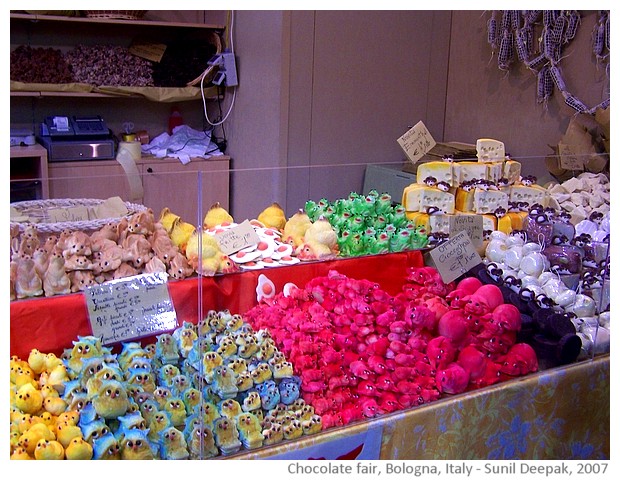
Among the different chocolate makers was also "Roccocicco chocolate company" from a small city called Cento near Bologna. Cristina Merlin the chocolate maker along with her pastry maker husband likes making funny shaped chocolates, among which a special version of penis shaped chocolates called Rocco, named after the Italian porno star Rocco Siffredi. Cristina claimed that those chocolates are modelled after the real specimen of the pornostar though reduced in dimensions.
Walking through the shops in the chocolate fair, I noticed the crowd in front of Cristina's Roccociocco shop. She had a much bigger varieties of chocolates compared to the other shops, with specialities like chocolate covered cheese in different colours, bugs bunny shaped chocolates, etc. However, the most popular product of her shop were those penis shaped chocolates costing 10 Euro each. Couples wanted to get photographed in front of them, girls were holding them in front to get their pictures taken, giggling and laughing all the time. It seemed like innocent fun.
May be if I was new to Bologna, I would have got scandalised but with the Neptune statue right in the middle of the Bologna city square showing off the family jewels unashamedly and the story they tell about the prudish chruchmen of sixteenth century wanting to cover it but citizens of Bologna voted to keep it that way, open and nude, perhaps I have also got used to similar sights. Plus it is common to find penis shaped pasta, that is sometimes gifted for marriages & birthdays to the future brides and grooms. So I thought making chocolate in that shape was a nice commerical idea, also took a picture, moved ahead and forgot about it.
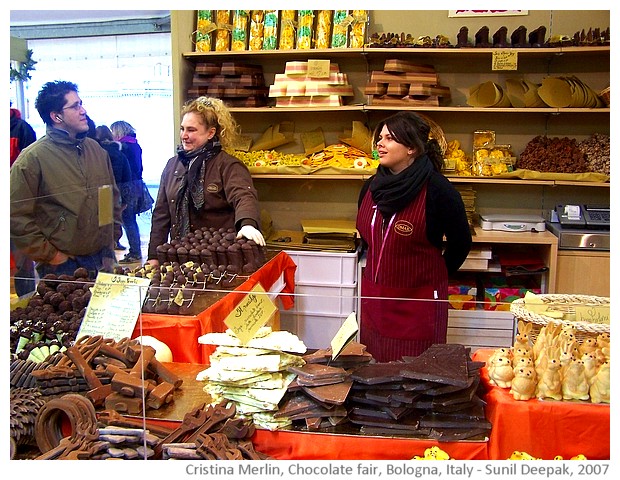
Next day morning when I read in the newspaer that one of our municiple council members, one Ms. Santandrea, had been to the fair, and had found those chocolates to be offensive and thus police was called, Cristina Merlin was asked to pay a fine of some 200 Euros and to remove those penis chocolates from her shop. As expected this has awakened some Bologna citizens who say that the chocolates are innocent and the council member is a hypocrite. Predictably, the church representatives have welcomed the "end to the depravity".
So if you want to have a copy of the porno stars' endowment, you must now go to Cento to Cristina's shop called Omar, it will no longer be available in the chocolate fair in Bologna!
That is what happened day before yesterday in the main city square. There was the annual chocolate fair that brings chocolate makers and people who love eating chocolates from all over Italy to Bologna for three days. It is a unique opportunity to taste special handmade chocolates in special tastes that you can't find in shops and superstores selling packaged factory made chocolates.
Among the different chocolate makers was also "Roccocicco chocolate company" from a small city called Cento near Bologna. Cristina Merlin the chocolate maker along with her pastry maker husband likes making funny shaped chocolates, among which a special version of penis shaped chocolates called Rocco, named after the Italian porno star Rocco Siffredi. Cristina claimed that those chocolates are modelled after the real specimen of the pornostar though reduced in dimensions.
Walking through the shops in the chocolate fair, I noticed the crowd in front of Cristina's Roccociocco shop. She had a much bigger varieties of chocolates compared to the other shops, with specialities like chocolate covered cheese in different colours, bugs bunny shaped chocolates, etc. However, the most popular product of her shop were those penis shaped chocolates costing 10 Euro each. Couples wanted to get photographed in front of them, girls were holding them in front to get their pictures taken, giggling and laughing all the time. It seemed like innocent fun.
May be if I was new to Bologna, I would have got scandalised but with the Neptune statue right in the middle of the Bologna city square showing off the family jewels unashamedly and the story they tell about the prudish chruchmen of sixteenth century wanting to cover it but citizens of Bologna voted to keep it that way, open and nude, perhaps I have also got used to similar sights. Plus it is common to find penis shaped pasta, that is sometimes gifted for marriages & birthdays to the future brides and grooms. So I thought making chocolate in that shape was a nice commerical idea, also took a picture, moved ahead and forgot about it.
Next day morning when I read in the newspaer that one of our municiple council members, one Ms. Santandrea, had been to the fair, and had found those chocolates to be offensive and thus police was called, Cristina Merlin was asked to pay a fine of some 200 Euros and to remove those penis chocolates from her shop. As expected this has awakened some Bologna citizens who say that the chocolates are innocent and the council member is a hypocrite. Predictably, the church representatives have welcomed the "end to the depravity".
So if you want to have a copy of the porno stars' endowment, you must now go to Cento to Cristina's shop called Omar, it will no longer be available in the chocolate fair in Bologna!
Hiding the body?
Why did man decide to invent clothes? Did ancient man have a sense of shame about the human body so that certain parts were supposed to be hidden behind clothes? Probably not. Man had evolved in nature full of animals, birds, roaming around without any clothes, except for those given by the nature - the body hair of different animals that covered the body, changed colours according to the seasons.
Probably early humans evloving in the hot tropical climate of Africa, did not even need lot of body hair and thus clothes were probably invented much later, when Homo Sapiens moved towards colder climates in the north?
Another reason could be that the genitals are delicate parts of the body and evolution of human beings from being four-legged creatures like other animals to the upright walking two legged creatures, further exposed to these delicate body parts to possible injury. Thus human beings had to look for something to cover and protect these parts.
Whatever the reason, today clothes are considered necessary for human life, and when ever new tribal groups are discovered, they are taught about the need to cover themselves. Apart from the stray nudists who may rebel against this imposition of the society, we all tend to accept to cover ourselves to varying degrees. Most cultures allow men to wear lesser clothes than women.
Artists have always tried to critically look at the social costumes and question them through their art. One such artist who questions the need for wearing clothes is Joanne Gair. Gair has become famous for her body painting, where she paints the clothes over nude bodies, giving the illusion that the person is wearing clothes. Here is sample of the art by Joanne Gair.
About 10 or 15 years ago, an Indian actress, Pooja Bhatt, had also posed for a magazine cover wearing just body art and that had raised a scandal. I personally admire such persons who dare to provoke the society into questioning the seemingly unbreakable and rigid social costumes.
Subscribe to:
Posts (Atom)


